|
World-first for Tayside in ‘eliminating’ hepatitis C |
Related newsGlobal recognition for Tayside hepatitis programme Calls for help soar as addiction services ‘invisible’ Infection risk petition set to fail Aberdeen A&E first to offer routine HIV tests Rehab centre & St Mirren FC team up for community hub Rural alcohol and drug rehab centre opens Delayed ‘game changing’ cancer scan service launches Insight: Pharmacists in palliative care Interim chair to stay on at health board Community covid response team stands down Virtual appointments here to stay Dundee ‘green zone’ protects surgery patients 
|
|
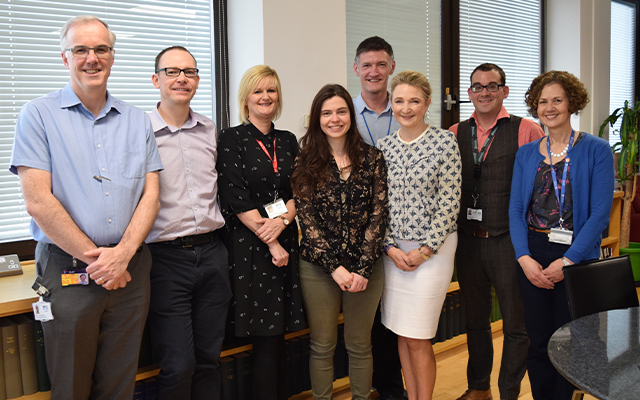
The Tayside viral hepatitis service team (taken earlier this year pre-social distancing measures)
|
||
|
||
|
NHS Tayside says it has become the first region in the world to “effectively eliminate” hepatitis C by targeting drug users at an earlier stage.
By late 2019, the health board had diagnosed 90% of HCV patients and treated 80% of eligible infected cases, meeting a World Health Organisation target for reducing prevalence by 2030 eleven years early.
Now it has announced it has achieved another target of a 90% reduction in the prevalence of the life-threatening virus, which the Scottish Government set as a target for 2024.
The majority of hepatitis C infections occur in people who inject drugs or have previously done so, through sharing needles.
Standard treatments were previously focused on those who were no longer using drugs or in recovery programmes, so there was more chance of treatment being sustained and therefore successful.
However, the NHS Tayside project, developed in collaboration with the University of Dundee, took a different approach in 2012 by targeting drug users without waiting until they were attempting to stop.
This prevents them from passing the virus onto others and helps stop the spread among the population.
Professor John Dillon, Consultant hepatologist and gastroenterologist at NHS Tayside, explains the idea is to have “treatment as prevention”.
“Hepatitis C is a life-threatening disease which consumes a significant amount of resource in the NHS,” he says.
“Previous thinking had been that a community of people who inject drugs and their lives are too chaotic to allow for the sort of sustained treatment that hepatitis C needs to achieve a cure.
“However, our view was that with the right approach, supported with appropriate resources, we could tackle what is a very significant problem and reduce the rates of hepatitis C infection.
“If you can offer treatment at a very early stage, while people who are infected are still actively injecting, when they have contact with other people who inject and share equipment with other people, their chances of transmission disappear because they’re not infected anymore.”
Professor Dillon also highlighted that standard treatments had been “arduous” for patients and required injections.
“Newer treatments are easier, safer and have high cure rates,” he added.
Treatment for HCV involves patients taking combination drugs daily for eight weeks.
Testing and treatment is offered in nurse-led community clinics, as well as in more than 60 community pharmacies, in prisons and drug treatment services, including third sector drug services.
Since testing began, NHS Tayside has diagnosed 1,970 people, who are still alive and living in Tayside, and treated in excess of 1,800 people.
Rachel Halford, chief executive of The Hepatitis C Trust, a UK-wide charity run mainly by people who have had the virus, said getting such a high proportion of people treated was a “huge achievement”.
“People who inject drugs often struggle to access treatment due to barriers like stigma around the virus and drug use,” she said.
“NHS Tayside has shown that it doesn’t have to be this way and that everyone can be treated for this virus.
“No one is ‘untreatable’. If services adapt to patients, everyone can clear the virus and we can make sure we leave no one behind.”
Sign up to our bulletin sent twice a week so you don’t miss out on the latest jobs and health and social care news. |
