|
Autistic Scots push MSPs for neurodivergent-led change |
Related newsBriefing: Mental Health in the manifestos A new consensus on lung disease A new health strategy “every seven weeks” Scotland’s third sector calls for health partnership Scots kidney disease patients urge politicians to act Holyrood hears calls for more inclusive communication 
|
|
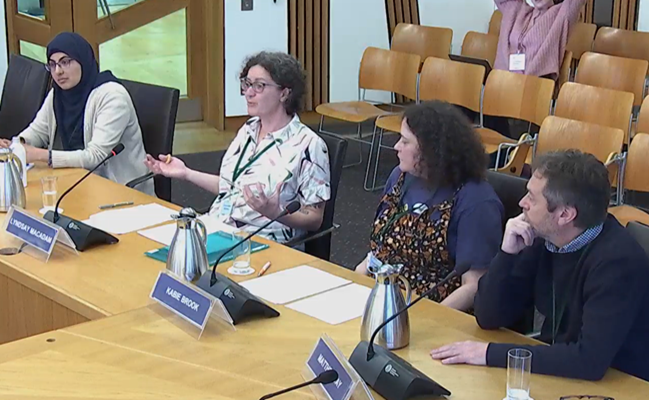
(L-R) Sofia Farzana, Scottish Ethnic Minority Autistics; Lyndsay Macadam, Swan Scotland; Kabie Brook, Autism Rights Group Highland; Matthew Day, Number 6
|
||
|
||
|
A lack of accessible diagnosis and support is driving autistic people and their families into crisis, MSPs have been told.
Representatives of autistic-led organisations giving evidence to Holyrood’s health, social care and sport committee said a national plan is needed to fix significant gaps in neurodevelopmental pathways.
Even in areas where services are still available, high thresholds to access assessments and long waiting lists continue to take a heavy emotional toll – with some resorting to costly private assessments.
Women, girls and people from ethnic minority backgrounds face particular barriers, they warned.
Kabie Brook, Chair of Autism Rights Group Highland (ARGH), told MSPs decisions are being taken locally with no broader oversight:
“There doesn’t seem to be any oversight or accountability. There’s no national plan so a local authority can close a pathway or can have its own threshold for pathways, and that’s just how it is.”
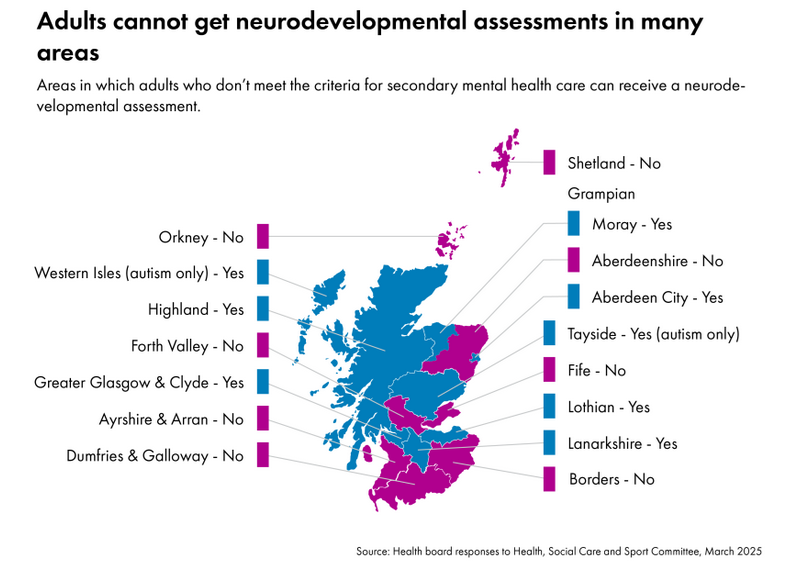
Research from the Scottish parliament Information Centre shows more than 1.3 million adults in Scotland, or just under 30% of the population, live in areas where neurodevelopmental assessments through the NHS are not available.
Across the rest of the country, more than 23,000 adults were waiting for a neurodevelopment assessment as of March 2025. In some areas, demand has grown by 2,200% in the last five years.
The average waiting time for both adults and children to get an assessment is around 76 weeks, with some waiting as long as five years to be seen.
The committee has launched an inquiry to better understand the drivers of increasing demand and explore solutions to improve capacity of services, referral pathways and support.
Panel member Lyndsay Macadam, CEO of SWAN Scotland – a charity led by and for autistic women, girls and non-binary people – told the committee that staff are simply overwhelmed:
“It’s not a lack of willingness. People, practitioners and diagnosticians want to be able to support and help people, but they’re so completely overwhelmed because of the way that understanding of neurodivergence has changed in recent years that they’re not able to meet the demand.
“They’re not able to offer support to people because the support isn’t there.”
Leading by example
Members of the panel stressed the need for holistic, joined-up support in the community, led by autistic and neurodivergent people.
A ‘one stop shop’ for autistic adults in Edinburgh and surrounding areas was highlighted by one panel member as an exemplar for how community-based services for autistic adults might be run in the future.
The Number 6 service gives people access to a professional assessment and then “seamlessly streamlines” them into local support and peer groups where they can feel understood and build relationships.
The panel members also urged parliamentarians to “lead by example” to address stigma, misinformation and discriminatory attitudes faced by neurodivergent people – starting with the use of language.
The title of the committee’s inquiry – ‘ADHD and ASD pathways and support’ – came under fire by the panel for what witnesses said is its use of outdated and medical terminology.
SWAN Scotland’s Lyndsay Macadam told the committee:
“ASD is autistic spectrum disorder and we don’t consider ourselves to have a disorder and most autistic people don’t.”
Members of the panel also said public sector workers – including teachers and doctors – should receive mandatory training to improve understanding and communication with neurodivergent people.
This is being explored as part of the delayed Learning Disabilities, Autism and Neurodivergence Bill.
Panel member Sofia Farzana, Director and Co-founder of Scottish Ethnic Minority Autistics (SEMA), stressed that this training must be delivered by neurodivergent professionals, to ensure it’s relevant, authentic and effective.
“We need to have the training done by professionals who are themselves neurodivergent and not just co-produced. That’s not good enough. It needs to be done by professionals who are living it.
“You wouldn't have a white person giving anti racism training, or a man saying, “I'll give you training on menopause.” It's the same with this.”
Read more: Autism groups lead call to scrap Commissioner plans; Scotland prioritises neuro-inclusion, says government; Future of adult autism and ADHD assessments in doubt
Sign up to our bulletin for key health & social care updates straight to your inbox and you can follow healthandcare.scot on Google News.
|