|
A new consensus on lung disease |
Related newsScots kidney disease patients urge politicians to act Holyrood hears calls for more inclusive communication Scotland’s chance to lead on disability benefit system Scotland can play central role in mRNA Charities: Mental Health funding must increase Call for stoma care to be equal across Scotland 
|
|
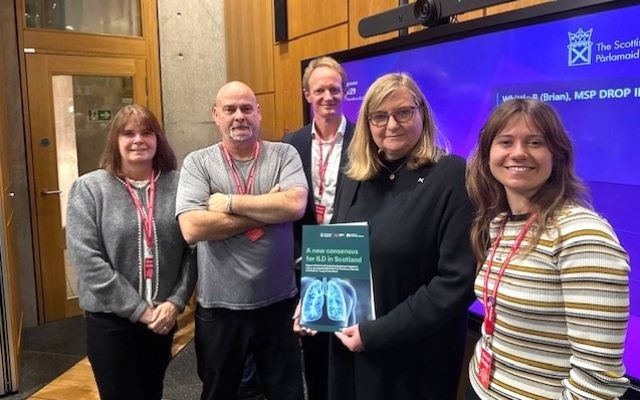
Patients and advocates share the report with Jenni Minto MSP, Scottish Government Minister for Public Health and Women’s Health
|
||
|
||
|
This article and the associated report were initiated and funded by Boehringer Ingelheim, co-developed with Action for Pulmonary Fibrosis and Asthma + Lung UK Scotland.
A cross-sector group of patients, patient organisations and clinicians has welcomed moves to create a national pathway for people with interstitial lung disease, and have published a report on what best care should look like.
In a joint consensus statement, Asthma + Lung UK Scotland, Action for Pulmonary Fibrosis, the Royal Pharmaceutical Society, Scottish Respiratory Nurse Forum and Scottish Thoracic Society, ask the government and NHS to implement the pathway with investment in diagnostic services, expert staff, data systems and patient support.
Brian Whittle MSP hosted a drop-in session last month for patients and clinicians to present the report: A new consensus for ILD in Scotland to MSPs.
Around 33,000 people in Scotland live with interstitial lung disease (ILD). Idiopathic pulmonary fibrosis (IPF) is one of the most common and severe types.1,2 IPF causes lung scarring, breathlessness, persistent cough, ‘crackle’ sounds when listening to the chest, and fatigue, leading to disability and early death, with an estimated median survival of only 3–4 years.3
There is no cure for ILD, so treatment focuses on slowing progression and easing symptoms. Early diagnosis and specialist referral are therefore vital, but patients with ILD in Scotland often face diagnostic delays of over a year, as early symptoms may be mistaken in primary care for asthma, COPD or infection.4,5
The new pathway being developed by clinicians and patients under a programme led by Scotland’s national Centre for Sustainable Delivery will be published in 2026. It will seek to ensure diagnosis and care for people with ILD is consistently good wherever they live.
Jim McLean from Largs was forced to retire from his job as his condition worsened. He told MSPs that, while the cause of his illness remains a mystery, the impact is considerable:
“Despite being under the care of an excellent team at Glasgow Royal Infirmary, the fibrosis in my lungs has continued to worsen to the extent that I now go everywhere with my canister of liquid oxygen. I will soon visit the lung transplant team in Newcastle for a fifth time for assessment.
“I have so-called ‘idiopathic’ pulmonary fibrosis, meaning ‘of no known cause’. I have never been a smoker or worked in hazardous environments. I always wonder if it is because, in my job as a senior executive in the IT Industry with banking clients, I travelled very widely and lived in four different countries.
“New treatments are being found that can keep these lung diseases at bay if they are diagnosed quickly and acted on.
“My hope is that, when the pathway is published, NHS boards across Scotland will act on it so those with these conditions who come after me are guaranteed to get the treatment and support they need everywhere in Scotland.”
A new pathway for ILD
Although Scotland’s Respiratory Care Action Plan6 included a focus on IPF, the report finds that challenges remain, including shortages of ILD specialists, oversubscribed multidisciplinary meetings – key to initiating some treatments – and variable access to lung function testing and high resolution CT scans for diagnosis and monitoring of the conditions.
At the end of October last year, NHS Scotland’s Centre for Sustainable Delivery hosted an online consultation meeting to inform the development of Scotland’s first national treatment pathway for ILD: to help shape future services and ensure the pathway is fit for purpose for the people it is designed to support.
In a joint foreword to the report, Action for Pulmonary Fibrosis and Asthma + Lung UK Scotland call on MSPs and NHS leaders to make sure the pathway is embedded across NHS Scotland:
‘Agreeing and publishing a pathway is a key step. However, implementing it across Scotland’s 14 NHS boards will take investment – in staff, equipment, and in support for patients and their families. Although better pathway-led care offers economic benefits to the NHS and is good for patients7, implementation will require political will and a sense of urgency.
‘We wholeheartedly welcome the commitment to a national pathway as there remains substantial scope for improvement to ensure the consistent provision of high-quality care across Scotland and to enhance the outcomes and experiences of people affected by ILD, regardless of where they live.’
Consensus statement
The report8 shared with MSPs includes a consensus statement endorsed by Asthma + Lung UK Scotland, Action for Pulmonary Fibrosis, the Royal Pharmaceutical Society, Scottish Respiratory Nurse Forum and Scottish Thoracic Society.
The statement reads:
You can read the full report: A new consensus for ILD in Scotland.
NP-GB-106342 January 2026
1 Whittaker et al (2025) Thorax;80:466-477.
2 Asthma + Lung. About Interstitial Lung Disease (ILD). Available at: https://www.asthmaandlung.org.uk/healthcare-professionals/ild/about-ild. Accessed January 2026.
3 Strongman et al (2018) Adv Ther;35(5):724-736.
4 Comments made during Boehringer Ingelheim-organised Scottish Parliament meeting (30 April 2025) Transcript on file.
5 Snyder et al (2020) BMJ Open Respir Res; Jul;7(1).
6 Respiratory Care Action Plan 2021-2026, Scottish Government (2021) https://www.gov.scot/publications/respiratory-care-action-plan-scotland-2021-2026/
7 Fiddler et al (2025) A retrospective evaluation of a novel specialist shared care ILD pathway; Poster ID 3012. Presented at: European Respiratory Society 2025.
8 Boehringer Ingelheim (2025) A new consensus for ILD in Scotland. Available at https://www.boehringer-ingelheim.com/uk/human-health/lung-diseases/pdf/respiratory-specialty-new-consensus-ild-scotland-2025. |
