|
Delay to newborn screening for SMA “nonsensical” |
Related newsEvery Moment Matters in SMA Screening Redefining clinical meaningfulness Call to expand Huntington’s specialist care Scotland’s soccer aid spotlights Alzheimer’s risk Rare condition screening for newborns across Scotland Scotland to work with UK on Physician Associate reform Scientists to help cut NHS medical device waste Edinburgh IJB faces judicial review over cuts Scotland’s new Chief Nurse appointed Urgent plea to safeguard advocacy amid local cuts New gene study offers arthritis treatment insights New Edinburgh hub set to transform global healthcare 
|
|
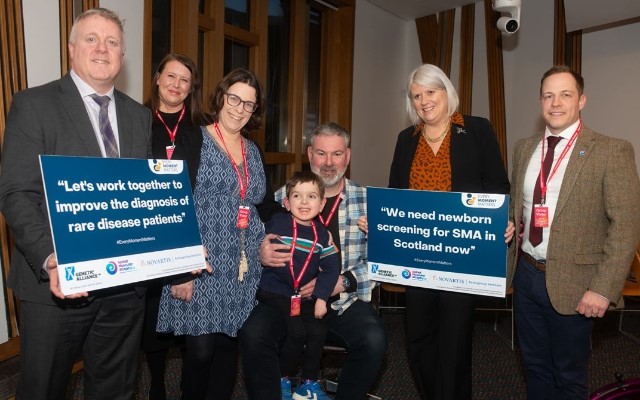
(Left to right) Bob Doris MSP; Natalie Frankish, Genetic Alliance UK; Bernadette Philips (Nathanael’s mother); Nathanael Philips; Charlie Mitchell (Nathanael’s father); Sue Webber MSP; and Giles Lomax, SMA UK
|
||
|
||
|
Partner Content: This article and the Every Moment Matters campaign have been initiated and funded by Novartis Pharmaceuticals UK Ltd.
There are calls for the Scottish government to honour the commitments it made in its rare disease action plan by supporting the introduction of newborn screening to speed up the diagnosis of rare genetic conditions, allowing any treatment to be started much earlier.
The father of a young boy with spinal muscular atrophy (SMA) says his son is in a “halfway house”: getting treatment to prevent his condition getting worse but, because the disease was well advanced when it was first spotted, still needing constant care.
Charlie Mitchell told MSPs at a meeting at the Scottish parliament that it would be "nonsensical" to deny other children the opportunity through screening to enjoy a life free from the symptoms of SMA:
“Nathanael is in the position where it is a halfway house. He's getting treatment but he can't walk. He's in a wheelchair and he has constant teams around him. He's so intelligent and so switched on, but his care is for life. We have an awesome team of people supporting us. We just accept, we have come to accept over time, that this is the situation that he is in.”
"That all makes it nonsensical, in our eyes, that we might have the ability to test and take this away from someone else, for them to be treated in the first 10 days and reach their normal milestones, and not do it."
At the meeting convened by Bob Doris MSP and arranged by Novartis, specialist clinicians were joined by leaders from charities SMA UK and Genetic Alliance UK to make the case for adding SMA to the conditions screened for in the infant blood spot test offered to every child within hours of birth.
In the UK, blood spot tests are currently examined for nine – soon to be ten – conditions.1
SMA has been introduced to newborn screening across much of Europe – including in Ukraine, introduced since the country found itself at war – and the whole of the USA.2 3
Many countries routinely test for at least 20 different conditions.
The UK's national screening committee last June recommended that a service evaluation pilot for SMA screening should take place.4 At the moment, while the UK National Institute of Health Research undertakes evaluation of all UK screening pilots, running a pilot would be paid for by the NHS in England but not the NHS in Scotland.
Clinicians say that the places that have already run a pilot can continue and expand it if the evaluation is positive, while those that have not been involved have to spend several months setting up a service from scratch.
Policy and Engagement Manager for the Genetic Alliance UK, Natalie Frankish, whose organisation represents 200 patient organisations for people with rare genetic and undiagnosed conditions, said supporting the process towards adding SMA to infant screening would be in keeping with the Scottish government's existing commitments:
“The rare disease action plan for Scotland was published in 2022. It references newborn screening and speaks about the importance of reducing the delay in diagnosis that many families face.
“In the plan, the government states that it will ‘continue to engage across the four nations on any new UK-wide screening research pilots’ and ‘will consider Scotland's participation in the UK National Newborn Screening Pilot which aims to carefully evaluate the benefits and risks of implementing newborn genomic screening to accelerate diagnosis and enable earlier access to treatments for rare genetic conditions’. I see that as a commitment to collaboration and to moving this forward.”
In the absence of NHS support, clinicians have put together a proposal for external funding to set up a Scottish feasibility study that will allow screening to begin as soon as possible, and for the knowledge gained to be fed into the UK-wide evaluation. They have identified funding for around half of the likely cost.
The clinicians argue that, because there is only one laboratory serving the whole of Scotland that needs to add the SMA test, introducing it here would be straightforward. In response to suggestions that testing earlier will add an extra cost burden to the NHS in Scotland, they point out that every child diagnosed with SMA is treated anyway – but if they are diagnosed once their nerves have started to die, the care costs are far higher.
Professor Zosia Miedzybrodzha, University of Aberdeen and NHS Grampian Genetics Service Clinical Director told the meeting that, given funding, adding SMA to the standard newborn bloodspot testing in Scotland would be straightforward as bloodspot screening is done in one laboratory in Glasgow.
“It is important that the impact of screening is properly costed and evaluated for the NHS before it makes a long-term commitment to screening. Screening costs more money but the treatment and care of SMA is itself very costly.
“There seems to be a worry that screening would add to NHS costs. But the treatment costs are already in the system anyway. We are treating every child that we diagnose, but we are diagnosing them once their nerve cells have died. The care costs are higher if you wait.
“We would like to see Scotland within the National Screening Committee in-service evaluation so that our investment in treating SMA can yield its full benefits.”
Same condition – two paths
The Chief Executive of the charity SMA UK, Giles Lomax, cited the case of two sisters with identical forms of SMA, but for whom the impact has been different:
"Where a sibling has been tested because their brother or sister has SMA, you can see the difference that early treatment can make.
“An example is Maisie who is six and a half. She was born with type I SMA but wasn't treated until she was seven months old. She can't sit up; she can't walk; she requires a spinal brace and equipment to help her breathe and feed. We know from other examples that a similar care package costs the government approximately £460,000 a year including 24-hour nursing care.
“Her little sister Amelia was tested at birth and she too had type I but was given one of the disease modifying treatments within 11 days. Now, two and a half years later, she has no symptoms whatsoever – she plays, she walks and she will continue to live a normal independent life because she was treated pre-symptomatically.
“Newborn screening must be part of the landscape so no child, now or in the future, should be disabled by SMA.”
Clinical geneticist with NHS Tayside, Dr Catherine McWilliam told the meeting that not being able to give the available treatments soon enough is putting huge pressure on clinicians:
“For those clinicians that are having these diagnostic conversations, you're also thinking, at the same time, if we'd just seen you five months ago, five weeks ago even, what a difference we could have made.
“The babies who are untreated with type 1 SMA will rapidly and irreversibly lose the ability to move, to swallow and breathe. But the children that are treated early, within the first couple of weeks, who can be identified through newborn screening – this is when we need to be seeing them to really change their future."
The MSPs at the meeting undertook to raise the issue with ministers to make the case for Scotland piloting newborn screening for SMA and other rare genetic conditions.
Read more: Every Moment Matters in SMA Screening; New tool for early detection of motor neurone disease; Scotland to host Alzheimer’s research competition; Rapid cancer diagnostic network improves outcomes; Medics warn pollution is risking children’s health; ‘Weaknesses’ found in Scotland’s cervical screening programme
References
1 Public Health England (Office for Health Improvement and Disparities). Newborn blood spot screening: programme overview. January 2023. Available here. (Accessed March 2024)
2 SMA Newborn Screening Alliance. Status Map. Available here. (Accessed March 2024)
3 Cure SMA. States screening and not screening for SMA. January 2024. Available here. (Accessed March 2024)
4 UK National Screening Committee. Transparency data: UK NSC minutes June 2023. Available here. (Accessed March 2024)
March 2024 UK 420918
Sign up to our bulletin for key health & social care updates straight to your inbox and you can follow healthandcare.scot on Google News. |
