|
Health and care innovation: Let 1,000 flowers bloom |
Related newsScotland’s NHS and social care app timeline unveiled Libraries offer light lift for low winter mood Briefing: The 5-year plan for NHS, care and science Accelerating digital innovation in social care Scots honoured in health, care and sciences AI for lung cancer care to help tackle “hidden killer” 
|
|

© natali_mis
|
||
|
||
|
Scotland can transform its ‘very messy’ innovation landscape by improving both the way it chooses which initiatives it supports to scale and how it learns from duplicated efforts, according to a panel.
Attendees at Scotland’s annual digital health, housing and care conference heard that the country is “awash” with ideas to improve health and care but more must be done to scale them.
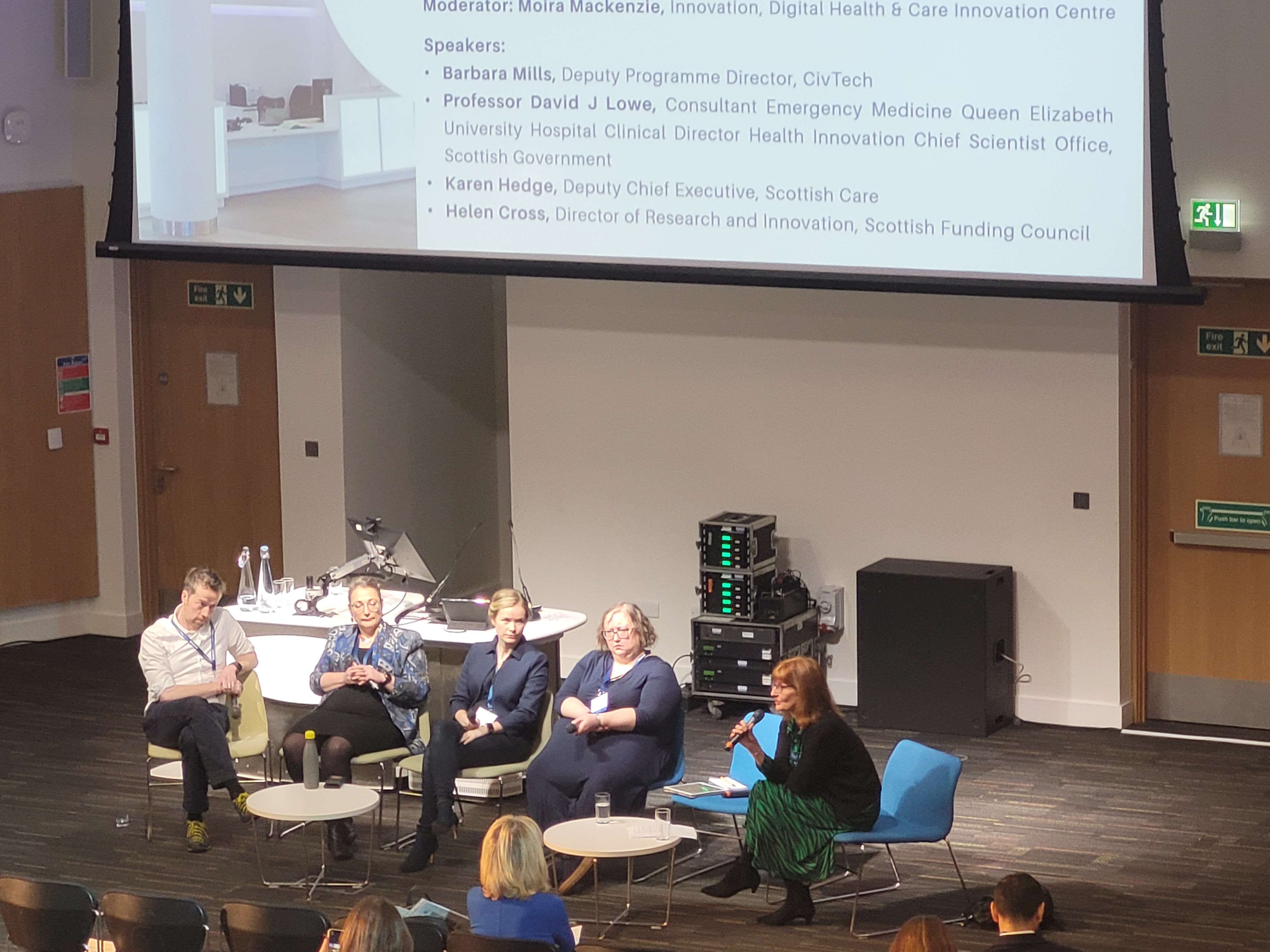
DigiFest23 panel members said Scotland must get better at coordinating innovation efforts to reduce duplication, especially within the “stark” budget context.
However, panel member Karen Hedge, Deputy Chief Executive of Scottish Care, said that concerns around duplication often fail to consider why different health boards choose to do the same thing in slightly different ways.
Rather than curb these efforts, she told DigiFest23 attendees that to move forward, Scotland must better understand the nuances in each new service, pilot or approach:
“If you actually capture why it was slightly different, that’s the bit that we’re not doing.
“Why is it slightly different there, why does it matter that it is different there and what did you learn from that experience?
“Don’t stop the 1,000 flowers from blooming at all but do capture the learning from it. That’s how we’ll move forward.”
Enough strategies
Nine in ten NHS staff surveyed earlier this year believe innovation should be at the heart of NHS Scotland improvements.
The Scottish government's Chief Entrepreneur last month said that Scotland’s NHS is making a choice not to innovate, focusing instead on ‘easy pickings’ at the expense of entrenched challenges in the system.
Despite a numerous strategies full of actions on how Scotland can become a more innovative nation, DigiFest23 attendees heard that a failure to quickly and effectively choose good ideas to support and scale is holding back progress.
Helen Cross, Director of Research and Innovation at the Scottish Funding Council, told attendees that Scotland must better harness its small size and creative, eager citizens:
“We are not short of strategies. But we’re not flush with cash and therefore we have to work with our natural resources. One of those I think is our size and scale.
“Scotland is an area that is innately knowable and we can have really meaningful collaborations to drive a particular activity and then think how to implement those quickly at scale.
“I guess the other is that we are a nation awash with ideas. There is no shortage of people with ideas they want to bring, but it’s about how we support and select those.
“If you let a thousand flowers bloom, that’s great, but then you have to pick the ones you’re going with quickly.”
She explained that a culture of entrepreneurship does not mean just having an idea then starting a business – it must also be accompanied with an understanding of how best to drive those ideas forward.
Sustainable innovation
Panel members spoke about the need for sustainable innovation, with the ability to scale and make a difference while being baked into the day-to-day processes of organisations working across the sector.
However, they said they were concerned about how, too often, innovations that have potential to make a hugely positive difference fail to progress beyond the pilot stage.
Barabra Mills, Deputy Programme Director at CivTech, explained that implementation challenges is not always caused by public sector issues – it can be communities themselves that turn down opportunities for change.
She said this is why “a broad diversity of different types of solutions” need to come through, in the hopes of fitting as many people’s needs as possible.
Karen Hedge emphasised that innovation must also be meaningful for every citizen equitably, telling DigiFest 23 attendees:
“Those organisations that Scottish Care represent purely exist to enable individuals to lead fulfilling lives. And that’s actually the point where innovation happens.
“’What matters to you? How can we support you in your day to day lives? How can we support you to meet your human rights or support you to have a dignified life?’
“It’s through those conversations that innovation happens , in the tiny spaces of everyday moments of the heart.”
Read more: Young entrepreneurs win health innovation challenge; NHS launches good ideas accelerator; HealthTech losing faith in UK market?; Care Technologists pilot expands
Sign up to our bulletin for key health & social care updates straight to your inbox and you can follow healthandcare.scot on Google News. |