|
Scotland’s first chief scientist |
Related newsCollaboration on NHS procurement key to healthy future Pharmacy’s road to stigma-free drug dependency care Politicians must take ‘bold’ action on child poverty Doctors: ‘Shocking’ A&E figures require action Young men’s deaths of despair overlooked in policy Greener NHS research funding boost 
|
|
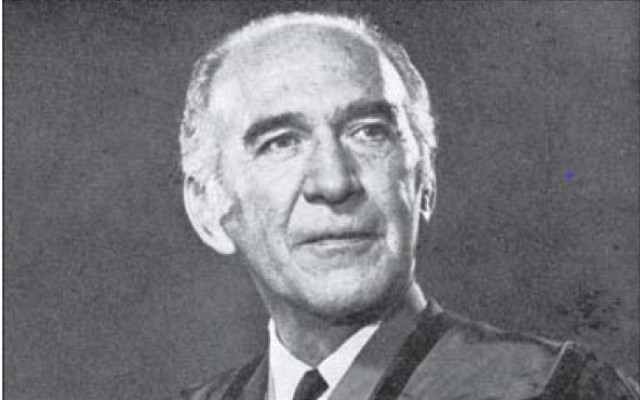
Sir Andrew Watt Kay
|
||
|
||
|
Next week a conference at the Queen University Hospital campus in Glasgow will bring together researchers, innovators, healthcare staff, policymakers, industry and the public to explore how research and innovation can tackle Scotland's growing healthcare challenges. The conference marks the 50 years since the creation of the Chief Scientist Office for Scotland.
Journalist and historian Chris Holme looks back at the life and times of Scotland’s first Chief Scientist for health.
‘In these days we tend to meet any new crisis by reorganising, and, in my own experience, it is a magnificent method for creating the illusion of progress while producing confusion, inefficiency, and demoralisation.’
Words of wisdom which still resonate today. They were written in 1977 by Sir Andrew Watt Kay, the first Chief Scientist at the Scottish Office Health Department.
He was appointed four years earlier in 1973, and next week Glasgow hosts a celebration of the first 50 years of the Chief Scientist Office (CSO).
So how did it come about?
In the early 1970s, the Conservative government in London appointed Lord Rothschild to look at the provision of scientific advice for various government departments. He introduced the concept of customer and contractor where each department would commission its own research.
Whilst okay for defence and other ministries, this created a huge stushie in health where the Medical Research Council had been operating in this role for sixty years. Its record had been outstanding in championing randomised controlled trials to ensure treatment was based on objective evidence.
But others believed it had too narrow a medical focus rather than assisting with the huge practical challenges of running the NHS.
Push came to shove when the new Chief Scientist for the UK Health Department was allocated one quarter – Rothschild had originally recommended half – of the MRC’s annual budget. This was not the best of starts.
Until the advent of the Scottish parliament in 1999, the same party was always in charge of health policy in London and Edinburgh, and UK initiatives were replicated in Scotland.
This is where Kay came in to ensure the new CSO worked in Scotland.
It was against the backdrop of an astonishingly successful era for Scottish biomedical science.
Science in the 70s
In 1972, the process of apoptosis – programmed cell death – which is now crucial to cancer research, was first described by Alastair Currie, Andrew Wyllie, and John Kerr.
Three years later another Aberdeen research group led by Hans Kosterlitz and John Hughes discovered endorphins, the natural opiates produced by the brain.
In Edinburgh, Ken and Noreen Murray were making their first recombinant DNA which later led to the world’s first synthetic vaccine against hepatitis B.
James Black’s second discovery, cimetidine for treating stomach ulcers, was launched in 1975. It became the world’s largest selling prescription drug, overtaking propranolol the heart drug which he also discovered.
Black had cut his research teeth setting up and running the University of Glasgow’s veterinary pathology laboratory.
These were the glittering prizes, but Kay knew the daily grind of research, the dead ends, and all the disappointing failures.
Scotland was small enough that researchers and clinicians knew each other, although this also carried the risk of developing wee, self-serving cliques.
Unlike in England and Wales, the act to set up NHS Scotland included representation of the medical schools on the five area hospital boards and brought all hospital endowments together in a single fund.
Research embedded in Scotland’s NHS
Kay recounted the first four years in his Rock Carling lecture in 1977.
A key priority he said was to make the system flexible enough to encourage young graduates to conduct research.
He established five specialist research units: nursing at Edinburgh, health economics in Aberdeen, GP support in Dundee, operational research at the University of Strathclyde, social, paediatric, and obstetric medicine in Glasgow, and hospital research at the Western Infirmary in Glasgow.
A much wider focus was needed with input from economists, social scientists, and epidemiologists. Communication was generally poor between individual groups - and with the public at a time of high expectations of what medicine and the health service could provide.
However, scientific discovery was not always reaching patients. By 1975, there was already a glut of research publications which left some life-saving interventions lying undiscovered on bookshelves, rather than being put into practice.
One way to keep everyone in touch was through the Scottish Health Bulletin, first launched in 1941. It survived in print form until 2002.
Not always an easy job
Kay reckoned the Chief Scientist should serve at least five years on a part-time basis. He himself continued his day job as Regius Professor of Surgery at the University of Glasgow.
In England, problems persisted in defining what the customer – the government departments - wanted from the contractor – the scientists. Worse still, Rothschild had not foreseen a change in the customer.
Dick Cohen, the first Whitehall chief scientist retired in 1973 to be replaced by Shetland-born Sir Douglas Black. He grew to hate the job because civil servants blocked his work and he quit after two years.
Black was then asked by the Labour government (and commissioned by his successor as Chief Scientist) to research health inequalities.
By the time The Health Divide was completed, there was a new Conservative government which rejected all its findings and refused to print it.
Rushed photocopies were launched on a bank holiday in an office in Soho instead of at the Department of Health.
The farcical attempts to suppress the Black Report merely stoked media and public interest and its conclusions also still resonate today.
Back in Scotland, Kay continued as Chief Scientist until 1981.
There was one surprise left. In 1990, a list was drawn up of the fifty most influential papers published by the British Medical Journal since 1945 based on the number of citations each paper received in later publications by other doctors.
All the major research breakthroughs featured in the table. But top of the list with 820 citations was a 1953 paper by Sir Andrew Watt Kay.
Working at the Western Infirmary he had devised a test which, for the first time, could accurately and reliably diagnose duodenal ulcers.
When told of the honour, he said:
“It is a great surprise to me, and I am delighted. The principle behind it was such that a similar test could be developed for other organs, mainly in the digestive system. That’s why I think it caught on and began to have a wider impact.”
There could not have been a more suitable choice for the post of first Chief Scientist.
Chris Holme is a former Reuters Foundation fellow in medical journalism.
Read more by Chris Holme: 75 years in the making: NHS Scotland; 75 years on: The birth of NHS Scotland; Dr Finlay and the making of the NHS; The father of evidence-based medicine
Sign up to our bulletin for key health & social care updates straight to your inbox and you can follow healthandcare.scot on Google News. |
