|
Right to rehab: The first step to recovery |
Related newsAll public bodies must focus on health, urges charity Health and charity leaders join forces for NHS reform Third sector – not third in line Charities: Mental Health funding must increase New discharge to care homes programme 
|
|
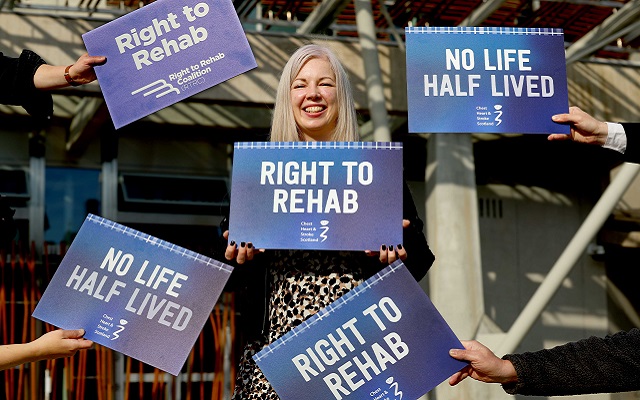
Chest, Heart & Stroke Scotland CEO Jane-Claire Judson and the Right to Rehab campaign
|
||
|
||
|
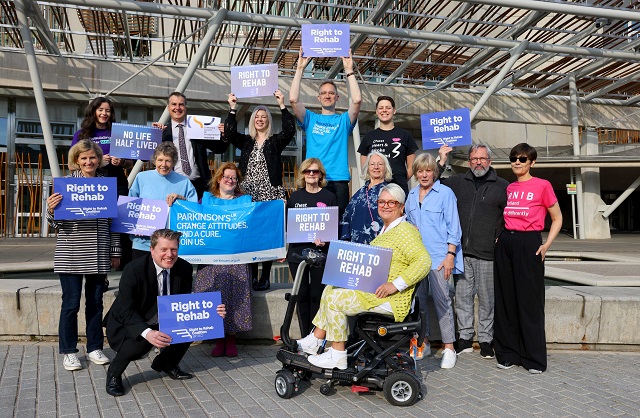
A coalition of healthcare charities, professional bodies and those living with long-term conditions has recently taken their calls for access to rehabilitation be recognised as a core human right to politicians.
Spearheaded by Chest Heart & Stroke Scotland, the ‘Right to Rehab’ coalition believes rehabilitation should be accessible to everyone who needs it for as long as they need it – but too many people are not getting the support they need.
With the launch of the charity’s refreshed No Life Half Lived strategy, CEO Jane-Claire Judson says that working closely with policymakers and healthcare professionals in hospitals and in the community will be the only way to ensure the Right to Rehab is made into reality.
One in five people in Scotland live with a chest, heart or stroke condition or Long Covid. Some live with more than one of those conditions.
Those figures mean that even if you are not directly affected yourself, you are likely to know someone who is.
But despite these huge numbers, we also know too many people are missing out on the crucial rehabilitation they need to take the first step on their recovery journey.
Earlier this year Chest Heart & Stroke Scotland (CHSS) carried out the most in-depth survey we have ever done of people living with our conditions, with more than 1,850 people telling us directly about their healthcare experience and its aftermath.
The results on rehabilitation were damning: only 45% of people with our conditions had accessed NHS rehab. A quarter told us they were not referred to rehab at all.
This chimes with CHSS's estimate that 40,000 people who have had a stroke in Scotland and have been hospitalised don’t receive stroke rehabilitation.
We stand shoulder to shoulder with NHS staff who are working under challenging conditions to deliver the best care they can, and are committed to supporting those living with long-term conditions.
We estimate, based on published NHS data, that 500,000 people should get the rehab set out in national standards and guidelines – but don’t.
We consider this to be completely unacceptable.
Rehab covers all the services people need to make the most of life with their condition, such as mental health support, physiotherapy and stroke rehab. We see rehabilitation as important as any medicine and the key first step in recovery.
Without this vital first step, people are at increased risk of readmission to hospital. They are more likely to need repeat visits to their GP. They may require additional care from family or social care providers. Crucially, they may struggle to return to work or simply live as they want to.
The economic cost of this failure is high. The human cost is scandalous.
Chest Heart & Stroke Scotland’s guiding principle is ‘No Life Half Lived’. It is our vision that everyone living with one or more of our conditions can live their life well – with the right support, at the right time and in the right place for them.
That’s why Chest Heart & Stroke Scotland have taken the lead in the Right to Rehab Coalition campaign to include the right to rehab in the Scottish Government’s forthcoming Human Rights Bill.
Working with a collective of health charities and professional bodies in Scotland, our public petition allows people across Scotland to show their support for this important legislation.
Our objective is simple: we believe the Right to Rehab is an essential component of health, and we want every political party in Scotland to commit to incorporating this right into all future human rights frameworks.
But we know a political commitment is only the start of making the right to rehab a reality for all who need it, which is why we’re moving into phase two of our No Life Half Lived strategy to ensure people living with our conditions receive the support they need to live life to the full. We are rolling our sleeves up now to do the hard work required to establish the supported self-management and community-based personal services that rehab requires.
We will work to deliver our Community Healthcare Support Service across Scotland. Our service is based on a framework of supported self-management and community recovery led by people with our conditions and informed by expertise and published research.
Only with that vital structural change in how services are delivered can we ensure everyone can access rehabilitation when they need it. We are committed to the principle of equity of opportunity: no one should be excluded by a label of “no rehab potential”, and everyone’s needs should be met, regardless of where they live.
To achieve this, we are calling on the Scottish government to ensure rehab pathways set out in national guidance and standards are delivered; that access to rehab services is universal and equitable; and that rehab should be available for as long as it is needed.
All of this will only be possible if the Scottish government also commits to proper resourcing of allied health professional staffing across the country.
We are ready to play our part in making the Right to Rehab a reality through our Community Healthcare Support Service. A model of a quality, supported self-management and community recovery, the service has been developed using the latest research and healthcare expertise – and informed by the lived experience of people with our conditions.
We know we cannot do this alone, so we are actively building on the partnerships we already have and developing new collaborations.
Our vision is No Life Half Lived. The Right to Rehab can make the vision a reality.
To sign the petition to support the Right to Rehab campaign, visit www.chss.org.uk/policy-and-campaigns/right-to-rehab/
Read more: Call for legal right of Scots to rehabilitation; Psychological support after stroke lacking
Sign up to our bulletin for key health & social care updates straight to your inbox and you can follow healthandcare.scot on Google News. |