|
The Assisted Dying Bill - The thin edge of the wedge? |
Related newsProviders: children’s service cuts ‘devastating’ FM candidates asked if they care about care Challenge to in-sourcing policy Sceptical response to government’s care proposals Party health and care leads are named 
|
|
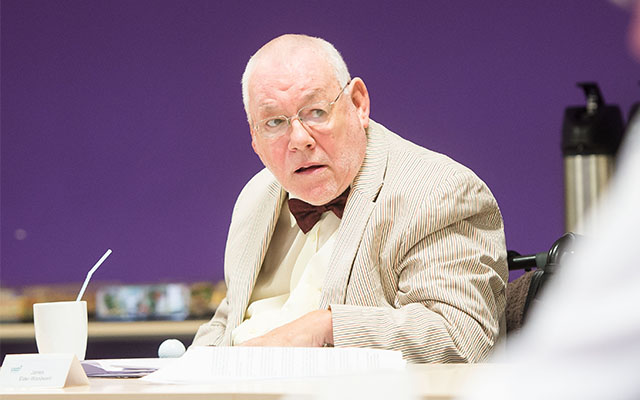
Dr Jim Elder-Woodward
|
||
|
||
|
A bill to legalise assisted dying has today been submitted to the Scottish parliament, following a public consultation which has received full support from more than three-quarters of respondents.
Dr Jim Elder-Woodward, OBE, Vice Chair of Inclusion Scotland and disabled activist, argues that assisted suicide laws are out of step with the current times and, ultimately, what disabled people need is “support to live before having support to die”.
This week, Liam McArthur, MSP, published the outcomes of the consultation on his Assisted Dying for Terminally Ill Adults (Scotland) Bill. It is fair to say, the majority of those in favour of the Bill will not be affected by its introduction, or are possibly reacting to the way society, today, inadequately responds to their need to live and die in a respectful and supportive manner. Whereas, the majority of those, directly affected by it, and fearful of its consequences are not.
Alongside disabled peoples’ organisations (DPOs), Care Not Killing (CNK) a UK-based alliance, that brings together disability and human rights groups, healthcare providers, and faith-based bodies, submitted similar thoughts to this consultation. CNK pointed out assisted suicide laws are:
The proposed Bill is deficient in comparison with dangerous laws already in place elsewhere. When legislation such as this is brought in, it is always widened to include others beyond those diagnosed with ‘a progressive disease, which can reasonably be expected to cause their death’. There is little to no safeguard that could keep some people from becoming victims of its abuse. With the absence of current support within palliative care, and social care support more widely in the community, there is ‘the distress of choice” to end their life when they are at their most vulnerable. Pressure may well be put upon them, as assisted death becomes the cheapest option when other treatments and care support are considered. Disabled people are already marginalised throughout society and at risk from our current health and social care support systems. Some disabled people will already be diagnosed with life limiting conditions. We need support to live before we have support to die.
The recent pandemic spotlighted and deepened inequality. We will be living with the negative consequences of the pandemic, vis-à-vis our NHS, services, society and economy, for a long time. This proposed legislation is out of step with the times we are living through, and the measures that need to be put in place now to allow people to live their lives to the full and die good deaths with the support and care all of us deserve.
In a survey of more than 6,000 disabled people, by the Glasgow Alliance on Disability (a DPO), many people cited their experiences of the pandemic as the ‘tipping point’ that cemented their fears in relation to this legislation: “I can no longer trust that the state will look after me and make the best decisions for me as my health and wellbeing worsens. Everything I need to survive was taken away from me over the past 18 months. If it hadn’t been for GDA, I just would not be here now.”
With the probable future of a smaller neoliberal state, with the consequential development of a dearth of support and comfort to live and die, newly disabled people may be more likely reject their new sterile situation, favouring suicide instead. The growth of awareness of dementia, and the negativity which surrounds the lifestyles of such people, would seem to suggest that assisted suicide (for that’s what we are talking about) was a pragmatic solution. But if it were acceptable for people with dementia, what about those with a stroke, or spinal cord injury; or even those born with cerebral palsy, or Down’s syndrome?
It is argued that assisted dying is a separate issue to disability rights. That people should have the right to choose how to die, as disabled people have the right how to live. But that is not the case. This Bill shows a disablist view of chronic illness and disability. It advocates that pain and debility should be exterminated, rather than accepted and managed. It indicates that an impaired life of pain and distress is not one to be endured. Yet there are many disabled people who live, today, a life of pain, and struggle against a society which devalues them. They do day-to-day battle to get the support they need to live a full and rewarding life.
Death is inevitable for all of us; but it should not be hastened. A good death should be pain free, surrounded by friends and family and in a familial surrounding. There should be the maximum of palliative care, which politicians presently under-value and under-finance. Assisted death lessens the value of life, most especially of those at the margins of society. There, they find themselves unwelcome and not valid (invalid) to those at the centre, who are secure in the knowledge that society will meet their needs and are therefore more powerful than those on the edge. Solutions to the needs of those on the margins of society may be larger or different, so administering a pill or injection may seem to be the most cost-effective solution.
That is the most chilling aspect of this Bill. This Bill and its advocates cannot guarantee that further down the line the safeguards within it will not be relaxed. As has been cited before, in every country which has adopted assisted dying the safeguards have been lessened such that one can decide to be assisted to commit suicide, simply because they don’t accept their (often new) state of disability.
This Bill is the thin edge of the wedge. It is frightening to think what the thick edge will be.
Read more from Dr Jim Elder-Woodward: The right to have needs met by the NCS; A rebuttal to NCS discontents
Sign up to receive our bulletin for key health & social care updates straight to your inbox. |
