|
The right to have needs met by the NCS |
Related newsNational Care Service Forum 2025 Social care wage settlement branded ‘derisory’ Yousaf: No place for tax haven firms in NCS National Care Service cannot be ’mini-NHS’ Politicians told: “Carers cannot wait” 
|
|
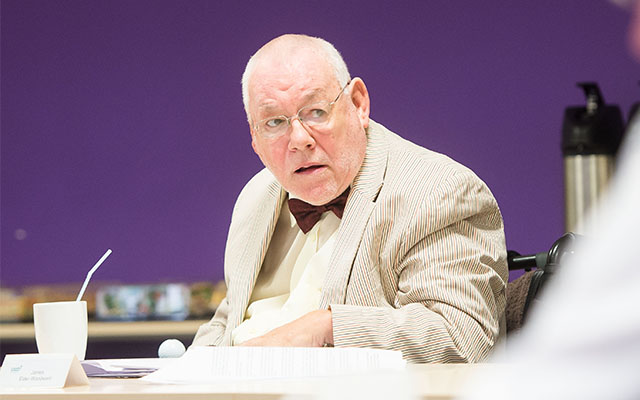
Dr Jim Elder-Woodward OBE
|
||
|
||
|
A disabled activist says legislation to create Scotland’s new National Care Service (NCS) must include a central commitment that people in need will be empowered to have a more central role in the deliberations around their needs and the choice of resources to satisfy them.
Dr Jim Elder-Woodward OBE was part of the advisory panel behind the Independent Review of Adult Social Care, the findings of which have paved the way for the creation of a National Care Service.
As MSPs seek feedback on the government’s draft legislation by the beginning of September, Dr Elder-Woodward argues that, as a rights-based organisation, the NCS should first secure people’s fundamental Right to Need-Satisfaction.
Despite today’s hype over ‘personalisation agendas’, and its ‘person-centred’ care, people in need are still made vulnerable and disempowered by the system of resource allocation.
This is particularly acute at the point of need-assessment. In fact, one of the proponents of the present system, Simon Duffy, has written a public apology for its promotion. According to Duffy, Complex Resource Allocation Systems, and Support Plans are now being abused, undermining the autonomy and freedom of people in need and their families.
The National Care Service promises to promote rights-based provision, free from eligibility criteria and designed to ‘get it right for everyone’ to have a ‘full life’.
But how can it achieve this, particularly after years of the gatekeeping culture and minimalistic outlook of the social care sector?
In their book, ‘The Theory of Human Need’, Len Doyal and Ian Gough argue there should be a social right to need-satisfaction, where people within the same culture have a duty to satisfy the needs of others, as they have the right to have their own needs satisfied in a similar fashion.
The right to need-satisfaction is therefore equal between those in need and those in plenty.
For Doyal and Gough, this theory of reciprocity holds true for both basic and optimum needs. Such reciprocity will fulfil everyone’s right to be and do all that they can be and do. It will also aid the fulfilment of the person’s own duty to each other to do the best for themselves and their community.
To deny such reciprocity, Doyal and Gough argue, may be to satisfy immediate happiness (and greed) amongst the ‘haves’, but is inconsistent with moral values and social justice.
A human rights-based approach to social care and support proposed by the National Care Service, must overcome the present social care mantra, “A need is only a need if there is a resource to meet it”.
Such a philosophy only leads to people in need living impoverished and insecure lives.
To ensure the person has greater opportunity to argue for those resources needed to get it right for a full life, the person must first have an explicit and legal right to need-satisfaction.
This should be a composite right, covering the following seven sub-rights:
Presently, often people are at the mercy of the assessor’s knowledge base – including what options might be available to them – and willingness to share their knowledge;
Often there is a need to have the support to argue for that which will meet their needs, fully;
Presently, although independent (peer) advocacy is welcomed during assessments, the lack of a right to have such support means they are not available on a national basis;
Self-assessments should be enabled to allow the person freedom of expression; to explain what matters to them;
There needs to be the right to freedom of self-expression, and the right to be present when decisions are made which affects the freedoms and quality of life of the person in need: ‘nothing about us without us’;
Presently, there is no independent authority to challenge the decision of the resource allocation process. Requests for a review of a decision go back to the group who made the original decision. The Local Authority Ombudsman, if approached, can only make judgements on the processes undertaken;
At present, there is no record of ‘unmet need’, as only resource led acknowledgement of need is recorded. This means there is no recognition of unmet need, presented by the person in need. This lack of necessary information merely serves to cloud the statistical and policy basis for future funding and strategic development;
The subject, content and process of these individual sub-rights are nothing new as they should be part of the assessor’s 'good practice'. However, they are evidently not part of 'regular practice'.
Making them 'rights' will place a 'duty' on assessors to make them 'good, regular practice'.
Although the process of these rights still may not result in the person receiving the support they desire, it would ensure the process will become more transparent.
Thus, the person also becomes a ‘rights holder’, therefore strengthening their position during the assessment process. They should be empowered to have access to sufficient and intelligible information, which is pertinent to their situation, and understood by the rights holder.
They should have free and accessible face-to-face (peer) advocacy - before, during and after the assessment process and resource allocation. If necessary, they should be free to produce their own self-assessment and/ or gain access to a free, independent arbitrator to investigate any dispute between the distributing authority and the holder of the right to need-satisfaction.
These rights should be enacted when accessing resources to meet need; and at times when those needs are being re-assessed to reduce or withdraw them. The rights holder, and their advocate if required, should be present at any decision-making, or arbitration meeting. There needs to be an acknowledgement that once the agreed provision has been supplied, there must be a universal agreement that before it is removed or reduced, the original need is no longer there, or has diminished in magnitude, or another equivalent satisfier has been provided to the holder’s satisfaction.
This composite Right to Need-Satisfaction should be secured by the National Care Service paradigm of a much broader spectrum of resources, including those of a preventative nature, and the mantra ‘to get everything right for everyone’ to live a ‘full life’.
Nevertheless, there may still be disputes. So, some recourse to an independent arbitrator is required. If any human right approach is to be validated, surely, the National Care Service must facilitate such an independent arbitration procedure. If it does, there must be an effective agent out with the decision-making process. Whether, or not, this will be filled by the appointment of a ‘Commissioner’ is yet to be decided.
By enshrining a right to need-satisfaction, people in need’s legal position will be made stronger, particularly at the vulnerable time of resource allocation and re-appraisal.
Read more: A rebuttal to the National Care Service discontents; MSPs seek views on National Care Service Bill; NCS Bill published;
Sign up to receive our bulletin for key health & social care updates straight to your inbox. |
