|
Insight: Carers in need as fuel poverty hits |
Related newsInsight: Scotland’s ‘invisible’ patients and carers Exercise key to combatting frailty epidemic TV advert promotes human right to benefits FM candidates asked if they care about care New carers continue to face financial crisis Lifetime support for thalidomide survivors NHS staff say data vital to improving care FM commits to £12 an hour for care staff Briefing: Cabinet Secretary plans for health and care Insight: The health benefits of being able to work Watchdogs: Scotland’s IJBs face £124m gap 
|
|
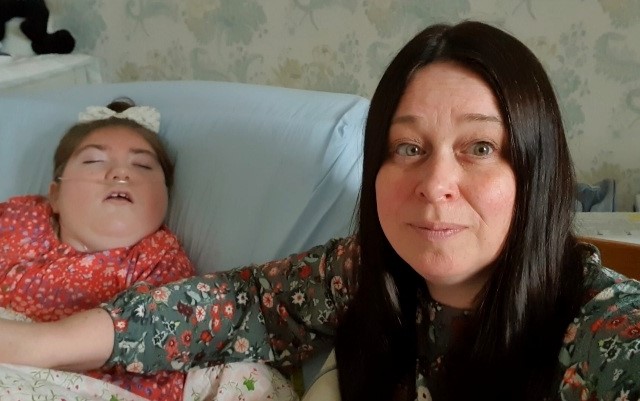
Image Credit: © Carolynne Hunter
|
||
|
||
|
Unpaid carers need additional support measures amid the fuel crisis and should be more involved in government decision-making, says Carolynne Hunter, a Scottish parent-carer.
Carolynne spoke with healthandcare.scot in the first episode of our joint podcast, Equally Valued, with the ALLIANCE about her experiences caring for her daughter amid the rising costs of living.
As a mother of four and carer for her daughter Freya, Ms Hunter is unsure how to pay her upcoming energy bill, as already steep prices set to rise higher. Freya lives with severe, complex health needs and disabilities and is looked after at home by her mum and a team of NHS and self-directed support care staff 24/7.
Ms Hunter explains some of her daughter’s health needs, sharing that Freya’s life depends on her equipment:
“She requires a lot of medical intervention due to having a really compromised airway and she is also completely immobile. She is oxygen-dependent, requires continuous suction and chest physio, postural care and personal care provision all the time.”
From the suction machine and saturation monitor, to oxygen and nebulizer, most of Freya's needs are met with equipment that uses lots of energy – and that is before heating is considered.
Ms Hunter explains that, as Freya is unable to regulate her temperature, she must be continuously monitored and the room’s temperature adapted as needed. Ms Hunter adds that cleaning is another hidden cost:
“Freya requires at least one bed change a day, so you can imagine the amount of washing and drying that goes on with Freya’s care.
“There are kettles being boiled all the time, because we have to make sure that our equipment’s sterile. So she has frequent nebulizers – they’re aerogenerators procedures – throughout the day and night. Freya needs to have all those bits of equipment sterilised a lot.”
Freya herself also needs a lot of baths because her condition means she tenses up and needs to relax so she can cough and clear her airway, explains Ms Hunter. These daily medical and therapeutic aspects of caring for a child with additional support needs contribute to the higher-than-average energy usage for Ms Hunter.
With energy prices continuing to rise across the UK, their monthly costs are set to become completely unaffordable for Ms Hunter. Her direct debit forecast from Scottish Power for April was £855:
“You can imagine that kind of tipped me over the edge. I didn't really believe it, to be honest, at the time when I read it. I do have quite a high usage of energy, but what I was paying before wasn't really affordable anyway as a carer, so when I got that news I was really shocked. I just thought, “what am I going to do?””
While everyone tries to cut their energy costs, Ms Hunter cannot cut from Freya’s care and they only use heating for Freya's room and the bathroom since their total bills are already so high.
Living in an old, high-ceilinged house meets Freya’s needs, but is not energy efficient and means they do not qualify for the Scottish government’s £150 contribution towards these rising costs. In their Budget Bill, the government announced this contribution for households receiving a tax reduction or in energy bands A-D.
Currently, Ms Hunter does not have any options for addressing such a large bill, which has left her in fuel poverty:
“I can't afford the energy bills. What am I supposed to do? It's almost 50% of my income. That's not right – who can afford that? I don't think anybody can afford that. I'm not going to be the only person that's having to deal with this problem, there's going to be hundreds of thousands of people who are going to be faced with this.”
She adds that her only option may be for Freya to enter residential or hospital care, as rising energy costs could force the family to move out of their home. This itself is likely to be incredibly costly to the NHS, as Freya requires round-the-clock care.
“You can’t leave Freya’s side – she needs specific nursing care. Her nurses have been trained for a long time before they are able to look after her to proactively.
“So for Freya to receive that care in residential or hospital, I would say that it's over £1000 a night in hospital [on the NHS]. Residential, I think it might be £4000 month – that’s a lot of money.”
Beyond the figures, Ms Hunter shared how the strain from these prices rises have impacted her family:
“It's been quite horrific to be honest. Because Freya is only alive because she has the love roundabout. She's thriving because we love her so much. We just want to be together, we don’t want this looming over us. So yeah, it’s hard – it’s tough.”
Support from the government is needed urgently and Ms Hunter says ministers need to really consider the impact of the energy cap increase on the most vulnerable. She adds that the government should be improving the provision for at-home support packages:
She adds that while the government is considering ways to meet its Net Zero targets, they should prioritise vulnerable people like Freya, investing to make their homes greener and supporting energy costs.
Last week, Ms Hunter met with her council's housing team to discuss making their home more energy efficent. She made some green energy suggestions and is due an assessment in the next month, but says there is no quick solution here.
For now, Ms Hunter is thankful that the weather is not too cold so that the rest of the family and carers in her home are not freezing.
You can listen to all Equally Valued podcast episodes here.
Read more: Insight: Links workers' vital role; New Disabled Children and Young People Transition Bill; Column: Carers still not being cared for Tags: Chronic Conditions; Disability; Home Care; Unpaid Carers. |