|
TB and the Edinburgh physician |
Related newsScotland’s Clinical Entrepreneur initiative returns Robotic surgery shows pioneering path to the future Mum scrubs-in to help deliver her baby by c-section Innovation and Scotland’s first digital hospital Greener NHS research funding boost AI for lung cancer care to help tackle “hidden killer” FM commits to £12 an hour for care staff Briefing: Cabinet Secretary plans for health and care Watchdogs: Scotland’s IJBs face £124m gap New health and care secretary named Joint pharmacy project cuts adverse events Analysis: Why people are left behind 
|
|
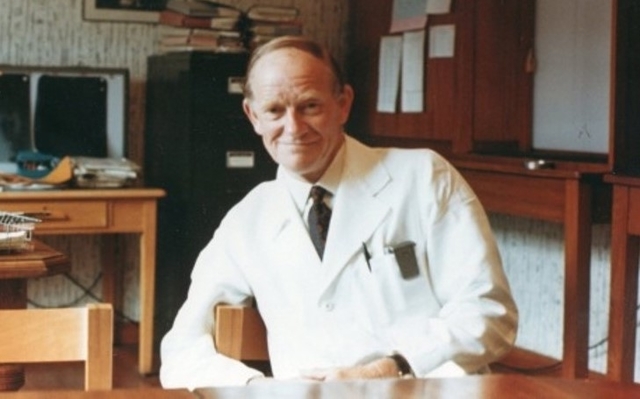
Sir John Crofton
|
||
|
||
|
The covid-19 pandemic has often been cited as the biggest public health crisis since the devastating Spanish flu outbreak of 1918 to 1919. Yet another illness, this time caused by a bacterium not a virus, continually challenged health services in Scotland for much of the 20th Century –– and a respiratory physician, who made Edinburgh his home, played a pivotal role in finding a way to treat the millions affected.
That man was Sir John Crofton who went on to be President of the Royal College of Physicians of Edinburgh.
Ahead of a major symposium on tuberculosis (TB) hosted by the College, Chris Holme looks at what Sir John Crofton was able to achieve and how the story of this disease is far from over.
Rising waiting lists, exhausted staff, and despair displacing hope against a deadly infection spread by coughing…. Sound familiar?
The first crisis faced by the National Health Service soon after its inception in 1948 was caused by the dreadful scourge of tuberculosis, a disease that had plagued humankind for millennia.
Deaths had dropped since their peak in the late 19th century but in the 1950s Scotland was the only country in Europe, apart from Portugal, where new cases of TB were continuing to rise unchecked. It was killing someone every two hours and young adults were at particular risk.
Patients were sent to sanatoria for treatment often lasting months, and some underwent surgery, but there was no cure.
Pulmonary TB was the most common form. Half of all those diagnosed would be dead within five years.
Public concern and media coverage contrasted Scotland’s increasing waiting lists with empty beds available at reduced rates in Switzerland.
So, the NHS paid to fly patients out for treatment at sanatoria in Davos and Leysin. By the time the scheme ended in 1956, more than one thousand Scottish patients had been treated. It provided a welcome respite, but at a considerable cost: £525,000.
It was publicised as the first triumph for an egalitarian NHS – ordinary British people now enjoying the best TB facilities in Europe, hitherto only available to the very rich. The first flights to Zurich begin in June 1951.
At that time in Edinburgh the situation was becoming increasingly desperate. Hospital and outpatient services in the city were kept separate – partly to maintain the fiefdoms of two senior doctors who loathed each other.
Young women seemed to develop a reddish pallor with TB. One consultant combined misogyny with sadism telling young women on his ward: “You are all rosy, red apples, rotten to the core.” He told another patient that she was to be transferred from the Victoria Hospital to the City Hospital because the Victoria did not have a mortuary.
A different attitude arrived in December 1951 when Dublin-born John Crofton was appointed to the chair of tuberculosis at Edinburgh University.
Crofton changed everything. He brought in new consultants – Norman Horne, Ian Grant, and Ian Ross. Jimmy Williamson was the last to arrive in 1954. The group was well supported by two able bacteriologists, Archie Wallace and Sheila Stewart, and a superb administrator, Alec Welstead.
Critically, Crofton brought knowledge of drug resistance. At the Brompton Hospital in London he had worked on the Medical Research Council’s trial of streptomycin, the first effective drug against TB.
Great hope was placed on it. However, streptomycin worked for some but not for others.
George Orwell, then being treated in Hairmyres Hospital, obtained a supply from New York through his friend David Astor, the editor of the Observer. But he had a severe allergic reaction and it had to be stopped. At this time, he was polishing the final draft of ‘1984’.
Bill McLaren, the future rugby commentator, was a patient at East Fortune hospital in East Lothian. Streptomycin worked for Bill but not for three fellow patients who died.
He wrote later: “I came closer to despair that time than at any other stage of my career …. the saddest thing was constantly seeing your fellow patients, especially those you had got friendly with and chatted to every day, suddenly decline, and then die.”
Two more drugs became available – PAS and isoniazid. The problem was that no-one knew how to use them to best effect.
Many people were cured with one or two of the drugs, but thousands also developed drug resistance, relapsed, and died.
Crofton’s group met every week to closely study treatment failures. They decided to give all three drugs from the outset and scrupulously monitored each patient’s progress with bacteriological tests.
To their astonishment, they discovered they were curing everyone, even those with advanced disease.
Rising TB notifications in Edinburgh were halved between 1954 and 1957, a feat not achieved anywhere before or since.
Many did not believe their results. But two colleagues at the Pasteur Institute in Paris did – and they helped arrange a trial in 23 leading TB centres – one of the first international collaborative trials of any treatment.
Though never named as such, the ‘Edinburgh method’ was introduced as standard protocol. As a result, it became the gold standard treatment around the world.
In their dreams, Crofton’s group thought it would be 20 years before TB was brought under control. They managed it within six – the final effort coming from mass x-ray campaigns in Glasgow, Aberdeen, and Edinburgh to root out residual cases in the community.
But the TB challenge remained for the rest of the world.
Crofton and his colleagues threw themselves into work for the World Health Organisation and the body representing national TB associations: the International Union against Tuberculosis.
Drug resistance grew through poor prescribing and patients not completing their treatment. Millions of the poorest people in the world had – and still have – no access to any treatment.
Things got a lot worse in the late 1980s when HIV formed a deadly alliance with TB by suppressing immune systems, which led to millions of deaths.
Treatment programmes pioneered by the Medical Research Council were developed for poorer countries with fewer resources. They achieved some success but then came covid which has curtailed much TB control work worldwide.
Experts meeting at the Royal College of Physicians of Edinburgh next week (Friday April 8) fear the work of Crofton’s group in developing the first 100% cure, and progress since, are both under threat.
That’s a grim outlook for a disease which has been eminently curable and preventable for more than six decades.
There is more information on the symposium ‘Changing Times for Tuberculosis: Building on Sir John Crofton's Legacy’ on the Royal College of Physicians of Edinburgh website.
Chris Holme is the founder of The History Company.
Read More by Chris: Scottish midwives on the frontier; Long read: The CMO who spoke the unspeakable; Long Read: Now wash your hands
Sign up to our bulletin for key health & social care updates straight to your inbox.
|
