|
Adults with incapacity face longest discharge delays |
Related newsCare homes urged to act early on improvement Government to establish West Highlands care review Care home staff numbers increase after record low Fixing social care funding must be council “priority” Care worker visa changes ‘inhumane’ and risks services Meet the secret weapons of GPs 
|
|

© sudok1____
|
||
|
||
|
Adults who cannot make their own decisions due to conditions such as dementia are more likely to face the longest delays to be discharged from hospital.
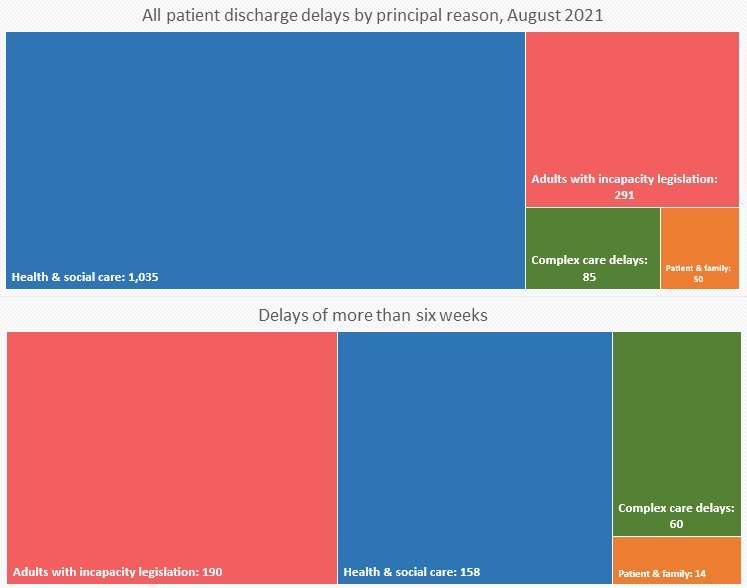
Seven in ten patients who face hold-ups because of adults with incapacity legislation stay in hospital unnecessarily for more than six weeks.
In contrast, fewer than two in ten people on a list for assessments or social care wait more than six weeks.
Disruption to court services during the pandemic has exacerbated the problem, which Scotland’s largest health board NHS Greater Glasgow & Clyde has highlighted as a “significant challenge”.
The Scottish government has pledged to reform legislation when an ongoing review of mental health law reports, but this is not due until autumn 2022.
In the meantime, ministers say they are working to improve the legal processes that must be followed in these hospital discharges.
This week a joint statement was issued by the Scottish government and the Mental Welfare Commission to "ensure individuals’ rights are respected...at this time of pressure on the hospital system".
Commission CEO Julie Paterson told healthandcare.scot: “People are admitted to hospital for specialist care and treatment based on their health needs. It is not in anyone’s interests to stay in hospital when there is no clinical reason to do so.”
A Scotland-wide campaign is urging people to grant power of attorney, which nominates a legal proxy to look after someone’s affairs when they can no longer make decisions themselves.
Without this, relatives or friends have no automatic legal rights to make decisions about the finances or care of a loved one, and a guardianship order must be sought through the courts.
Jim Pearson, Director of Policy & Research at Alzheimer Scotland, says: “If you are a family member, a carer, a husband or a wife of somebody who has dementia, and you haven’t had the opportunity to organise power of attorney, then you are going to find it really difficult to do some of the practical things to support that person.
“You end up with people stuck in hospital, waiting for a guardianship application process to proceed, and that can take months.”
In August, the last month for which figures are available, nearly 1,500 patients faced unnecessary waits as delayed discharges returned to pre-pandemic levels.
Most were as a result of assessments, care home places or care packages being unavailable, grouped together as ‘health and social care reasons’.
But looking at the 422 patients facing delays of six weeks or more, adults with incapacity legislation was the single biggest factor, listed as the principal reason for 45% of delays.
Complex care delays, which often relate to adults with learning disabilities, are also over-represented in longer delays.
The number of adults facing long waits because of mental health legislation has risen steadily since the early days of the pandemic.
Concerns were flagged last year in a report by Health and Social Care Scotland, which brings together chief officers of HSCPs.
It said the existing adults with incapacity framework was one of the main barriers to further reductions in delays and said urgent reform was needed before the end of this year.
Jim Pearson called for more support to be given at the point of diagnosis, describing current low levels of coverage as a “missed opportunity”.
He said: “There’s a lot of people with dementia who end up needing unscheduled crisis interventions because of a lack of support throughout the illness.
“There’s an ideal opportunity, when someone has been diagnosed, to have a conversation about future decision making and future care planning.”
A Scottish government spokesperson said: “Where a patient lacks capacity, the correct protocols must be in place before they are discharged, such as power of attorney or guardianship.
“We encourage everyone to grant a power of attorney in order to appoint someone they trust to look after their affairs should they become incapacitated. We are also working with Health and Social Care Partnerships, the Mental Welfare Commission, the Office of the Public Guardian and others to improve the legal processes involved in seeking guardianship for those in hospital.
“We are fully supportive of the calls to reform adults with incapacity legislation and mental health law.”
Read more: Watchdog: Law broken in some hospital discharges; Delayed discharges return to pre-pandemic levels; Honesty on care homes & action on delayed discharge?
Sign up to our bulletin for key health & social care updates straight to your inbox. Tags: Older People; Staffing & Workforce. |