|
Ex NHS CEO: Health service needs “fundamental reform” |
Related newsEarly career help for Scottish GPs Doctors say GP funding boost “just the start” Less than full-time – behind the NHS trend Doctors invited to shape medical workforce reforms Scotland to work with UK on Physician Associate reform 
|
|
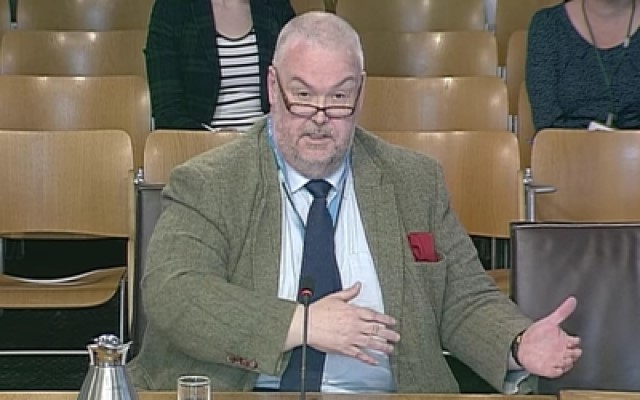
Paul Gray appearing before a parliamentary committee
|
||
|
||
|
A former chief executive of NHS Scotland has said the health service is “overwhelmed” and cannot continue to function without “fundamental reform”.
Professor Paul Gray, chief executive of the NHS Scotland between 2013 and 2019, suggested the “record investment” promised by ministers will not be enough to fix the challenges facing the health service.
“If the NHS is truly precious, it deserves a robust diagnosis, and it requires radical surgery. Whether there is the courage to take such an approach remains very much open to question,” he said.
“…unless the government is willing to engage constructively in radical change and stop arguing about increasing investment (record investment in something that isn’t working will not make it work)…we will stay on this merry go round.”
As director general of health and social care at the Scottish government, Mr Gray oversaw the integration of health and social care.
But in a blog for the think tank Reform Scotland, the former senior civil servant says services remain split across different providers with competing, “increasingly perverse” incentives that can negatively affect patients.
And he says the third and private sector providers are “under represented in decision making; treating the third sector as a disposable contractor while calling them partners is the worst of all possible worlds.”
The Scottish government’s consultation on a National Care Service proposes that the integration authorities with the NHS and councils at the same table, brought in under Mr Gray’s watch, are replaced by Community Health and Social Care Boards with wider membership more closely overseen by ministers.
Professor Gray, who became an honorary professor at the University of Glasgow in 2019, said international examples showed integrated health and care systems could be “made to work at lower per capita cost without sacrificing quality, and with better access and better outcomes.”
He added: “But they involve integration and local delegation to an extent that would frighten most politicians here.”
In comments at odds with previous statements by the First Minister, who said the private sector should be kept “at the margins” of the NHS, Mr Gray said its contribution had to be recognised and discussed rationally.
“We can do better than adopting a stance of “private sector bad” accompanied by accusations of selling off the NHS; we can equally do better than asserting that the private sector would be better and more efficient at everything”.
He concluded his blog: “All that said, the health and care system is chock-a-block with highly skilled professionals and amazing techniques for diagnosis, treatment and care. It is at its fundamental best, its inspiring pinnacle of performance, in a crisis. The people within the system are most definitely a crucial part of the answer to the problem we currently face.
“But the problem will not be solved simply by wishing for more of them, or by a bidding war between the professions and specialisms, not least because there are worldwide shortages of supply in some specialisms and it would take 10 years to train the additional numbers required, by which time the demographics would have caught up again and we would need more again…The real answer lies in fundamental reform of the whole system and not just parts of it.”
As well as being an honorary professor, after stepping down as health service CEO in 2019, Mr Gray took on board roles with a range of public bodies including and became a consulting partner at Charlotte Street Partners.
Read more: Former NHS Scotland CEO moves to health board; Leaders chosen for national health & social care roles; Watchdogs’ concerns at NHS leadership ‘churn’
Sign up to our bulletin for key health & social care updates straight to your inbox. |
