|
Holyrood research shows no integration funding shift |
Related newsHealth and care in the Scottish budget Scotland’s chance to lead on disability benefit system Primary care progress falls behind need, say doctors ‘Substantial’ health harms of gambling to be tackled Call for ‘urgent’ review of ADHD and autism services NHS private care referrals at five year high 
|
|
|
||
|
||
|
The integration of health and social care is not leading to major shifts of money from hospitals into community or social care, according to analysis from the Scottish Parliament’s research body.
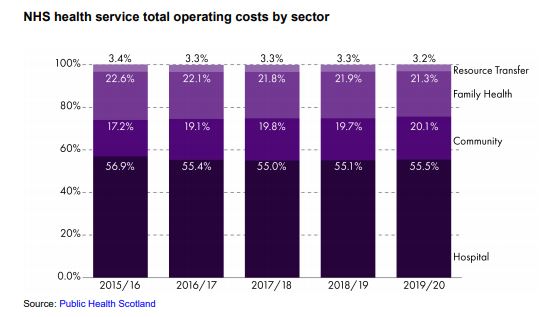
Instead, the share of health spending going to hospitals has remained more or less the same for the last five years.
In a briefing published this week by the Scottish Parliament Information Centre (SPICe), researchers say ‘the underlying structures and operation of both health and social care have not changed’.
This is despite the ‘best efforts of integration authorities to commission services that fulfil the principles of integration.’
From 2008, shifting the balance of care from hospitals to communities has been an ongoing priority of successive governments. It was intended to avoid people being in hospital unnecessarily, enabling them to receive more anticipatory care closer to home, ultimately reducing acute hospital activity and preparing services for an ageing population.
The integration of health and social care was intended to build on this, particularly to ensure appropriate support was in place for a population where more people were living for longer but with more complex health problems and rising social care needs.
However, the share of overall health spending going to hospitals has remained essentially unchanged from 2016-17 to 2019-20.
Community health service spend has risen only slightly from 17.2% in 2015-16 to 20.1% in 2019-20.
Emergency medics have previously called for a funding boost for social care to ensure patients ready to go home do not face unnecessary waits in hospital and to prevent bed occupancy rates in the health service ‘routinely’ reaching above safe levels.
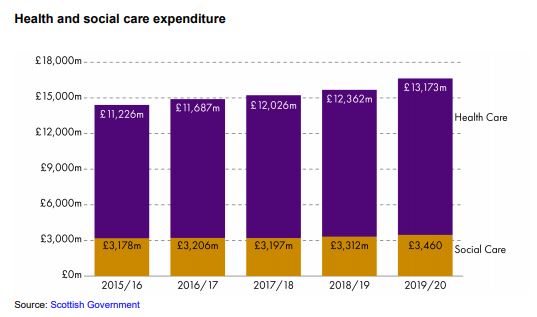
Healthcare spending as a proportion of the overall Scottish government budget has increased steadily from just over £11bn in 2015-16 to a little over £13bn in 2019-20.
Social care meanwhile experienced a more modest spending increase, shifting from £3.2bn in 2015-16 to £3.46bn in 2019-20.
A national care service – a second chance for integration?
The next parliamentary session will, according to researchers, ‘see tension between dealing with the backlog of hospital treatment, and the drive of integration to focus on prevention and community-based interventions.’
They question whether any momentum behind shifting the balance of care will be picked up again in the new session.
The independent review of adult social care that reported in February called for a greater focus on preventative care delivered in people’s homes – keeping them out of hospital – and for Integration Joint Boards to be handed responsibility for commissioning social care.
The SNP has promised to implement all the recommendations made by the review, which arguably opens the door for the reinvigoration of the integration agenda.
The mental health legacy of covid-19
The Holyrood experts also said they expect the impact of the pandemic on mental health and related services to be another of the issues that will feature heavily in the next parliament.
More than 24,000 people have so far been hospitalised with covid and a Scottish government report found up to a third of covid patients admitted to hospital developed serious mental health issues, including depression, anxiety and post-traumatic stress disorder.
The Scottish government published a mental health transition and recovery plan in October and has increased funding for services. An additional £120m was pledged for mental health by the government in March – the ‘single largest investment in mental health in the history of devolution’ according to then Mental Health Minister Clare Haughey.
Despite this, SPICe says questions still need to be answered when it comes to how the government’s covid-19 recovery plan will tackle the causes of mental health inequalities that have widened during the pandemic.
Read more: Manifesto to mandate: the SNP on health & social care; Irons: Integration ‘underpinned’ rapid virus response; Election social care funding plans ‘fall short’; Integration ‘inconsistent & fragile’ five years on
Sign up to our bulletin for key health & social care updates straight to your inbox. Tags: Finances; Scottish Parliament. |