|
Unpaid carers the forgotten ‘last line of defence’ |
Related newsCare home fears over rising community infections ALLIANCE chief: It’s all about the money Community pharmacy project finds ‘hidden carers’ ‘Covid showed ministers should be in charge of care’ Insight: Where is the plan for social care? Freeman: ‘We won’t nationalise social care’ 
|
|
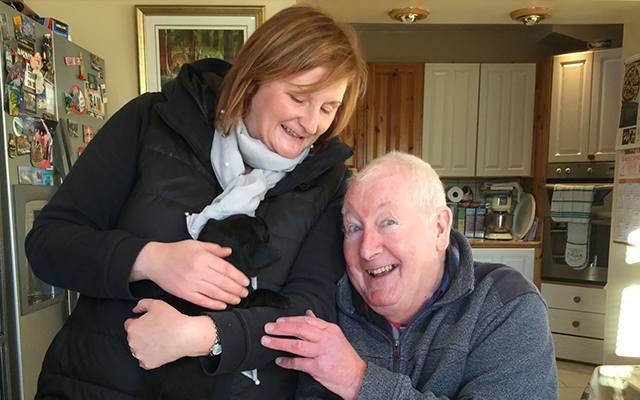
Care campaigner Lynn Williams and her husband Derek
|
||
|
||
|
For ten long months now, Lynn Williams and her husband Derek have effectively been shielding in their home in Paisley.
Without any hands-on support possible from friends and family or care services, Ms Williams, like so many unpaid carers, has been left “shattered” and says getting up each morning is getting harder, knowing there will be no break from the isolation, worry and responsibility.
“Things have become much worse over the past wee while,” Lynn tells healthandcare.scot in the first half of a two part interview, “and balancing work with care is becoming increasingly difficult.
“It’s so stressful to have to plan everything through that lens of care just now – it is becoming a nightmare, having to continually work through how you adapt around the person you are caring for.”
A glitch in the system meant, after requesting that he be put on the shielding list in April of last year, Ms Williams’ husband was only added to the list the day before shielding ended, and only after she had approached Scottish government officials directly on social media about the matter.
“Regardless, though, we just shielded anyway,” Lynn explains. “I decided early in March we needed to lockdown. Policy geek that I am, I had been watching what was going on further afield and decided we needed to do that.
“I spoke to a number of other carers across March – pre-national lockdown – and they did the same thing, organise shopping and pharmacy deliveries and so on. I spoke to my GP who agreed it was absolutely the right thing to do.
“We had no respite during the summer – we had one friend round, but that has pretty much been it. I have seen my family a couple of times and that was only because my brother was seriously ill in August and he cares for our dad.
“We haven’t seen my husband’s family since last February, and we have basically been in isolation since then. We aren’t seeing friends and family and most of them aren’t online, so we keep in touch through phone calls.”
Managing care for her husband alone under lockdown has left Lynn feeling “shattered”, but she still manages to work part time from home.
“I’m delighted to still have a job…It gives me space to be me. Usually all I am is a carer and that identity is not a great place to be right now.”
“I’m delighted to still have a job and my employer is so supportive – they bend over backwards to make things easier for me and that means I have that space for me for a few hours a week.
“It gives me space to be me. Usually all I am is a carer and that identity is not a great place to be right now.
“Most of us feel we have been abandoned, so to be a carer means almost you are more hidden than you would be. I’m working from home and still caring; I just have to make sure work fits around that. But a lot of carers don’t even have that, and I know I have to just keep going.
“We didn’t have support pre-lockdown and I think, even if we had, we would have stopped that in the lockdown because of the risk of infection.
“We aren’t any better or worse off in terms of care levels but we are isolated now. I know a lot of carers are struggling psychologically.
“I spoke to my GP away back in April because I reached a point where I just thought I can’t do this anymore. But I spoke to her and she did encourage me to go out for a walk – she said don’t stay in the house all the time – get yourself out for an hour walking and that really helped – it was a great release to get out the house, be in the fresh air and have that hour to keep me going.
“There have been times though this year where getting up in the morning is getting harder and knowing that it is the same routine every day; there is just no break from it, and that’s hard.
“But I know there are people who have it so much worse than what I am dealing with – they have multiple caring roles and I have no idea how they are still standing.
“I think the clinch for me in all of this is that at no point in the pandemic has the government acknowledged that if we weren’t doing as we were doing, my god, the demand on the health service would be so much worse.
“An example of that would be a few weeks ago with my husband; we were dealing with his blood pressure which we have to monitor. At one point it was not stabilising at all and there was talk of admission to hospital and that whole day my GP was in touch with the hospital who was saying they could admit him and that we should, but our fear was that he wouldn’t come home again because of covid, so we agreed that I would monitor him at home.
“That is the level of stuff that we have to deal with – we are preventing people from being admitted to hospital. We are key workers and none of that is recognised.
“What I do is nursing – I am a nurse dealing with skin integrity, wounds, blood pressure and a whole range of stuff that nurses normally would.
“The district nurses we see sometimes ask me stuff, about what I’m doing and so on. We are getting support from the district nursing team and our GP has been fabulous.
“If we weren’t doing as we were doing, my god, the demand on the health service would be so much worse.”
“The Health and Social Care Partnership – we do have a community alarm for emergencies – but we haven’t heard a single peep from them, no phone calls.
“We have had two standard letters from them which bear no resemblance to what we get from them which is virtually nothing – they have been invisible in all of this, the council too.
“We have relied on the Carers Centre – a charity group – and we were able to rely on them for things like shopping for us. They check in every so often just calling and seeing how you are and that makes a huge difference. There is a key worker there I am linked with who always calls to check on me and that really is a tremendous support.”
Should Lynn become ill herself and no longer be able to care for her husband, she says the emergency care plan they did have is now effectively defunct. If their local carers centre isn’t able to help, a care home may be the only option, but that “fills me with fear” Lynn says.
“The Scottish government guidance for carers last year was ‘rely on friends and family’ – a lot of us just laughed at it. Most of my friends and family are caring for someone already or couldn’t do what I do.
“So emergency planning is non-existent as far as I can see. The Scottish government’s latest advice seems to still be to rely on friends and family.
“I can’t do that – I can’t put friends at risk, and they couldn’t do half the stuff I do anyway. Where’s the back-up plan? For me that is where things are falling down. To me the Carers Centre is the back-up plan.
“I am speaking to carers now who have been shielding but are still catching coronavirus – from going to the supermarket. Suddenly your last line of defence is starting to fall – where is the national oversight of this?
“Where is the national response that says partnerships need to start planning for replacement care?”
Follow us on twitter for the release of the second part of Lynn Williams' interview with healthandcare.scot.
Sign up to our bulletin for key health & social care updates straight to your inbox. Tags: Infectious disease; Social Care; Unpaid Carers. |
