|
Tech transforming the work of ‘disease detectives’ |
Related newsScotland at the table with UN healthy air commission Meeting to spotlight NHS Clinical Entrepreneurship Pharmacy’s road to stigma-free drug dependency care NHS and Glasgow rethink routes into healthcare Chief Medical Officer: ‘Critical connections’ priority Racism in NHS Scotland still rampant, doctors reveal Health boards to soon accrue £380m in lifeline loans Go ahead for vulnerable teenagers’ inpatient unit Public health concerns voiced for Ayrshire’s children NHS buys private hospital for new treatment centre Cash-strapped board warning over new medicine costs Insight: Operating frustration at Westminster 
|
|
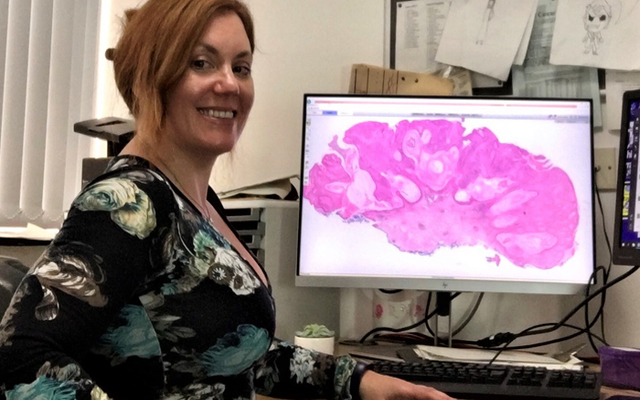
Dr Lorna Cottrell, consultant pathologist at NHS Ayrshire & Arran
|
||
|
||
|
The world of the pathologist has long involved hours in a laboratory staring down a microscope at tissue samples.
Now technology is revolutionising the way in which these ‘disease detectives’ work – including allowing cancer to be diagnosed by staff from home during the covid pandemic.
Digital pathology involves scanning tissue samples from a traditional glass slide and converting it into an image which can be examined on a computer screen.
“For hundreds of years pathology has not changed very much,” says Dr Lorna Cottrell, consultant histopathologist at NHS Ayrshire and Arran.
“You get a glass slide and you look at it down a microscope, which apart from getting a little electric bulb have not changed very much.
“The obvious comparison in terms of diagnostics is radiology. If you think when X-rays were discovered - now there are PET MRI scans and all sorts of technology.
“So digital pathology is a leap forward for us.”
Dr Cottrell, who is also the health board’s lead for digital pathology, described her day-to-day work as being like a ‘disease detective’, based on examining samples of tissues and fluids under a microscope.
Along with the clinical history of a patient from their GP or surgeon, the information gleaned is used to make a diagnosis or provide more insight into the severity of a disease, usually cancer, to help inform treatment plans.
“A lot of people think if you are a pathologist you are not a clinical doctor. We are - we just don’t see our patients face to face,” Dr Cottrell said.
“We are still very much involved in clinical care and we are very focused on our patients.
“We always try and remember that behind every bit of tissue is a patient and our aim is to get an accurate result as quickly as possible.”
While many NHS services have been paused during the pandemic, pathologists have been continuing diagnosing cases.
However a drop in urgent cancer checks because of covid-19 resulted in an “unprecedented opportunity” to focus on digital pathology in NHS Ayrshire and Arran, which was introduced in March.
Dr Cottrell said there had been interest in the technology for some time in terms of its ability to increase efficiency and flexibility.
“In the UK we have got a huge crisis with the numbers of pathologists,” she said.
“A report from Cancer Research in 2017 showed about 35% of pathologists were due to retire in the next five years without the numbers to replace them. Nine out of ten pathology departments in the UK are understaffed.”
As the covid crisis hit, Dr Cottrell said digital pathology meant her department was able to introduce remote working, with staff able to share information with other doctors during meetings on patient cases.
She said: “The immediate side of it is that it frees us up from a microscope, which means I can work anywhere I have got a computer that can access that image.
“It also means I can send that case to anybody in the world for a second opinion, at the click of a button.
“Going forward with social distancing, it just makes that easier – you don’t have to have every pathologist in the department every day.”
NHS Ayrshire and Arran is the first health board to fully sign up to the system, which is being rolled out elsewhere in Scotland.
Digital pathology is also expected to open up a “whole new world” in the future, with the expectation that artificial intelligence will assist with analysis.
“What it is producing is not just a picture, it is turning that glass slide with tissue on it into data,” Dr Cottrell said.
“A lot of what we do is look for prognostic indicators, the information that will help us predict how well the patient is going to do – the stage of the disease, and how bad the cancer is.
“So a computer can count the number of inflammatory cells that are in a tumour – it might be millions – which we can’t do by eye.
“There is already work going on to develop a scoring system which can work out if somebody has got a certain number of inflammatory cells in relation to their tumour then they are likely to do badly or well.”
She added: “There are probably things we haven’t even thought of yet that we will be able to do.
“In future we will be able to get a lot more information out of a tissue biopsy than we currently can.”
Sign up to our bulletin sent twice a week so you don’t miss out on the latest health and social care news.
|
