|
Insight: NHS Pharmacy First |
Related newsHealth and charity leaders join forces for NHS reform Respiratory care vision unveiled Realistic medicine in Lanarkshire COSLA & Government integration report Chief Medical Officer: ‘Critical connections’ priority First Minster pledges people will see GP sooner 
|
|
Scottish Parliament TV
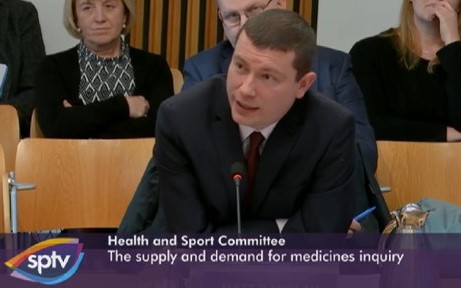
Matt Barclay giving evidence to the Scottish Parliament’s health and sport committee on 28 January.
|
||
|
||
|
As community pharmacists take part in a national consultation on what could be a ‘world first’ for high street pharmacies, Matt Barclay, a pharmacist and director of operations with the representative organisation Community Pharmacy Scotland, explains what is being proposed.
“From all the information we can gather looking at similar services across the world, this is actually a world first in terms of how community pharmacy is being employed and recognised. It is something to be celebrated and something that we need to talk up because it is important.
“We want it to be a success for our members, a success for the NHS and, above all, for the public who are coming into community pharmacies.”
As its name suggests, NHS Pharmacy First is about making it possible for people to go directly to consult their local pharmacist on a range of issues as a gateway into the NHS.
The scheme will be open to anyone ordinarily resident in Scotland, the homeless, those in care homes and the travelling community, to consult their pharmacist and then be given advice, prescribed a treatment or referred on to another healthcare professional.
The pharmacists themselves will be able to prescribe and supply a growing range of medicines.
A new reimbursement contract will recognise consultations with patients rather than just when a medicine is dispensed.
NHS Pharmacy First builds on the long-standing minor ailment service and a series of local Pharmacy First pilots. Where the minor ailment service was restricted to only those people who had historically been eligible for free prescriptions, NHS Pharmacy First will be available to anyone living in Scotland.
The Pharmacy First pilots were local arrangements that paid pharmacists to treat a small number of conditions, such as urinary tract infections and impetigo, without the involvement of any other healthcare colleagues. The aim now is that the list of eligible conditions will steadily grow as the new scheme beds in.
Matt Barclay says an important element of NHS Pharmacy First will be data and record keeping:
“The first interaction with a pharmacy will be about the pharmacy asking for the patient’s details and explaining that they are accessing an NHS service. The focus for the government and ourselves is the value of the consultation itself.
“Along the way we will be capturing data which we have not captured before around how many consultations we do, how many people are referred to us and how many we refer on. It’s also about capturing the outcomes from those consultations and, over time, showing how people are using the service as a route into the NHS.
“Ideally, from a pharmacy point of view, what we would like to see is the use of mobile technology so information about what is happening can be easily captured seamlessly.”
Community Pharmacy Scotland believes the new reimbursement system that accompanies NHS Pharmacy First is more in keeping with pharmacists’ increased role as prescribers undertaking first line triage:
“We want to create a payment system that incentivises the right behaviours, realises the value that care through community pharmacy can deliver. The payment mechanism, rather than just incentivise transactions, has been attached to the value pharmacies bring.”
The amount of activity will still be recognised in the payments, but pharmacists will have to demonstrate they are working directly with patients on a routine basis to be classed as offering the service.
Tonight (Monday), Community Pharmacy Scotland’s fourth NHS Pharmacy First consultation roadshow takes place in Lothian. The aim was to hold one in each NHS board area, but extra dates are now being considered as some meetings were oversubscribed.
Matt Barclay says it is the biggest national consultation of members the organisation has undertaken in over a decade:
“We didn’t have any real sense of what sort of numbers would be interested or how eager people would be to learn more about how the service might work or to engage with the vision behind the service.
“We are certainly finding lots of contractor owners, pharmacy teams and others are coming along. At our meeting in Lanarkshire, a nurse who is working in a health and social care partnership came because she wanted to understand how the service will work so that she can embed it in referral pathways within her area.
“The questions that we are being asked are largely very positive. The feeling in the room seems to have been positive too. Equally, we understand that community pharmacies are under pressure, like all areas of the health service.
“I myself work in community pharmacy at weekends on a regular basis so understand the pressures on the frontline. So, we recognise this is a huge, fundamental culture shift for pharmacy teams and for the public.
“There is extra resource going to be put in by government to support the service, both to promote it and in terms of the pharmacy services contract itself.
“In the meantime, we want to get the message out about why this service is important – not just how the service will happen, but also the reason that community pharmacy is seen to be so crucial to the NHS in Scotland in terms of reshaping an element of primary care.”
|
