|
A third of positive bowel tests not followed up |
Related newsCall for genomic test for every cancer patient Scotland must prioritise new bladder cancer test AI for lung cancer care to help tackle “hidden killer” High cancer risk for adults with learning disabilities Charity: follow up more positive bowel cancer tests Genetic data offer new routes to fight breast cancer 
|
|
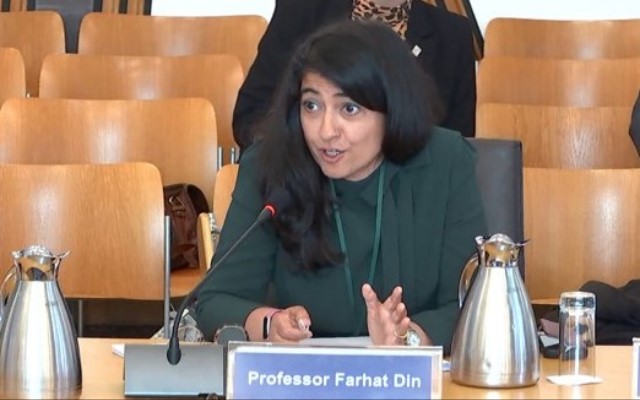
Image: Scottish Parliament TV
Professor Farhat Din
|
||
|
||
|
As many as four in ten people who return a positive bowel cancer tests are not being followed up because there isn’t the capacity to investigate them further. Giving evidence to Holyrood’s Health, Social Care and Sport Committee, a colorectal surgeon told MSPs that she is seeing patients with bowel cancer who had been falsely reassured by not having been followed up after sending back their bowel screening sample.
Giving evidence during a session on NHS waiting times, Professor Farhat Din, a Council Member at the Royal College of Surgeons of Edinburgh, said the new faecal immunochemical test (FIT) for bowel cancer is helping encourage more people to do the home test.
However, she said how the tests are followed up means an opportunity is being missed to detect the cancer early.
Professor Din, Scotland's first professor of colorectal cancer surgical research said a decision had been taken to only follow up some positive tests to better match the NHS capacity to undertake scoping procedures:
“So for bowel screening, we screen patients at 80 micrograms of haemoglobin per gram of faeces. But in fact, the test is positive at 10. And we know that screening capacity, or rather the threshold, is titrated against the endoscopy capacity to test positive results.
“But actually, if we want to detect cancer early, there is an obvious way to do that within the system that we have by thinking about models where we lower the threshold, because – and this is work that we've done, that I’ve led in our region – what we do know is that we will miss about 35 to 40% of patients who will actually have had a positive test, but it wasn't at threshold for colonoscopy.”
Professor Din said she feels patients are being ‘falsely reassured’ as a result:
“I see patients coming to clinic within a two year period saying: “but actually I did my bowel screening six months ago, how come you're telling me that I now have a bowel cancer?”
“So I think there's a lot of work to be done around thinking about how we address capacity issues within bowel screening.”
Gerard McMahon, Head of Policy & Influencing for the devolved nations at Bowel Cancer UK, said Professor Din raised an issue that the Scottish government needs to address urgently:
“The earlier bowel cancer is spotted, the more treatable it’s likely to be, with more than 9 in 10 people surviving the disease when it’s diagnosed at the earliest stage.
“Screening is one of the best ways to spot the disease early, however waiting times for bowel cancer patients identified via screening are far from acceptable. Only slightly over half (52.2%) of patients begin treatment within 62 days of being referred with an urgent suspicion of bowel cancer.
“Professor Din is absolutely right to highlight the problems with the current threshold in the screening programme. The UK National Screening Committee (UKNSC) has recommended a FIT threshold of 20 micrograms per gram, but the level required to trigger further investigation in Scotland is currently four times greater (80 micrograms per gram).
“We call on the Scottish government to urgently evaluate the requirements for delivering the UKNSC’s recommendations in full. Including the cost of additional staff, equipment, and other necessary infrastructure. It’s essential that they set out a roadmap to deliver these changes in a safe and timely manner.”
Read more: ‘Substantial’ drop in cancer deaths; Lung cancer screening could save 1000s of lives; Double testing improves bowel cancer detection
Sign up to our bulletin for key health & social care updates straight to your inbox and you can follow healthandcare.scot on Google News. |
