|
Care sector needs ‘rights, respect and redistribution’ |
Related newsDonald Macaskill: Where is Scotland going? One precedent, inconsistently applied Care at home: A guide for new health ministers Moves to extend FOI to care homes Beyond the edge: why care homes are in crisis The in-between: what’s happened to care reform? 
|
|
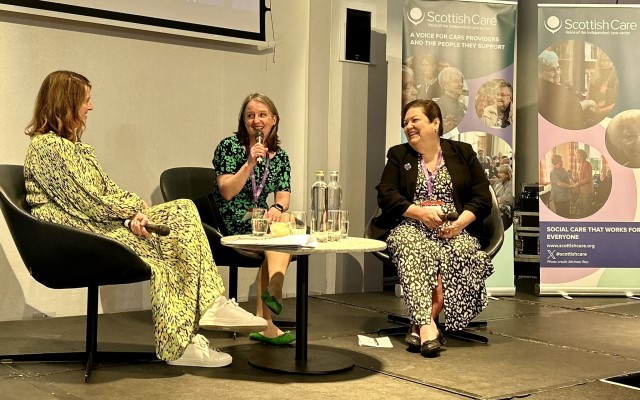
(From L-R) Katharine Ross, conference chair; Maree Todd MSP, Minister for Social Care; Jackie Baillie MSP, Scottish Labour health and social care spokesperson
|
||
|
||
|
Scotland's social care minister has assured attendees at a homecare conference that the government is accelerating efforts toward ethical commissioning.
Maree Todd told more than 200 attendees at the recent Care Revolution - Time to Act conference that soon more staff will join the civil service team responsible for developing ethical commissioning.
The work going on should be "very visible, very soon", according to the minister, who reiterated her full support for the principles of a more ethical approach to procurement within social care:
“I think ethical procurement offers a real opportunity because we’ve got a mixed market economy. It gives us an opportunity to make sure that the important thing is not the ideology – so not the business, not whether it’s council-owned, not whether it’s third sector-owned: it’s about the quality of care that’s delivered.
“And I think that’s really important. That’s fundamentally the focus we need to have of the whole system.”
During a fireside session with the minister, Scottish Labour health and social care spokesperson Jackie Baillie MSP said that history shows legislation alone is not enough to fix issues in competitive tendering.
She pointed to the lack of progress in procurement reform following the 2014 change in legisltaion as proof that more must happen on the ground:
“I love the idea of ethical commissioning – I absolutely do. But is it going to work if the budgets aren’t there? Because commissioners are trying to squeeze every penny out of the system that they can, I understand their dilemma and what they have to do every day, but I also understand those of you who deliver services are on the receiving end of that, with commissioners dipping into what you have for terms and conditions for your staff.”
Care workers across Scotland came together last month to demand the return of ‘missing millions’ meant to fund improvements to their maternity, paternity and sick pay they say was cut from the Scottish Budget last year.
Jackie Baillie MSP said that care workers have been “marched up the hill and then left there” by the Scottish government, and ministers must now focus on rebuilding trust.
Ms Todd said she believes that ethical procurement offers a chance to raise the pay and conditions for people working in social care, with the National Care Service as a vessel for delivery.
Ethical commissioning for the independent care sector
A Scottish Care policy lead told attendees that the organisation will urge the Scottish government to reset the relationship between regulators and the sector and ensure language used in commissioning empowers providers and people who use services.
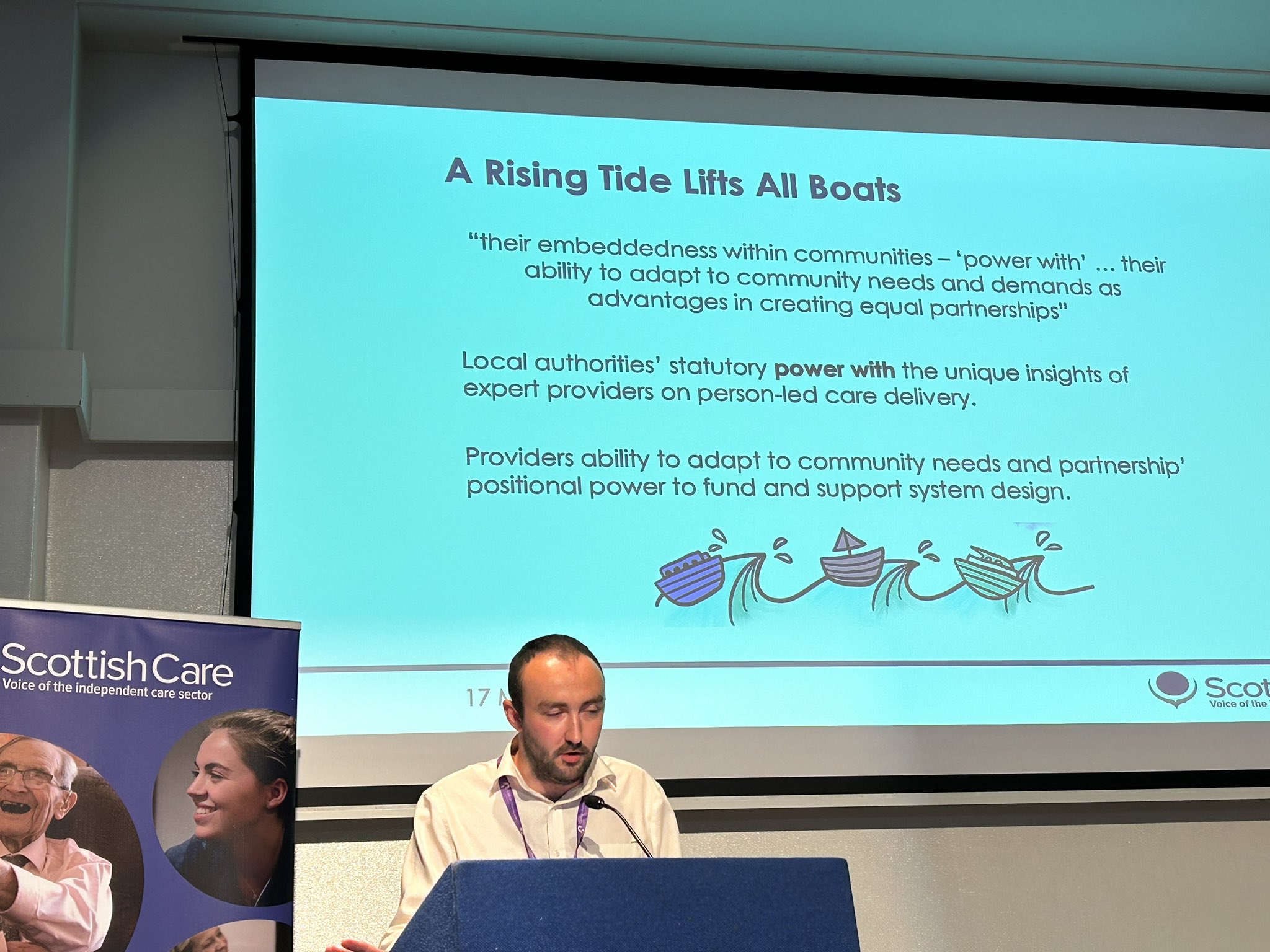
Fraser Smith, Scottish Care's lead for ethical commissioning, said that rights, respect and redistribution will underpin the recommendations the organisation will soon make to ministers to inform their next steps for ethical commissioning.
He said that Scottish Care members have reported feeling powerless when negotiating care packages in a system that currently prioritises cost savings over individuals and providers:
“As we move towards policy recommendations, we'll be considering the role of statutory requirements to maintain a competitive element, but not one that is solely based on finances, instead based on express wishes of the service user.
“So adjacent policies are required to rebalance the market. It’s a market failure.
“Scottish Care wants to advocate towards a bottom-up approach for funding negotiations, where people are empowered, providers are empowered – and service users – to use their skills and knowledge to justify their care packages.”
He added that Scottish Care will work with the government to support upskilling across the sector – from commissioners to providers – to ensure that when people engage with commissioning, it is with “the strongest knowledge and expertise” of their local area and service-users.
It comes after Scottish Care revealed hundreds of thousands of pounds are owed to care providers by local authorities in late payments for care packages.
Scottish Care has warned that inadequate commissioning is jeopardising the future of the sector in Scotland, and represents the long-term ‘undervaluation’ of social care.
Meanwhile, a myth-busting report from Scottish Care has recognised the potential of ethical commissioning as a means to address this crisis in sustainability by establishing a ‘more collaborative and participative framework’ for adult social care procurement.
The Scottish government has said that ethical commissioning will be a ‘cornerstone’ of the National Care Service, to support the standardisation and implementation of fair work in the sector.
However, many say that progress on ethical procurement has been too slow – for years the case for an overhaul of the commissioning process has been made by sector experts, while Professor Feeley, who led the adult social care review, argued just last month that many core tenants could be put in place now.
Read more: Care services at risk from delayed payments; Carers facing full force of health and care crisis; Feeley: NCS still an opportunity for transformation; Self-directed support organisations boosted;
Sign up to our bulletin for key health & social care updates straight to your inbox and you can follow healthandcare.scot on Google News. Tags: Home Care; Scottish Government; Social Care. |