|
Parliament urged to recognise deafblindness |
Related newsSocial care wage settlement branded ‘derisory’ New social care minister appointed Call for ‘urgent’ review of ADHD and autism services A timeline of Scotland’s National Care Service ALLIANCE: Third sector can’t be taken for granted Government outlaws assisting self-harm Scientists to help cut NHS medical device waste Edinburgh IJB faces judicial review over cuts Scotland’s new Chief Nurse appointed Urgent plea to safeguard advocacy amid local cuts New gene study offers arthritis treatment insights New Edinburgh hub set to transform global healthcare 
|
|
|
||
|
||
|
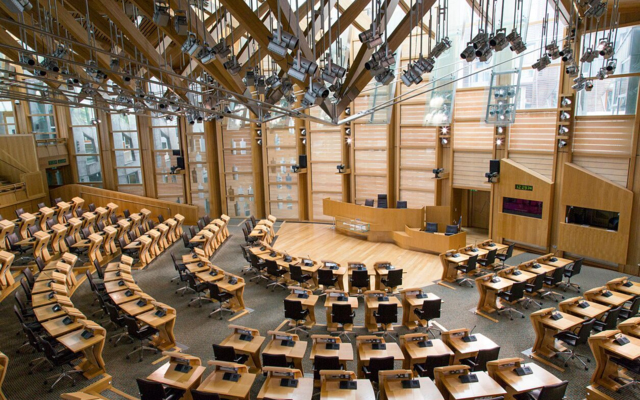
A call to formally recognise deafblindness as a distinct disability has made in the Scottish parliament.
Deafblind Scotland and the Scottish parliament’s Cross-Party Group on Deafness are gathering support for Scotland to adopt a formal definition of deafblindness.
A formal definition, they say, will make a meaningful difference to thousands of people in Scotland who currently fall into gaps in the current system.
Deafblindness is a combined vision and hearing impairment of such severity that it is hard for the impaired senses to compensate for each other.
Rona Mackay MSP led a debate in the parliament yesterday on a proposed definition of deafblindness.
She said she was delighted to have a chance to put forward the motion:
“It is a crucial step towards identifying, diagnosing and supporting people with dual sensory loss.
“Under the leadership of CEO Isabella Goldie, the inspirational team at Deafblind Scotland whose state-of-the-art HQ is based at Lenzie in my constituency, are doing so much to make life better for people with dual sensory impairment.
“I applaud Deafblind Scotland, its members, staff and volunteers, for working to ensure that lived experience plays an integral part in informing policy.”
More than 30,000 people are thought to live with the deafblindness in Scotland, and this number is set to rise in line with an ageing population.
Unlike other parts of the UK and many European countries, Scotland does not currently recognise deafblindness as a distinct disability.
Responding on behalf of the government, Scotland’s Minister for Social Care, Mental Wellbeing and Sport, Maree Todd said she wants to explore the issues raised in the debate with Deafblind Scotland.
She told parliament that she is “keen” to better understand where the definition has been adopted across the UK and what impact this has had, adding:
“I recognise how important formal recognition is to the community and I am keen to work with it to resolve the many challenges that I am certain its members face.
“Our focus is on listening to what disabled people have told us about the challenges and obstacles they face, and on finding solutions that address those challenges. I will carefully consider all I have heard today, and I remain committed to playing my part in taking forward this important work.”
A crucial step
Julie Ferguson, a teacher in Orkney who lives with deafblindness, earlier told healthandcare.scot that adopting this definition in Scotland will work to reduce isolation and increase life satisfaction for so many:
“This work is very important to me because I’ve experienced how essential it is for deafblind people to receive specific support.
“I grew up as a deaf person but I started losing my eyesight in my late teens. Suddenly I couldn’t use my eyesight to help me manage my deafness and when I was given advice for my sight loss, the advice relied on me being able to hear well.
“I felt like I was on my own, trying to learn how to cope, work, and lead a fulfilling life.”
Deafblind Scotland says incorporating a formal definition of deafblindness is a crucial step toward the earliest recognition and diagnosis of dual sensory loss, which will make it possible for people to gain new skills and tactile languages before the condition progresses.
Dr Hannah Tweed, the Scottish Sensory Hub Manager at the ALLIANCE, told healthandcare.scot that the recognition of the definition could be a key moment for Scotland:
“The ALLIANCE has long supported the need to recognise Deafblindness as a distinct disability.
“This parliamentary debate is a welcome opportunity to highlight the human rights of Deafblind people – who are too often left out of systems design and planning, with insufficient sensory care and support.”
Read more: UN told rights of disabled people in ‘crisis'; Adult disability review chair appointed; Government announces more support for disabled kids; Glasgow project makes research accessible to all; Scotland prioritises neuro-inclusion, says government; Holyrood committee fails to back Transitions Bill
Sign up to our bulletin for key health & social care updates straight to your inbox and you can follow healthandcare.scot on Google News. |
