|
Opinion: Unmasking the problem |
Related newsRemoval of mask wearing ‘dangerous’ Scotland’s third sector calls for health partnership Long COVID putting Scots at risk of poverty Scots kidney disease patients urge politicians to act COVID jags end for staff and chronically ill Holyrood hears calls for more inclusive communication Scientists to help cut NHS medical device waste Edinburgh IJB faces judicial review over cuts Scotland’s new Chief Nurse appointed Urgent plea to safeguard advocacy amid local cuts New gene study offers arthritis treatment insights New Edinburgh hub set to transform global healthcare 
|
|
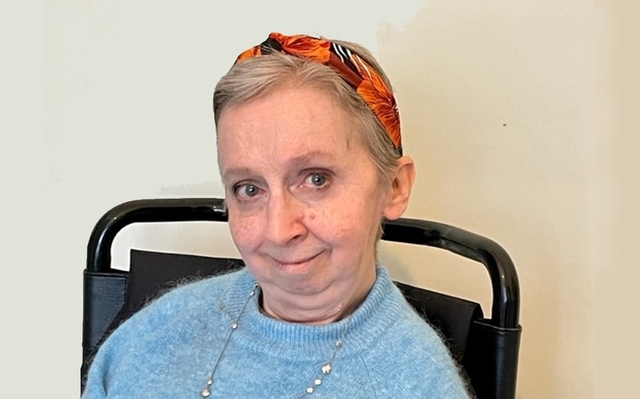
Image Credit: © Feena Mckinnell
Dr Sally Witcher.
|
||
|
||
|
Masks in health and social care across Scotland are no longer required, following guidance issued last month by the Scottish government.
Dr Sally Witcher, with a career in equalities and inclusion spanning senior roles in third and public sectors and founder of new social enterprise ‘Inclusive New Normal’, writes in a personal capacity as a disabled person with high-clinical risk from COVID-19.
Here, she argues that a failure to learn lessons during the pandemic has left healthcare workers ill-equipped to control airborne infections and people still at clinical risk who must use services in a very difficult situation.
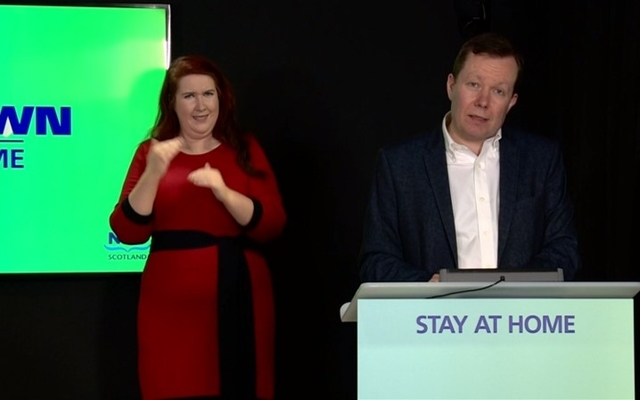
National Clinical Director Jason Leitch is not known for his poor communication skills but I’d like to think that when he proclaimed that the easing of facemask rules in health and social care settings was a ‘good thing’, he didn’t understand his words would be received by some as salt in the wound.
In the letter to health and social care leaders, on the withdrawal of extended guidance on use of face masks, amidst assertions as to why now was the right time, a particular paragraph leapt out:
‘In practice, for social care settings, this will mean that the element of choice to wear a mask outwith when it is recommended in the NIPCM [National Infection Prevention and Control Manual]/ CH [Care Home] NIPCM will no longer apply. Personal Protective Equipment (PPE) including face mask use should be based on clinical need and risk assessment as per the NIPCM and CHIPCM.”
Is choosing to wear a mask to protect yourself and others now an act of rebellious defiance against authority? Once urged to wear masks ‘to protect the vulnerable’, do people now have to justify why ‘the vulnerable’ should be protected?
It wasn’t just clinically vulnerable people who reacted with concern. Scottish Care issued a statement confirming:
“…Our members will continue to exercise and enable personal choice, allowing staff, families, residents and those supported in their own homes to wear masks if they should wish.”
It was unclear what all this meant for visitors and residents, or for choice to wear masks in healthcare settings; whether the problem was the policy or its communication.
Yet it is critically important to get both right, for people needing and working in care settings and for service sustainability. It's also vital to incorporate valuable learning over recent years. The Scottish government’s press release headline “Return to pre-pandemic advice for health and social care” did not bode well.
Looking for good guidance
With some trepidation, I set out to explore the all-important National Infection Prevention and Control Manuals that care professionals are told to follow.
There is overwhelming evidence that COVID spreads via tiny airborne aerosols, breathed out by infected people, and that can include if asymptomatic and vaccinated. They hang in the air like invisible smoke. The worse the ventilation, the smaller the space, the more people in it, the greater the infection risk.
I don’t know about you, but when I’m in a crowded, stuffy room my first thought is not “where’s the hand-sanitiser?” nor is it “must wipe down all the surfaces.” Those are important for mitigating risk from infections spread via heavier droplets or contact. To prevent and control infection transmitted via smoke-like aerosols, a key thing to do is clear the air.
A chapter titled “Infection control in the built environment and decontamination” looked promising, but was “in the early stage of development”. As it stands, it is a “repository for evidence and tools”.. Anything on decontaminating the air seems buried so deep that only the very determined would ever disinter it. Neither was there anything under “Safe Management of the Care Environment”. I finally found the following in 3.7.6 of Chapter 3 on outbreaks (and something on page 4 of Appendix 18):
“Learning from the COVID-19 pandemic to date has highlighted the risk of COVID-19 transmission associated with closed environments that have poor ventilation. It is important to consider best practice on ventilation.”
Indeed, it is – to help prevent an outbreak happening in the first place! England now has guidance on the use of HEPA air filters in healthcare settings. Yet unusually, on this occasion Scotland doesn’t seem to be following England’s lead.
Eventually, via the A-Z of Pathogens, I tracked down Appendix 19: Covid Pandemic IPC Controls for Health and Social Care Settings apparently now combining the appendices formerly known (and still listed there) as 21 and 22. There’s something vague on avoiding overcrowding but not clean air.
Along with clearing the smoke, you try not to breathe it in. At least there’s no dispute that well-fitting FFP3 respiratory masks are needed, not just Fluid Resistant Surgical Masks, where it concerns airborne aerosols, although the focus is on aerosol generating procedures.
Regarding infection, asymptomatic testing has been largely abandoned and screening questions concern identification of symptoms, despite the NIPCM stating: ‘The infectious period begins around 2 days before symptom onset to 10 days after.’
The letter asserts that the wearing of facemasks can create communication barriers.
Happily, the NIPCM says transparent face masks may be used to aid communication, if they conform to UK Government Department of Health guidance – guidance which you’ll discover was withdrawn on 3 March 2023 “because it’s out of date”.
I could go on. I did. I found more dead-ends and misdirection. I gave up. As, I strongly suspect, will busy care professionals.
Understanding risk
Care professionals completing the Public Health Scotland risk tool as directed won’t get far without already understanding the risks, as all it basically asks is ‘what is the task, what are the hazards and what are you doing about them?’
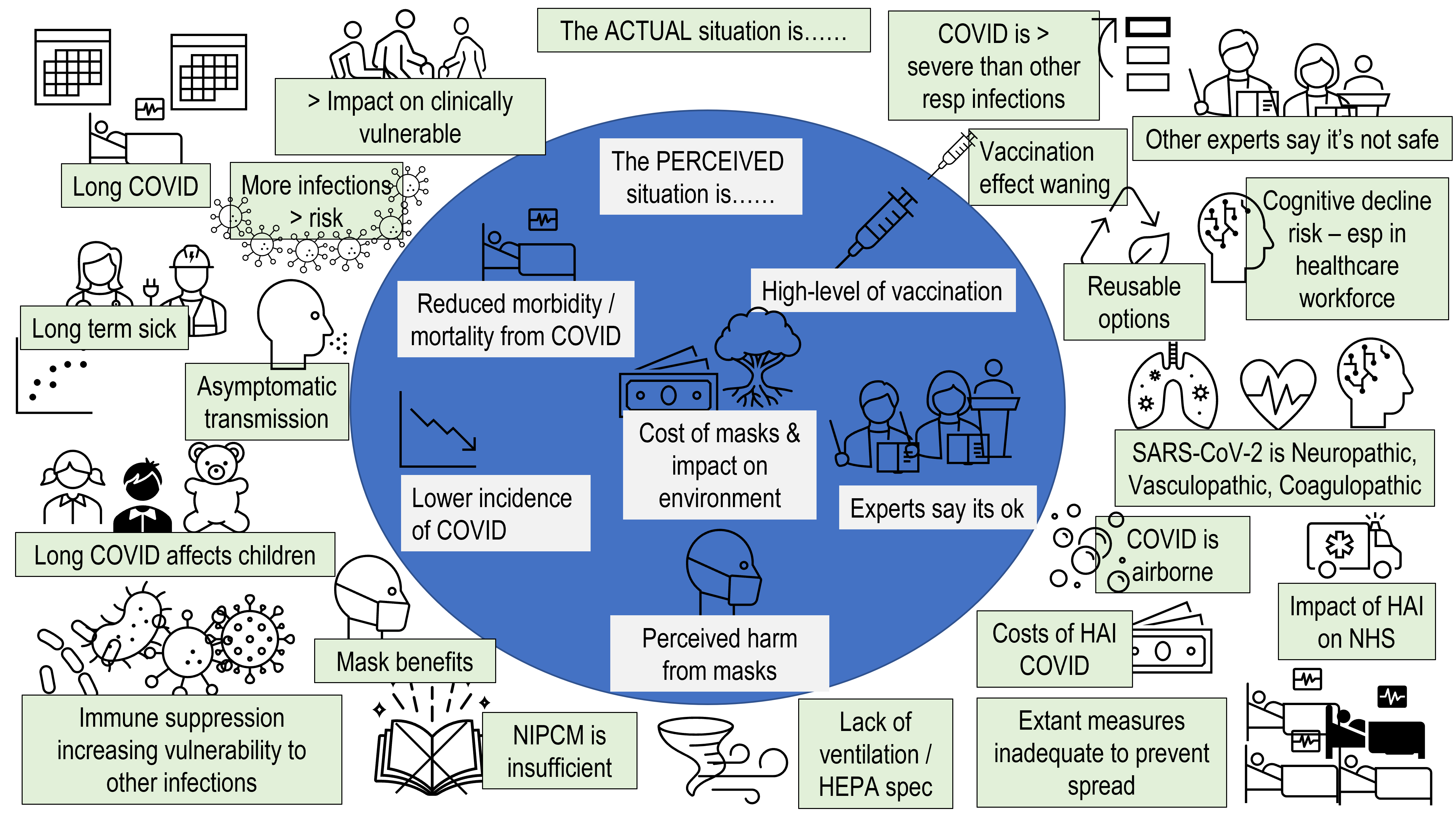
So if, like the Scottish government, you believe that vaccination has largely neutralised clinical risk, you may not even bother to risk assess. However, you would if you knew that vaccine protection wanes after a few months and often needs updating to protect against new variants. You might join the dots to the fact that most people are ineligible for boosters, those recognised as having high underlying clinical risk don’t get them often enough and for others aged 5-49 the chance to get vaccinated ends on 30 June 2023.
You might not miss the fact that acute infection isn’t the only adverse impact of COVID infection, with 1 in 10 infections leading to long COVID, rising to 20% with reinfection, and evidence showing COVID doesn’t just affect the lungs. It’s a disease of the blood vessels, damages the brain, fertility, causes diabetes in children; the list goes on. Small wonder there are high levels of sickness absence among care professionals and they top the long COVID league table.
As Evonne Curran, recently retired Doctor of Nursing specialising in Infection Prevention and Control for over 30 years, sums up:
“The letter mainly assesses risk based on the reduced incidence, morbidity, and mortality of COVID post vaccination yet omits mention of Long COVID; the incidence of which increases with the number of infections acquired. Also, Long COVID significantly impacts the workforce. Likewise, that SARS-CoV-2 is considered vasculopathic, neuropathic and coagulopathic is unmentioned. Nosocomial [originating in hospital] transmission was around 30% prior to data ceasing – with a higher mortality than community acquired COVID. Finally, there is no specific consideration of the higher risk to clinically vulnerable people.”
Hostile environments
According to Lara Wong, founder of Clinically Vulnerable Families:
“Clinically Vulnerable people are finding accessing safe healthcare incredibly challenging now masks are no longer required…Our polling data from October 2022 revealed that people were already struggling, 91% of Clinically Vulnerable people either delaying or cancelling medical appointments due to the risks posed by COVID.
“Even more distressing, is the growing trend of some healthcare professionals to discourage us from wearing masks, even the most vulnerable and severely immunosuppressed individuals, frequently telling us “You don’t need that now”.”
This is happening in a wider context of antagonism towards mask-wearers, with examples abounding on social media:
“I was shouted at and called a sheep by two middle aged couples in town… it didn’t help that we’d gone for a stroll to cheer me up after chemo. I had a nurse tut and make a nasty comment about my mask and hospitable receptionist say she couldn’t hear me in “that stupid mask”.” Juliet
Lara Wong added that, just under half of those in another recent UK poll reported having been challenged or verbally abused simply for wearing masks since ‘Freedom Day’, adding:
“Thankfully it is rarely physical, but we find that we are regularly shouted at, spat at and deliberately coughed on.”
That is what hate crime looks like.
Ignorance isn’t bliss
Professor Leitch is correct: “Everyone is fatigued with a global pandemic”, begging the question why governments ensure it continues by not taking the preventative action they could.
How can anyone know if “the pandemic is in a calmer phase” or “remain vigilant” when testing and data collection has been largely dismantled?
But we do know this pandemic comes in waves and waves can go up as well as down.
For all these extremely good reasons, clinically vulnerable people do not accept that exceptional risks no longer exist, and the growing number with long COVID wish they didn’t prove that they do.
It's not that “Wearing a mask outwith times where there is a clinical need can create a false sense of security”. Instead, it’s that not wearing one creates justifiable insecurity in places where everyone most needs to feel secure: care settings.
This has left people further disempowered to stop others subjecting them to risk, and care staff reliant on shockingly poor manuals.
Yet endangering others is an issue for equality, human rights, health and safety, and professional standards. These are surely not matters for personal choice. Clinically vulnerable people are being placed under intolerable strain, as are workforces and services.
And none of this, Jason Leitch, is a good thing.
With thanks to Giulia Villanucci for research support.
The views of columnists and people who write other guest insights articles are their own.
Read more from Dr Sally Witcher: Time to end COVID's Project Ignorance; Welcome to the new normal?; Desperately seeking COVID sense; An inclusive new normal
Email:Witcher.Work@outlook.com Twitter: @SalWitcher #InclusiveNewNormal |