|
Adopting innovation can be ‘Once for Scotland’ |
Related newsGovernment boosts health innovation funding Digital health: This is the moment Scotland at the table with UN healthy air commission AI for lung cancer care to help tackle “hidden killer” Chief Medical Officer: ‘Critical connections’ priority How data insights will help deliver NHS reform 
|
|
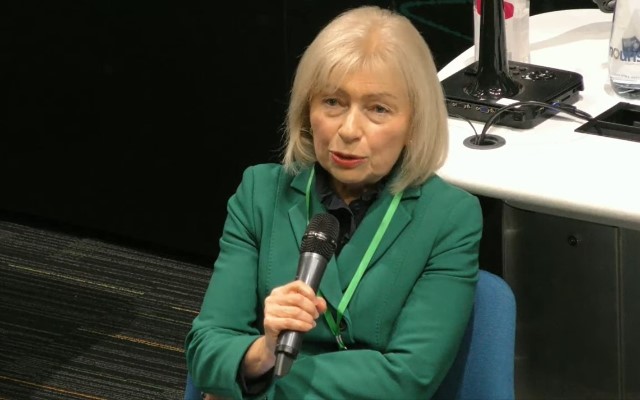
Image: Scotsman Conference/National World Events
Chief Scientist for Health, Professor Dame Anna Dominiczak
|
||
|
||
|
Scotland’s Chief Scientist for health says the NHS can and will adopt good ideas and improved treatments across the whole of Scotland under a programme launched this year – benefiting patients and a triple helix of the NHS, academia and industry.
Regius Professor of Medicine at the University of Glasgow Dame Anna Dominiczak told the Scotsman Life Sciences conference that a single pathway where innovation is assessed and then introduced across all of the NHS in Scotland will be much easier to deliver than a similar programme in England where the NHS is governed by hundreds of trusts, networks and groups.
The conference later heard from Peter Ellingworth, the head of the leading industry association for health technology that, without some level of backing from the NHS in Scotland, it can be tough for Scottish companies to achieve their export ambitions.
Dame Anna said the most important first step is to come up with solutions to problems the NHS is trying to solve:
“We talk to chief executives of our territorial health experts, we talk all the time, because you can't adopt something that people don't want to adopt. So that voice of chief executives, medical directors, people from territorial health experts, is absolutely key.
“And the hope is to reach quickly, in months not years, that final value case delivery plan, and eventually national adoption, Once for Scotland – not a little different in the west because west thinks it does it better than the east – it must be very, very similar.”
Dame Anna presented three innovations that are being assessed under the ANIA accelerated national innovation adoption pathway that she hopes can be taken on board across Scotland.
The first is a scheme to roll out a national digital approach to dermatology, using smartphones to submit images of skin lesions for review by dermatologists. She said thishas the potential to save 7 in ten people from having to travel for a face to face appointment, minimising this common barrier to accessing health services.
A second innovation is to make a step-change in the adoption of a ‘closed loop’ system for people with Type 1 diabetes to help them control their insulin levels effectively.
As with the digital dermatology programme, systems that interlink people’s continuous glucose monitoring ‘patch’ with their glucose pump, are in routine use across many areas. Dame Anna said it ‘pained’ her that this closed loop wasn’t available everywhere, particularly when children and young people can benefit from it most.
The third programme is the use of simple genetic tests to establish whether a patient is likely to have a bad reaction to a medicine before they are prescribed it. Dame Anna said this area, utilising pharmacogenomics, will benefit both patients and NHS finances:
“In silico analysis [with computer modelling] done in Greater Glasgow and Clyde health board through The Living Laboratory for Precision Medicine, showed enormous savings in millions just for one health board. Imagine that for all of Scotland.”
Dame Anna was asked what, in practical terms, she meant by a Once for Scotland approach:
“I think Once for Scotland means that, once the innovation has been prioritised and gone through all the safety steps and the [NHS and Scottish government] Innovation Design Authority, and agreed with the territorial health boards, it will be adopted in all 14 health boards as identically as possible, provided the digital, IT and other infrastructure is ready.”
Yesterday an Export Plan for Scotland's Life Sciences Sector was published by the Scottish Government's Directorate for International Trade and Investment, alongside the Life Sciences Scotland Industry Leadership Group and the enterprise agency Scottish Development International (SDI).
The plan includes a commitment to support smaller Scottish companies and university spin-outs to identify and research foreign export markets and ensure their technology, pharmaceutical, digital or animal health products are able to get local regulatory approval.
The plan identifies the USA as the priority market for pharma services, medical technology and digital health; with Asia, the Middle East and Africa described as ‘exciting future markets’ for Scotland's medical technology and digital health companies.
Speaking at the conference, the head of the biggest HealthTech industry body, Peter Ellingworth, CEO of the Association of British HealthTech Industries (ABHI), said seven years of visits alongside Scottish and other UK teams to the USA had shown the clear benefit of having the NHS at your side:
“When we take companies to the US, we also take the NHS with us. So that's chief executives, clinical leaders, chief innovation officers… Because when we go out, we're going to meet the health systems. Those health systems are dealing with the same problems as health systems in Scotland. And they'd like to have a peer to peer relationship. Clinicians work in a global context, we need to get the health systems working that way, too.”
However, Mr Ellingworth said NHS Scotland’s adoption of innovative ideas is key to those ideas then being sold abroad:
“I would say, I think you can find it really difficult to take something abroad if a part of your home market does not use that technology, because it immediately raised the question: ‘So Peter, you've come from Glasgow, why isn't Glasgow using your technology?’ It raises an unnecessary question.
“So, it doesn't have to be adopted right across Scotland, but find a partnership, get some evidence and then go.”
Read more: NHS launches good ideas accelerator; HealthTech losing faith in UK market?; Care Technologists pilot expands
Sign up to our bulletin for key health & social care updates straight to your inbox and you can follow healthandcare.scot on Google News. |
