|
Insight: Early childhood development inequalities |
Related newsHighland children hit by poverty and geography COVID jags end for staff and chronically ill Children’s doctor new Chief Scientific Adviser Charting Scotland’s future health and hospital demand Regulation key to reducing obesity Concern as COVID protections reduced New health & social care governance initiative EU staff qualifications & registrations confirmed Westminster committee launches drug misuse inquiry "Poverty remains a problem" for children in Scotland Postcode lottery persists in dementia support COSLA & Government integration report 
|
|
Image Credit: © Jelleke Vanoote / Unsplash
|
||
|
||
|
Almost one in four children living in Scotland’s most deprived areas have a developmental concern, as Scotland’s public health body reveals continued healthcare inequalities in children across Scotland.
The pandemic ushered in a new way to approaching early childhood development reviews, but despite high coverage of Scotland’s children receiving their review, this report indicates that more work needs to be done reduce these inequalities.
Public Health Scotland (PHS) have also found “substantial variation” across NHS boards in children’s development, with as many as one in five 13–15-month year olds having at least one developmental concern in Dumfries & Galloway.
In a statistical report covering the period from April 2020 to March 2021, Scotland’s national health public body outlines adaptations made to child reviews as a result of the pandemic. At the beginning, this meant phone and video conference reviews only, with a phased return to in-person reviews beginning in June.
Across three key early development stages before the age of five, involving 137,116 child health reviews, PHS reports “persistent inequalities” in the proportion of children who are found to have a developmental concern, particularly in the later reviews.” The developmental inequalities span deprivation gradients, ethnicity, and whether the child is considered a ‘looked-after’ child.
In its investigation, PHS reported a deprivation gradient – those in the most deprived areas in Scotland are most likely to return concerns in development compared to those in the least deprived area in every type of review. For 2020/21, 11% of children from the most deprived areas had a concern recorded compared to 7% for the most affluent areas at the 13-15-month review.
Health inequality worsens at 27-30 months, with more than twice the number of children living in the most deprived area reporting a development concern compared to the least deprived areas. Almost one in four children in Scotland’s most deprived areas had a concern recorded, compared to 9% in the least deprived areas.
For the 13–15-month review stage, the most prominent concerns were reported for gross motor and speech, language and communication skills.
For 27-30 months, the largest area of concern is speech language and communication, with the second most common being emotional and behavioural concerns. Here, was an average of 16% of children recorded to have at least one developmental concern, with the lowest (3%) again in Grampian and peaking at 20% in NHS Greater Glasgow and Clyde.
Early developmental inequalities by deprivation have been observed since at least 2013/14 within 27–30-month reviews. Recently, healthandcare.scot spoke with Professor Steve Turner from University of Aberdeen, whose research showed that health poverty impacts foetuses, as early as 20 weeks into pregnancy. Claire Sweeney, Director for Place and Wellbeing at PHS, said:
“We know that a lot of this starts way before the child is born and we need to look at everything that can be done, particularly when pregnant and struggling with low income.”
In early childhood development, PHS also found persistent health inequalities across ethnicity, relating to population by area and reflecting disadvantages experienced by ethnic minorities in Scotland.
Inequalities are again most significant at the 27–30-month review, with 15% of White Scottish children with a concern noted compared to 19% of Asian children and 21% of Black, Caribbean or African children in 2020/21. At this review, the lowest proportion to have a development concern recorded was 11% for White Other British children in Scotland.
These inequalities are likely largely a result of wider racial and cultural inequality, as well as the way assessments are carried out. PHS says:
“These ethnic inequalities in early child development are likely to reflect the wider disadvantages experienced by some ethnic minority groups, and possibly also variation in how reliable developmental reviews are for children from different cultural and language backgrounds.”
High levels of developmental inequality were also found among children under the care of local authorities. PHS reports that 31% of ‘looked after’ children had a concern recorded at 27-30 months, compared to just 15% of children categorised as ‘non-looked after’.
Impact of the pandemic on review process
Despite needing to adapt to virtual and phone appointments, the number of children who received their review across the health boards in Scotland was not severely impacted by the pandemic over this period.
PHS reported that the proportion of children who were reviewed with respect to those eligible for review was high, stating that “coverage has been maintained or increased for each review”, with data quality also remaining high.
There were 45,013 children who received their 13–15-month review, 90% of the children eligible, increasing slightly to 91% of those eligible among 27-30 month children, with the lowest coverage was for 4-5 year olds at just 81% of children eligible.
The report recognises that although these reviews continued to high levels across Scotland, families have struggled throughout the pandemic, with challenges to meet children’s needs which could impact early development.
This period has especially affected children with additional support needs and their families, and PHS expect that their next report – due in 2023 – will provide greater insight into the impact of the pandemic on children’s development.
For guidance and support services, PHS recommends Parent Club and NHS Scotland’s Ready Steady Baby and Ready Steady Toddler as resources for parents and carers of young children.
Read more: Virtual care worsens outcome for disadvantaged mothers; Health poverty hits children halfway through pregnancy; Pandemic impact on cancer incidence in Scotland
Sign up to our bulletin for key health & social care updates straight to your inbox. Tags: Child Health; Covid-19; Public Health Scotland. |

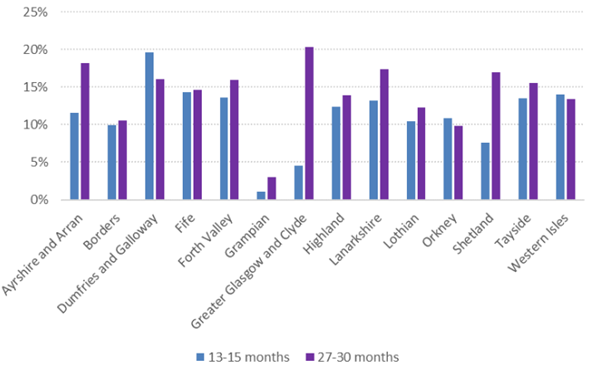 At this age, a median of 12% of children were reported as having at least one developmental concern, varying from just 1% in NHS Grampian to 20% in NHS Dumfries & Galloway.