|
Parliament united in call for care change |
Related newsCare home visits promote wellbeing FM candidates asked if they care about care Kerley: Don’t talk about a postcode lottery ‘Devastating’ scale of home care cuts revealed Plea to prioritise care in local budgets 
|
|
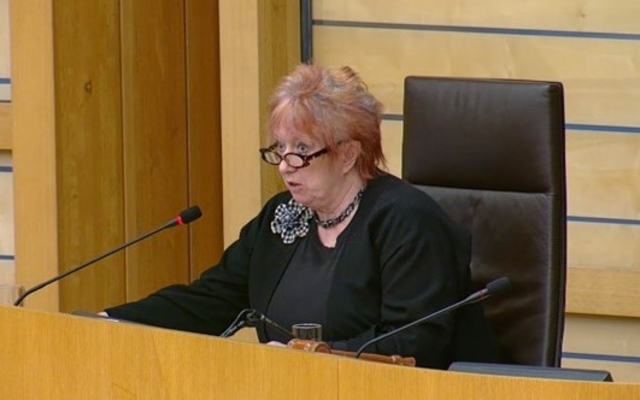
Scottish Parliament TV
Deputy Presiding Officer Christine Grahame MSP
|
||
|
||
|
Scotland’s Health Secretary has unveiled a £20m Community Living Change Fund for people needing complex care during a debate in Parliament where the SNP said it will make the creation of a National Care Service, on an equal footing with NHS Scotland, an election promise.
MSPs debating the findings of the Independent Review of Adult Social Care universally commended Scotland’s social care workforce and unpaid carers, but some questioned whether the answer really lay in creating a new centralised organisation to oversee their work.
Health Secretary Jeane Freeman used her speech to restate that she supports the Review’s recommendations, saying that it should be a priority of the next Parliament to implement these as quickly as possible – including scrapping non-residential social care charges, delivering better funding for services and improved pay and conditions to reflect ‘Fair Work’ principles.
She admitted that there was a concern amongst those who had contributed to the Review “…that this is another report of fine words and laudable sentiments that, in the end, goes nowhere because vested interests combine to make little real improvement to people’s lives, because we spend all our energy and time arguing about structures, but we fail to grasp the opportunity to deliver.”
Ms Freeman said there was action that could be taken immediately: “On the associated themes of individual autonomy and citizenship, I am pleased to announce a new Community Living Change Fund of £20m to deliver a redesign of services for people with complex needs, including intellectual disability and autism, and those who have enduring mental health problems, focusing on delivering a proper sense of home for people with complex needs including those who have encountered lengthy hospital stays or who might have been placed outside Scotland and who could, and should, be more appropriately supported closer to home.”
The Health Secretary revealed that the process of reviewing the National Care Home Contract would involve union representatives for the first time and embed changes to support the fair work agenda. She said she accepted that considerable investment was needed, but added:
“Many may be tempted to ask how we can afford at this? But I think for me, for the [Review] report authors and many across this chamber, the answer has to be: how can Scotland now not afford to?”
Scottish Labour called for equal recognition of both paid and unpaid carers, and repeated its call for family caregivers to be seen as an essential part of the teams delivering safe care in care homes.
Health and social care spokesperson, Monica Lennon, said that the principles of fair work had to be seen “as a floor not a ceiling”.
“The opportunity posed by the creation of a National Care Service offers the chance to create jobs and improve pay for social care workers.
“The Scottish Labour amendment reflects our support for £15 an hour for social care workers. This workforce is made up primarily of women. It is not unskilled, and the workforce deserves to be properly recognised for its labour.”
And, Ms Lennon said, care should always be about people not profits: “As it stands, too much money has leaked out of care to offshore tax havens.
“The [Review] report criticises the market-based system but then largely recommends leaving the market-based system in place with a bit more regulation. That is not Scottish Labour’s position.”
This was a theme picked up by Scottish Green Party communities spokesperson, John Finnie, who said there was much in the recommendations from the Review team that his party could support, including the call for a clear vision of the future of adult social care:
“Vision is good. Passion is good. Empathy is much better and I’m not sure that that has ever featured as a qualification in any procurement process.
“Private companies, I don’t think have a role in this at all.
“But it is important that we discuss the recommendations in a positive and constructive manner. We must recognise that posturing sometimes puts people off and we want there to be public support for what goes ahead.”
Scottish Conservative health spokesperson, Donald Cameron, said the party has long agreed that health and social care need to be seen as integral parts of the same system, and he accepted that this implies parity between health and care.
But Mr Cameron said he was concerned that any new system had to be able to allow for local variation, flexibility and accountability, with social care providers involved in its design:
“The Scottish Conservatives believe that the creation of a National Care Service in Scotland could assist in achieving higher quality care, as well as improving the employment conditions of care workers. But the SNP government must provide details of how this will work in practice.
“Such a service must avoid becoming a centralised, monolithic structure. It must ensure that individual people are at its heart.
“This government has an unenviable record when it comes to centralisation and there are patent dangers if this were to become another act of amassing power and control in central government.
"It is imperative that any change to the delivery of social care should focus on such care being person-centred.”
Scottish Liberal Democrat health spokesperson Alex Cole Hamilton said his party would always support efforts to "stretch higher in the quality of support" offered to all carers, agreeing that the establishment of national entitlements for pay and conditions could help make caring “a profession of choice”.
“People should have the security of nationally prescribed entitlements and an expectation of a gold standard in provision. We need a step change in how we do this, and that change is key to improving quality of life for social care users.”
Mr Cole Hamilton was also concerned about centralisation:
“The fact is that we have tried and failed to reform social care through policy before. So this root and branch review is both timely and necessary.
“However, the suggested move to a national governance structure causes us significant concern. To our minds the delivery of health and social care is not suited to central control. That is why we rightly have 14 territorial NHS boards and even more integrated joint boards.
“Subsidiarity must apply here, because Scotland is too diverse for a one size fits all approach to the delivery of care governed from the centre.”
He added: “Implementation should begin now through existing systems and should not be delayed by the need to create a cumbersome overarching organisation to deliver it. Above all, the social care workforce should be respected for the work they do.”
The Convener of Holyrood's Health and Sport Committee, Lewis Macdonald, spoke of the insights that he and his colleagues had been given by witnesses during their two-year inquiry into social care:
“Crucially they told us that the voices of carers and care users were not being heard or being listened for.
“Users and carers were even clear with us that they did not feel that they were being listened to or valued.
“Yet, throughout our inquiry, we learned that care experienced individuals and front-line staff had invaluable insights from which decision-makers could learn a great deal,” he said.
“We believe there must be a national conversation about the future of social care and support in Scotland, with those giving and receiving care – their voices at the heart of that conversation.”
Sign up to our bulletin for key health & social care updates straight to your inbox. |
