|
GPs could be “overwhelmed” this winter |
Related newsChief Medical Officer: ‘Critical connections’ priority Insight: How covid changed the way we communicate Community care ‘overlooked’ in pre-pandemic planning Edinburgh GP to chair BMA in Scotland RCGP: Future of general practice model at risk Community Link Workers reducing stress on GPs 
|
|
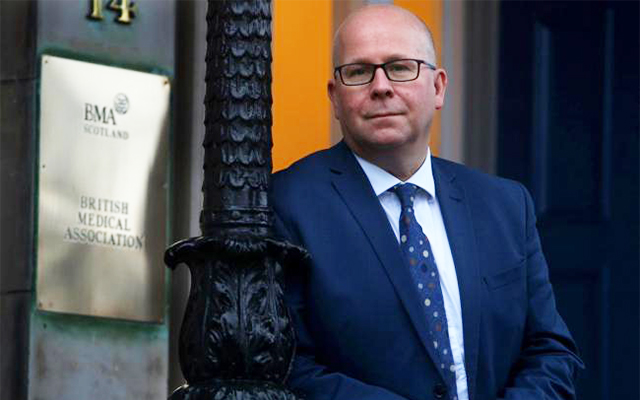
Image by Gordon Terris/Herald and Times Group
Dr Andrew Buist
|
||
|
||
|
In his latest blog, Chair of the BMA’s Scottish GP Committee Dr Andrew Buist issues a stark warning that family doctors are busier than ever – and services could be “overwhelmed” in winter:
"General Practice is under huge pressure. Across Scotland, surgeries have remained open for business through both the first wave of Covid and again through the current rise in cases – even as the way we work has transformed overnight.
"This is no small feat. Beyond this, GPs have shouldered almost all of the burden of staffing the Covid community clinical assessment centres and remote triage hubs which have been crucial in keeping surgeries and other parts of the NHS Covid free wherever possible.
We as GPs have been the protective ring around hospitals, and I have never been prouder of the profession.
"But of course, this has taken its toll. The sheer mental burden of the challenges we face to still do the very best we can for patients, while worrying about the risks to ourselves and our families is exhausting.
"Equally, while the proportion of work that is done virtually or by telephone has risen – it is important to recognise this in some ways feels more relentless than how we used to work not least because we’ve effectively moved to same day working, that is no waiting list. First, it’s a huge change, which of course always brings stress. And then, not always being able to see or interact with a patient can make consultations more challenging and lengthier in a whole number of ways – from the inability to pick up body language to the fear of missing something crucial.
"In this context, I know this second wave will be causing huge concern for GPs. Our workload has climbed consistently and, in some cases, exponentially as the first national lockdown eased and we moved towards less strict and now locally focussed arrangements.
"At the same time, as blanket strict lockdown measures were eased, so many members of the public perhaps expected GP practices would equally simply go back to normal – something which just isn’t possible while Covid remains in our communities.
"As a result, this has meant surges in calls to surgeries. This may vary somewhat between surgeries – but many, many GPs have reported to us that they and their staff are being simply inundated by demand – and are struggling to cope. We know that can sometimes unfortunately lead to staff bearing the brunt of patients’ frustrations too.
"Just some of the examples of the pressures shared with us include:
"Of course, these examples, while stark, are anecdotal snapshots and not all calls will need a GP response – but it gives just a flavour of the challenges being reported to us by GPs across much of the country. It also matches data we have seen in England about rising appointments.
"Two things are worth highlighting here. First, that this workload is not just impacting GPs, but also is hitting their practice staff hard. Receptionists, practice managers, members of multi-disciplinary teams like practice nurses are all struggling to deal with their workload. I would urge the public to please be patient with them and for the Scottish Government and politicians to be honest and open with people about just what is possible.
"Second this kind of feedback does demonstrate the need for much greater detail and data to illustrate, monitor and respond to GP workload. We are working with the SG to deliver exactly that at the moment – and looking to introduce a simple weekly practice situation report so that practice capacity is known to boards and government so that they work to better support practices – whether through the local escalation strategy or national arrangements to reduce the burden.
"Taking a wider view on this, I think we can say that this is a really tough time for GPs, at the very least. At worst, I think many of my colleagues are really being pushed to the very limit of what they are capable of and that General Practice is at risk of being overwhelmed if demand keeps rising over the course of what will be a really tough winter.
"What does that mean for the Government, politicians, health boards and the public? Well, there isn’t a cavalry coming over the hill in the form of more GPs – let’s remember we went into Covid with the Government setting out the need for another 800 GPs in Scotland.
"So, it seems we will have to plan to cope with what we have. I’ve had regular discussion with Jeane Freeman throughout Covid and I have been emphasising the pressure GPs are under in these conversations in particular over recent weeks.
"I have also made clear in these conversations that any steps to change how patients access emergency care must be exceptionally carefully handled and well communicated to ensure they don’t simply lead to large shifts of demand to general practice – which is something I know many GPs fear will happen. Indeed, I share a lot of that concern.
"There have also been examples recently of Government guidance possibly leading to substantial increases in time consuming, box ticking bureaucracy which would surely be better spent on helping patients.
"We are clear there must be better solutions for things like fit notes for people whose workplaces are considered not safe for them to attend, which still help people get the verification they need without eating into precious GP time.
"Public communication is also of key importance. All politicians and health leaders need to be open, honest and realistic about just what is possible in primary care at the moment. We are open for business, but as I have set out – I am afraid it is far from business as usual.
"Public expectations of what GPs can do in normal times are rightly high. We are a crucial service and despite everything we are still doing everything we possibly can to care for patients. But equally I hope we can all be understanding to GPs and practice staff about the very real challenges we all face to care for people effectively while guarding against Covid.
"For example, one GP described how the building their surgery was in placed severe limitations on what’s possible: “With the potential for 8 clinicians consulting, a waiting room that can only safely have a maximum of 4 patients and the fact that we can’t have a one way system we are having to be very careful how many patients we can have in the building at one time. This includes issues around patients who need to come to reception for other reasons – emergency scripts, hand in samples etc.”
"Many practices will be facing similar challenges. I am sure there will be people in Scotland frustrated that they, or their loved ones are struggling to access face to face contact with a GP. I don’t think reading this will assuage that, but I do hope it may help people understand the previous way of seeing a GPs is just not always possible at the moment. Where clinically required, face to face appointments will always be central to what GPs do. I know face to face appointments are rightly still happening where they are necessary and appropriate – and its right that they should be. But by necessity to reduce risk of infection we are having to rely more telephone and digital consultations. While Covid remains with us, I suspect this will continue to be the case.
"Finally, I want to finish on the wellbeing of GPs. I know just how tough it is out there on the front line. At the BMA we have support services available 24/7 and I would urge anyone who feels they need to talk to do exactly that.
"It is also vital work is done to make sure GPs do get some kind of break and a chance to recharge as we approach Christmas. They have given so much and we really risk them having nothing left to give, and exhaustion and burnout impacting on the care they can provide. I hope everyone will remember GPs are human beings too, who have a finite capacity to work flat-out. Let’s care for them and each other and we will get through this together."
Last month, Dr Buist - a GP in Blairgowrie - warned a lack of data was being gathered on how busy GPs really were as covid cases started to rise again sharply.
Supporters – If you can help support our reporting for Scotland's health and social care community, please head to our donations page.
Bulletin – Sign up for all the latest news and events. |
