|
Scientists seek carers’ help to develop robot support |
Related newsRespiratory care vision unveiled Scotland at the table with UN healthy air commission Scotland’s NHS and social care app timeline unveiled Chief Medical Officer: ‘Critical connections’ priority Community support ‘vital’ to asylum-seeking families ALLIANCE: Action needed from Scotland’s leaders 
|
|
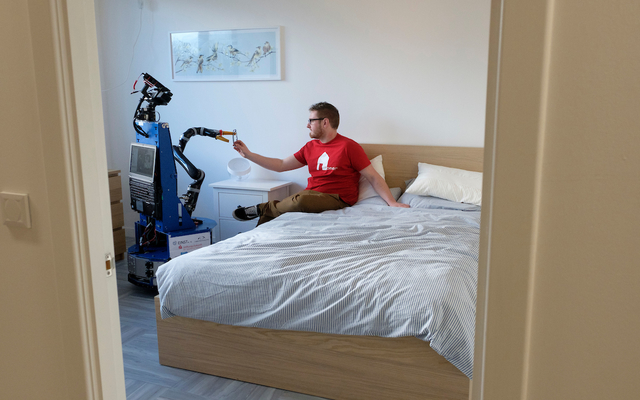
Heriot-Watt University’s Assisted Living laboratory
|
||
|
||
|
Carers are being urged to participate in a project to develop ‘smart living’ technology to support older people and those living with health conditions.
Heriot-Watt University is today launching what is believed to be the world’s first open and remote access ‘living lab’ to research and create solutions for Ambient Assisted Living (AAL) using smart devices, medical sensors and computers for healthcare monitoring.
The Coalition of Care and Support Providers in Scotland – led by Annie Gunner Logan – will play a key role by connecting its members to the project.
Organisers are also encouraging anyone working in care to take part in workshops and focus groups to help identify the most urgent challenges facing the sector.
National Service veteran David Weir, 87, who is registered blind, said he was keen to see how technology could assist him with everyday challenges.
“Measuring the right volume of liquid for medication, for example, would be invaluable as I can’t see the liquid or lines on the measuring tubes,” he said.
“At present, I can accept an incoming video call but can’t easily place one, even with the benefit of voice activation. Smart home technologies are of particular interest.
“For example, I have a digital thermostat, but I can’t read the digital display and setting the temperature on the cooker and grill is extremely difficult.”
The project, which will is part of Heriot-Watt’s National Robotarium, will initially focus on supporting key priority groups in the UK whose conditions have been compounded by covid-19 restrictions – including people with disabilities, and those in the acute stages of mental ill health.
Prior to lockdown, Mr Weir was a regular attendee at charity Scottish War Blinded’s West Lothian activity hub for veterans with sight loss, the Linburn Centre.
He said the biggest challenges over the past few months has been the lack of social contact and having to rely more on the internet.
He said: “During lockdown, shopping online has become even more important, but all websites are designed differently and navigating them, even with text-to-speech capabilities, is tough.
“If I touch the wrong area of the website for more information, I can end up lost and I can’t navigate back.
“Having the opportunity to interact with researchers in the course of their work will be really beneficial to end users like me.”
Dr Mauro Dragone, assistant professor at Heriot-Watt University, who is leading the Open AAL project, said the priority was to ensure the solutions created are practical and feasible so they could be quickly implemented “in the face of challenging social and economic conditions”:
“There is huge potential to unify efforts and provide better support to the nation’s most vulnerable at this time.
“By combining the University’s unique laboratories with expertise in the care sector, we have the opportunity to tackle the current challenges head-on, but also establish long-term and cost-effective solutions to the wider challenges faced by individuals with assisted living needs in the home.
“Successful innovation in this field is crucial to alleviate the strain on our health and social care services and enhance the resilience of our communities.”
Sign up to our bulletin sent twice a week so you don’t miss out on the latest health and social care news. |
