|
Kidney stone treatment capacity tripled in Grampian |
Related newsNHS Tayside consults on orthopaedic redesign Cardiac innovation gets public showcase Thousandth patient receives TAVI heart treatment Social robots show potential in patient support Award for “pioneering” Scots 3D bone scaffold research Scottish health research collaboration extended Aberdeen medical students join pandemic response Grampian staff re-train for covid-19 frontline Milestone in development of £223m Aberdeen facility New computer system for Grampian intensive care North-east school pupil flu vaccinations postponed Inspectors praise Dundee psychiatric unit 
|
|
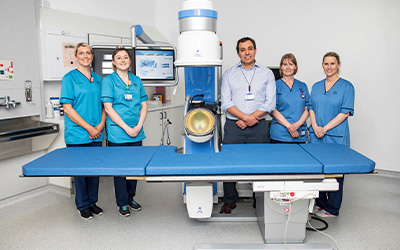
Pictured left to right: staff nurses Lynn Rankin & Jackie Reid, consultant urologist Ismail Mokadem, lithotripsy specialist radiographer Catriona MacGillivray, lithotripsy lead radiographer Laura Slater.
|
||
|
||
|
A new £400,000 device that delivers non-invasive kidney stone treatment is enabling patients in Grampian to “return faster to their normal lives”.
A permanent lithotripsy service launched in NHS Grampian has replaced a mobile service, providing improved and more effective treatment for patients with kidney stones.
Used to treat more than 170 patients in the last six months already, the new equipment means medics can treat more cases of kidney stones non-invasively, cutting waiting times and savings hours of surgeons’ time each month.
Lithotripsy is a minimally invasive treatment, where patients may require some painkillers but not an anaesthetic for a procedure that usually lasts between 20 minutes and one hour.
Side effects are “very rare” with lower risks of complication than surgery, explains urology consultant Dr Ismail Mokadem.
“The introduction of the onsite lithotripsy service has tripled our capacity to treat patients with stone disease with one of the least invasive techniques available,” he said.
“Previously, we were limited to endoscopic procedures which were performed with general anaesthetic or we relied on the visiting service which was only available every six weeks and was not as patient centred as the new on-site lithotripsy service.
“As the new service is on site, it enables us to offer emergency treatment to patients during the same admission or the latest within two weeks. This had a significant impact on emergency theatre utilisation and on readmission rates due to pain and allows patients to return faster to their normal lives.”
Prior to the launch of the service at Aberdeen Royal Infirmary clinicians relied on a touring service.
“The new service significantly reduces waiting times for other urological procedures too. As more and more patients are treated in the lithotripsy suite, this has freed more theatre time and capacity to treat other urological conditions,” added Dr Mokadem.
“We had the mobile lithotripter visiting every six weeks. There wasn’t much flexibility, patients received treatment then it could be three months before the next session.
“Now we treat the patients and we can see if the stone hasn’t responded and get them another session sooner, rather than waiting on another visit by the touring lithotripsy.
“Our latest figures show 91% success rate for cases who have completed their treatment with an excellent patient satisfaction rates on their feedback.
“It has made a huge difference and we’re so incredibly grateful to the NHS Grampian Endowment Fund for allowing us to purchase this fantastic piece of equipment.”
Sheena Lonchay, manager of the NHS Grampian endowment fund, said she was “delighted” the charity has been able to support the project, adding that the charity’s investment reflected the generosity of patients and their families in recognising the care they have received from the team.
She added: “The endowment fund exists to benefit patients in ways that otherwise wouldn’t have been possible and that is exactly what this system does.”
|
