|
Dundee celebrates part in ‘phenomenal’ cancer study |
Related newsScots patient first to join leukaemia study Scotland to open four new commercial research hubs ‘Substantial’ drop in cancer deaths Scotland can play central role in mRNA Scotland must prioritise new bladder cancer test Tayside team achieves global kidney study milestone 
|
|
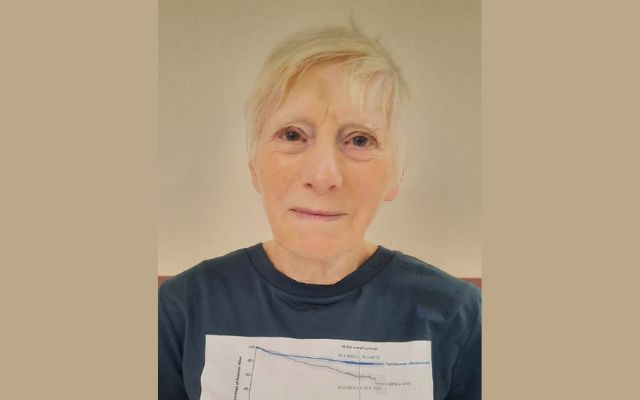
Image © NHS Research Scotland
Study participant, Catherine.
|
||
|
||
|
A major global blood cancer study success has been highlighted in a prestigious peer-reviewed journal, with Tayside expertise making a proud contribution to its findings.
The NHS Research Scotland (NRS) Cancer Network congratulated the Dundee team on their hard work in supporting this vital study.
Dr Gordon Marron, a Consultant Haematologist working at participating study site Ninewells Hospital in Dundee called the outcomes of the experimental arm of the ongoing MajesTEC-3 myeloma trial “phenomenal”.
The results were published in The New England Journal of Medicine in December – recognised as the world's leading medical journal and website – and make for a strong example of what continues to be achieved in Scotland during the same week as World Cancer Day.
This year World Cancer Day – held every year on 4 February – continued the 2025-27 theme of ‘United by Unique’ which emphasises people-centred care and the individual stories behind cancer diagnoses, encouraging global action to improve cancer prevention, detection, and treatment.
The treatment of relapsed or refractory multiple myeloma remains challenging, and while some newer treatments offer promise, “off-the-shelf and highly effective regimens are needed to fully address the needs of individual patients,” according to the MajesTEC-3 investigators.
The randomised Phase 3 study – funded by Johnson & Johnson – compared teclistamab in combination with daratumumab against standard treatments for relapsed or refractory multiple myeloma, characterised by progressive immune dysfunction.
Teclistamab is an antibody that activates a recipient's T cells, a type of white blood cell, to attack multiple myeloma cells expressing B-cell maturation antigen (BCMA), a protein found on the surface of most myeloma cells.
The published journal findings noted that the teclistamab-daratumumab antibody combination “showed deep and durable responses in heavily pretreated patients”.
It was concluded that, of the participating patients, those in the teclistamab-daratumumab group “had a significantly lower risk of disease progression or death” than those who had received standard treatments.
The estimated 36-month progression-free survival was 83.4% in the teclistamab-daratumumab group and 29.7% in the comparison group. This magnitude of Progression-Free Survival (PFS) benefit is unprecedented for a relapsed refractory myeloma trial.
Furthermore, the percentage of patients who had a complete response or better was significantly higher in the teclistamab-daratumumab group (81.8% vs. 32.1%).
Life changing
Dr Marron said:
“I’m extremely proud that our team has contributed to this study which has produced results even better than we could have hoped for”.
“The teclistamab-daratumumab immunotherapy combination represents a new standard of care option transforming how patients with multiple myeloma will be treated in the future.”
A participant in the study, Catherine said:
“This clinical trial has been life changing for me.
“Myself and my family are so grateful to Dr Gordon Marron and his team in Haematology that I was chosen to take part in the trial and for the wonderful care, kindness and thoughtfulness they have shown throughout.”
Clinical Lead of the NRS Cancer Network, Professor Jeff Evans said:
“Daratumumab-based regimens have long been considered to play a key role in advancing the treatment of multiple myeloma.
“Now, thanks to the MajesTEC-3 study, we have hugely encouraging data to suggest that its role can be taken a step further as the cornerstone of a more effective new option.
“It’s a global opportunity to improve patient outcomes and better combat the second most common blood cancer. We congratulate the Ninewells team on their hard work in supporting this vital study’s robust results.”
This article is written as part of a promotional agreement between NHS Research Scotland (NRS) and Healthcare News Scotland.
More from NHS Research Scotland: Cardiac gene therapy trial a ‘game changer’; International recognition for Dundee trials team; Research enabled innovation spotlighted; Scotland leads world first in premature baby gut trial;
Sign up to receive our bulletin for key health & social care updates straight to your inbox. Tags: Cancer; Medicines; Research & Innovation. |
