|
UK joins forces to combat antimicrobial resistance |
Related newsChief Medical Officer: ‘Critical connections’ priority Blue-green prescribing for climate and public health Scotland at the table with UN healthy air commission Pharmacy’s road to stigma-free drug dependency care NHS Scotland net zero efforts expanded Greener NHS research funding boost 
|
|

Image Credit: © Jacob Lund
|
||
|
||
|
The Scottish government has signed up to a new way of paying for antibiotics as part of a collaboration with other UK governments to combat antimicrobial resistance.
Ministers say the next five years will be a “pivotal period” in the battle to see off what they say is one of the world’s greatest threats to public health.
Working towards containing and controlling resistance to antibiotics, the Scottish government says the collaborative approach will see nations across the UK build on the first iteration of the action plan.
A central plank of reducing resistance to antibiotics is to prescribe them as rarely as possible, slowing the rate at which bacteria become resistant and render the treatment ineffective.
Under the traditional model, the costs involved in developing new medicines are recouped in sales.
The four governments are to adopt a new ‘subscription’ model for antibiotics, removing the link between sales and income to create a new incentive for investment in discovering new treatments.
Antimicrobial resistance (AMR) – where existing antibiotics no longer work to treat infection – is estimated to directly cause more than 1.2 million deaths globally and 7,600 deaths in the UK every single year - and to cost the NHS around £180m annually across the UK.
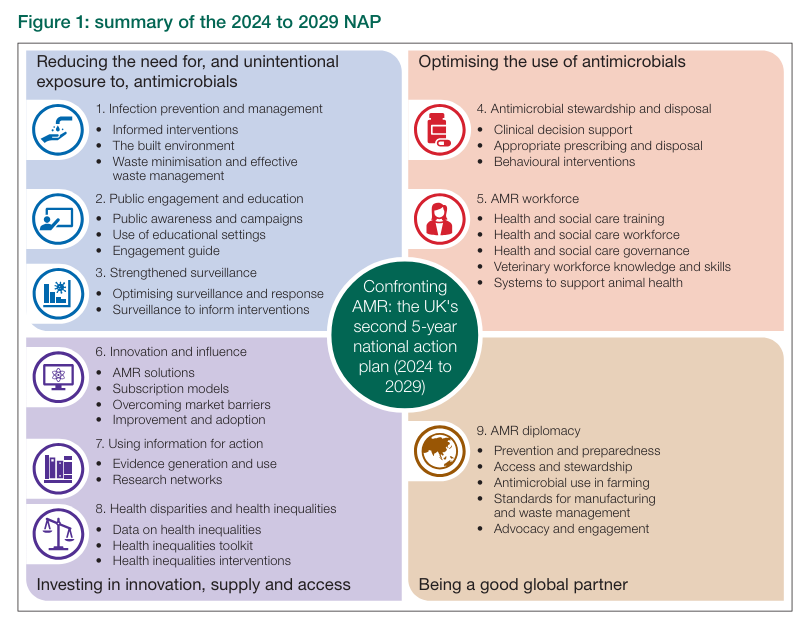
This new 2024-29 plan will see coordinated action between Scotland, Northern Ireland, England and Wales across nine strategic outcomes.
These include infection prevention, control and management, public engagement and education, innovation and influence, health disparities and inequalities, and optimising the use of antimicrobials when needed.
The plan sets out commitments for investing in innovation and working across the UK and with global partners to reduce the threat of infection across human, animal, environment and food sectors.
Scotland’s Cabinet Secretary for Health and Social Care Neil Gray said:
“The emergence of resistant infection is one of the greatest health threats of our time.
“Antimicrobial resistance is already causing people to suffer longer illnesses which are more difficult to treat, a position that will only worsen without collective action to contain it.
“This new national action plan will be crucial in our fight to control the threat of AMR.”
Climate drivers of AMR
The plan recognises the ‘linked emergencies’ of AMR and the climate crisis, with many infectious diseases being climate sensitive.
Hosting the first ever Global Sustainable Development Congress in 2022, the University of Glasgow’s Principal and Vice Chancellor shared the importance of partnership working on climate and health action.
Professor Anton Muscatelli told healthandcare.scot that a One Health approach which recognises the impact of environmental changes on the spread of infectious diseases is key to improving health and climate outcomes.
In 2022, Holyrood held its verey first debate on AMR, after which microbiologist Dr Donald Morrison told healthandcare.scot that such an approach capturing humans, animals and our environment is vital in dealing with the the public health crisis.
Now, from getting only a brief mention in the plan’s first iteration, this plan details stronger actions to mitigate both climate change and AMR through this One Health approach.
It states that support must extend to local mitigation and adaption, as well as global and cross-sectoral partnerships and data-sharing, to coordinate approaches, implement research and deliver technological advances.
Another key commitment is the launch and evaluation of evidence-based campaigns to raise public awareness and understanding of infection prevention and control and AMR.
This will seek to advance the Keep Antibiotics Working campaign in which Scotland promoted an ‘antibiotic amnesty’ in 2023 to support public understanding as well as ‘prudent’ prescribing practices among GPs.
In terms of monitoring prescribing trends, the plan seeks to expand 2020 work led by Scotland, reporting primary care trends in antibiotic use and assess the impact of COVID-19 on prescribing behaviour and antibiotic use in humans.
Reflecting on the previous plan, the updated 2024-29 plan recognises there have been areas of slow progress – from bringing together streams of evidence to effectively ‘raising the alarm’ with the public.
It adds that environmental health and diagnostics are areas where there are ‘opportunities for big wins’ to address AMR.
The plan also sees where the UK can learn from other countries policy implementation around antimicrobial use, noting that there have been a variety of AMR-related policy initiatives but ‘without formal prioritisation’.
Neil Gray says that achieving the new outcomes set in this plan is both essential and urgent:
“If we achieve the nine strategic outcomes set out in the plan, we will take a major step towards our 20-year vision to contain AMR by 2040.
“The next five years represent a pivotal period in addressing this global threat and the Scottish government will work collaboratively with all partners to combat AMR.”
Read more: Realistic medicine to help the climate; SMC backs antimicrobials pilot; Blue-green prescribing for climate and public health; Phage therapy approved for resistant infections; A question of action
Sign up to our bulletin for key health & social care updates straight to your inbox and you can follow healthandcare.scot on Google News. |