|
Concern as COVID protections reduced |
Related newsCharting Scotland’s future health and hospital demand Care home death inquiries unresolved COVID jags end for staff and chronically ill Home adaptations – council spend will prevent NHS cost Care worker visa changes ‘inhumane’ and risks services Working together to ensure No Life Half Lived 
|
|
|
||
|
||
|
The Scottish government says routine COVID-19 testing is to come to an end and fewer people will now receive a COVID vaccine autumn booster this year – moves that one leading campaigner for people at high risk from infection says make no clinical or moral sense and throw the human right to life out the window.
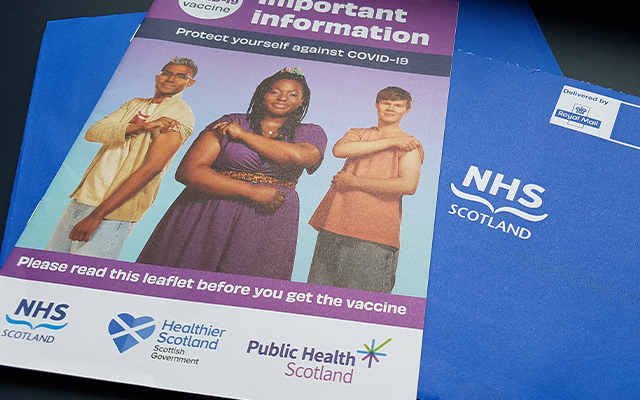
Unlike last year, people aged between 50 and 65 will no longer be automatically eligible for a COVID-19 booster vaccination this autumn.
The Joint Committee on Vaccination and Immunisation (JCVI) says the focus is now to be on those at greatest risk of becoming seriously ill who will benefit most from a booster – those aged over 65, older adult care home residents, children and adults in a clinical risk group, frontline health and social care workers, adult unpaid carers and those older than 12 living alongside people who are immunosuppressed.
People over 50 and those with certain conditions will continue to be offered a flu vaccination.
Public Health Scotland Consultant in Health Protection, Dr Claire Cameron, says vaccination remains the safest and most effective way to protect people against flu and COVID-19 this winter:
“This year's programme focuses on protecting those who are at highest risk. One of the ways we’re doing this is by offering vaccination to people who are most vulnerable to illness later in the programme to ensure they have maximum protection in the peak of winter."
Since the first people were told to ‘shield’ during the first wave of the pandemic, health agencies across Britain have sought to define which people fall into the higher risk group often because of a weakened immune system or other underlying health problems that would put them in particular danger should they contract the virus.
Dr Sally Witcher is founder of new social enterprise “Inclusive New Normal”, aiming to drive forward learning from the pandemic. She says that, while retaining flu vaccination for over 50s is welcome, cutting back on COVID protections does not make sense:
“Why are they ignoring all the valuable learning arising during the pandemic, on the clinical impact of this terrible virus, both acute and long-term, on strengthening clinical resilience via boosters and antivirals and preventing airborne infection transmission via well-fitting respiratory masks and clean air?
“Why, having now got many tools to enable everyone to live more safely with COVID are our governments completely refusing to use them? There is simply no excuse.”
In a separate move, the Scottish government has changed its guidance to "substantially reduce" COVID-19 routine testing requirements for frontline health and care workers citing the success of the vaccination programme and improved treatments.
People working in hospitals, care homes and prisons will now only be expected to test if they have symptoms, moving testing to being based on what the government calls ‘person-centred clinical decisions’.
Routine testing will continue for people moving from hospitals to care homes and will continue to be available for those receiving anti-viral treatments.
Scotland’s Chief Medical Officer Professor Sir Gregor Smith says now is the right time to revise the advice on routine COVID-19 testing to ensure it remains effective and proportionate:
“The clinical advice tells us that focusing on the risk to individuals under general infection control procedures will allow our hospital, social care and prison staff to better protect those in their care and that there is no longer a requirement to apply separate COVID-19 guidance across the board when so many are now protected from its worst harms.”
Dr Witcher says the changes to vaccinations and testing throws the human right to life out the window for her and many others with very high underlying clinical risk, who are under 65 and “don’t tick neat clinical boxes”:
“It takes some brass-neck to proclaim that routine testing is no longer needed “due to the success of the vaccination programme and improved treatments” when very few people are eligible for the vaccination programme and even fewer for antivirals.
“It frankly beggars belief that this announcement comes hot on the heels of them telling us the winter booster programme would be even more limited this year than last.
“[The government] cannot seem to grasp why a personalised risk assessment approach cannot possibly be effective when they refuse to recognise the nature of risk – clinical and exposure – or that it concerns an often asymptomatic, airborne infection that can destroy the lives of young, formerly healthy people.”
Mask-wearing requirements in health and social care settings in Scotland were relaxed earlier this year – in direct contradiction to advice from the Director General of the World Health Organisation (WHO).
Dr Witcher says these developments, alongside “ongoing abject failure” to take action on clean air, raise serious questions about how the Scottish government intends to keep people safe from infection:
“Under such circumstances it would be good to know how Scottish government proposes to ‘remain vigilant’ and ‘monitor emerging trends’, as it repeatedly assures us it will, and how anyone can possibly manage risk without good data.
“Surely, they can’t still believe the myth of ‘herd immunity’, in the face of repeated waves of immunity-evasive variants and robust research on the increased risk of long-term adverse clinical consequences of repeated reinfection. You’d think it might be a bit of a clue that professions at greatest risk of reinfections top the long COVID league table.
“As for people at high clinical risk, not all of whom tick the neat clinical boxes for booster eligibility, this is a truly desperate situation – a fight not just for our rights to equal citizenship but our right to life. It is the height of hypocrisy, coming from a government that never tires of proclaiming its commitment to equality, inclusion and human rights.”
Sally Witcher is a commentator on disability equality issues and has written several articles for healthandcare.scot: Opinion: Unmasking the problem; Time to end COVID’s Project Ignorance; Desperately seeking COVID sense.
Sign up to our bulletin for key health & social care updates straight to your inbox and you can follow healthandcare.scot on Google News.
|
