|
HALOs hope for beleaguered NHS Lanarkshire |
Related newsAberdeen A&E first to offer routine HIV tests “Mayday”: voices from NHS emergency departments Doctors: ‘Shocking’ A&E figures require action 20 years of stroke research and recovery at UKSF 2025 Less than full-time – behind the NHS trend Doctors invited to shape medical workforce reforms Breastfeeding project bridges generations Shocking levels of violence towards NHS staff Primary schools in breastfeeding project first Scotland’s frailty services to help address NHS waits NHS Greater Glasgow and Clyde welcomes new chief Cancer patient support bolstered by new funding 
|
|
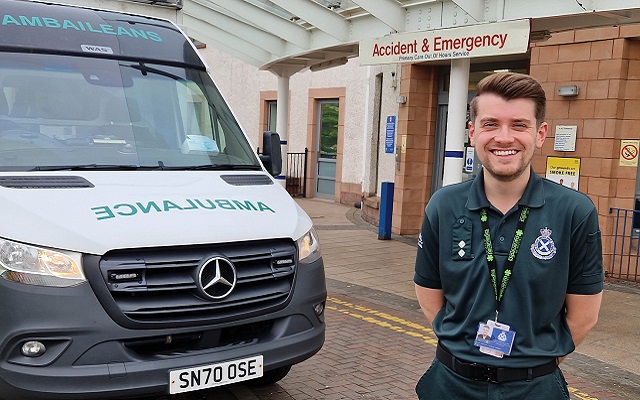
Chris McIntyre, Scottish Ambulance Service HALO
|
||
|
||
|
More timely discharges and reduced ambulance waiting times are anticipated across NHS Lanarkshire, following the recruitment of specialist members of the team who will enable closer working between the ambulance service and hospitals.
Hospital Ambulance Liaison Officers (HALOs) are to be embedded across NHS Lanarkshire thanks to a partnership between the health board and the Scottish Ambulance Service (SAS).
HALOs provide a direct link between the SAS and hospital operational managers, which allows them to identify early discharges and thereby reduce handover waits and plan in advance for inbound ambulance surges.
HALOs are also involved in reducing admissions to hospital, especially elderly patients, by establishing care pathways.
Chris McIntyre, SAS HALO for Lanarkshire, said: “The aim of the HALO role is to minimise delays to getting patients from an ambulance into the hospital, to improve patient experience.
“This allows the most appropriate care for the patient’s medical need, ensuring prompt assessment and treatment by clinical staff and increases ambulance availability so we can respond to other calls in the community.
“Our liaison with the discharge team and SAS patient transport service speeds up collection time to get patients home quicker, improving patient flow.”
This closer working partnership is part of Operation FLOW, a rapid improvement plan developed in response to the urgent and unscheduled care challenges across NHS Lanarkshire’s services.
Just 54.7% of emergency patients in NHS Lanarkshire were seen within the recommended four-hour time frame in the week ending the 16th of April – the worst performance of all Scottish health boards.
NHS Lanarkshire was moved down from the highest risk level in March 2023, after spending almost eight months at “code black” status.
However pressures throughout the board remain: just yesterday, the health board urged members of the public not to attend A&E unless absolutely necessary with its three emergency departments at Monklands, Hairmyres and Wishaw at full capacity.
North Lanarkshire hospitals have begun to offer cares of patients ready to be discharged a one-off £1,000 payment to tackle delayed discharge and support carer wellbeing.
NHS Lanarkshire and SAS are also increasing use of the Consultant Connect app and the Flow Navigation Centre to improve the patient journey.
Consultant Connect allows SAS teams to speak directly with senior clinicians to aid joint decision-making to establish whether a patient can safely remain in their home rather than be taken to hospital.
Around 50% of SAS calls is now thought to be managed on-scene without the needs to take patients to hospital.
Gordon McNeish, NHS Lanarkshire emergency medicine consultant, said these this approach has helped reduce the number of patients being taken to emergency departments while still receiving a thorough clinical assessment:
“SAS teams are clinicians in their own right, but there are occasions where they require support from clinicians in hospital to assess the appropriate care pathway, and often we can make that assessment – remotely – in a matter of minutes.
“While a patient would always be taken to hospital if that is what they wish, in some situations it is more appropriate for them to remain at home. It prevents them having to wait in an emergency department when this is not required, reduces the time SAS teams have to spend in emergency departments waiting to handover their patients, allows them to move on to other patients and can impact waiting times for other patients in hospital.”
Read more: More money for urgent care reform; Update: New portfolio to tackle inequality; Firm brought in to review urgent care reforms; Call for dedicated home carer 111 hotline
Sign up to our bulletin for key health & social care updates straight to your inbox. |
