|
Over regulation “neuters life” in care homes |
Related newsBriefing: Changes to sponsoring staff from abroad Collective bargaining promised for social care Care pay reform must come with stability not strain Care can be valued, visible, viable and visionary National developments for social work Care homes urged to act early on improvement 
|
|
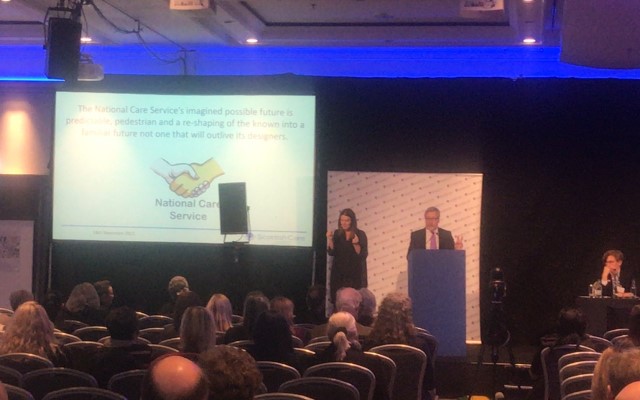
Scottish Care’s annual conference, ’More than four walls’
|
||
|
||
|
Care home operators say over regulation of the social care sector has “neutered out life” in care homes and taken autonomy away from staff, after the government gave the NHS a “right to intrude” even though it isn’t the sector’s official regulator
The issue was raised at Scottish Care’s annual conference, which brought together 300 delegates from across the independent care home sector and beyond, to address key challenges and find ways to innovate.
Additional direct oversight of care homes by NHS senior managers was introduced during the pandemic and has since remained in place.
However this additional supervision has been criticised by Scottish Care members for a “big brother” approach that has damaged staff morale, with NHS clinical assurance teams accused of fundamentally not understanding residential care settings.
At this week's meeting of the Scottish parliament's Health, Social Care and Sport Committee, Kevin Mitchell, Executive Director for Scrutiny and Assurance at the Care Inspectorate - the sector's regulatory body - said some services perceive the role of the oversight groups to be a secondary form of inspection, rather than support for improvement:
"I don’t want to speak in any way negatively about those oversight groups because they’ve done some very good work. But I know that some feel that, instead of offering support or guidance, they more or less repeat what the Care Inspectorate has done. That may be the source of some tensions that certainly have been made known to us.”
In a panel discussion on sustainability within the sector, Mary Preston, Operations Director at Scottish-based care home group Meallmore, told delegates that these oversight teams risk becoming entrenched within care homes, further muddying the already complex regulatory context and risking sustainability of services:
“Regulation is a huge deal in sustainability of care homes.
“Our regulators are the Care Inspectorate but now we’ve got another team of regulators in supporting the assurance teams that were introduced, that now seem to be becoming established. So we are more than regulated and I just don’t think that’s supporting sustainability.”
In his speech to round-off the conference, Scottish Care CEO Donald Macaskill told delegates that over regulation has “neutered out life” within care homes and that Scotland must reimagine aged care.
“We radically need to re-imagine the nature of scrutiny, inspection and oversight in aged care. Of course, both families and residents, and wider society needs a sense of assurance about the quality and humanity of care – but increasingly I feel we have the balance all wrong. A care home resident is more closely observed, monitored, and watched than your average penguin at Edinburgh Zoo.
“At the very least we need a radical balancing of risk in aged care regulation. The constant current behaviour and presumption of the right to intrude on the part of outside agencies is offensive and unacceptable.”
Conference key note speaker George Coxon, a care home manager based in Devon, raised a call to action for delegates to prioritse 'funguarding' for residents.
Mr Coxon said an overemphasis on safeguarding means that the enjoyment of people living in care homes is not a high enough priority. He said a better balance must be struck between the two:
"Who wants to be safe all the time? We want some thrill, we want some danger. Funguarding is more important than safeguarding."
Another member of the sustainability panel, Caroline Deane, Workforce Policy & Practice Lead at Scottish Care, said allowing care home workers more freedom in their role could also attract more staff to the sector:
“We are so overregulated as a sector and therefore the staff are overregulated. I think one of the ways we can attract staff back into the sector is by giving them back that autonomy.
“How do we give staff that power back, that they can make decisions when they’re out there? If we don’t trust, respect and value the workforce, we’re not going to be able to make that leap to be able to let them flourish and grow and grow relationships with the people they’re caring for. We need to give staff back autonomy. A lot of that has been eroded.”
An independent review of inspection, scrutiny and regulation of social care services was launched last month, in response to concerns Scotland’s social care regulatory framework is not fit for purpose.
Review lead, Dame Sue Bruce, told the conference that the review team will look at how regulation and inspection of social care services can effectively support improved outcomes and experiences for people:
“We want to make sure the system works best for everyone in it, including people working in the care sector.”
The inquiry will report its findings in June 2023.
Read more: NHS care home oversight led to ‘confusion’; Social care regulator flags course correction
Sign up to our bulletin for key health & social care updates straight to your inbox.
Tags: Social Care; Staffing & Workforce. |
