|
Health and care jubilee legacies |
Related newsBoard recruits big cohort of new midwives New NHS staff data makes case for workforce plan Nursing pressures creating high risk of harm Call for care home nurses to be given pay parity Mum scrubs-in to help deliver her baby by c-section Scots honoured in health, care and sciences 
|
|
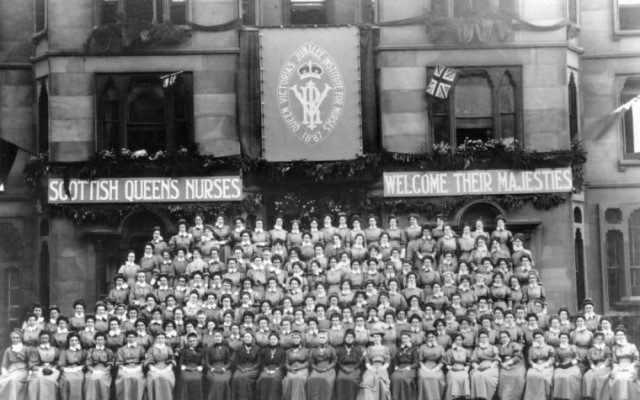
Image: The Queen’s Nursing Institute Scotland (QNIS)
|
||
|
||
|
The Royal Family has always had close connections with hospitals and health care.
Chris Holme explores two legacies of golden jubilees which are very much with us at present.
Jubilee celebrations leave various legacies. None has had more impact on health care - nor proved so enduring - as that for nursing.
In 1887 Queen Victoria gave £70,000 to set up a new body for district nursing. The money was shared between London and branches in Edinburgh and Dublin.
These became the Queen’s Nurses, the highly trained elite of the profession, who cared for the sick poor in their own homes.
They have always been hands-on, rather than highfalutin. Always at the sharp end rather than
patronising from above.
Remarkably, Queen’s Nurses are still at the centre of innovation and leading change. In Scotland there are now more than 130 who have passed the Queen’s Nurse leadership programme.
You’ll find them everywhere: on the oil rigs, looking after refugee mothers in Glasgow, young people with mental health problems, homeless drug users in Dundee, in prisons and police custody suites helping abused women - and helping blokes setting up a men’s shed in Govan.
Earlier this month, Queen’s Nurse Alison Bunce won the RCN’s UK nurse of the year award for her work in setting up and running Compassionate Inverclyde which co-ordinates services such as end of life companionship and ‘back home boxes’ for discharged patients
Back in the beginning, the Queen’s Nursing Institute Scotland (QNIS) was shaped by three remarkable women: Christian Guthrie Wright, who was also responsible for the Edinburgh School of Cookery (which later became Queen Margaret University), and Louisa Stevenson, a determined and capable organiser, and Queen Victoria’s rebellious fourth daughter, Princess Louise, the Duchess of Argyll.
Sherlock Holmes was also involved – or rather Joe Bell, the Edinburgh surgeon who inspired Conan Doyle’s famous detective. Bell had worked closely with Florence Nightingale to establish hospital nursing in Edinburgh. He was equally keen on the same exacting standards for Queen’s Nurses in the community, insisting on three years’ hospital experience before they could do Queen’s training in midwifery, district work and later, health visiting.
QNIS started life on April 1, 1889, in a rented double flat in North Charlotte Street, Edinburgh. Nightingale wrote to Miss Pauline Peter, the first superintendent, and her three nurses: “I most earnestly hope that you are beginning under the conditions you and we wish for and bid you success from the bottom of my heart. God bless you.”
In this pre-NHS era, most Queen’s Nurses were employed by local nursing associations. By 1907 there were 184 nursing associations employing 293 nurses. QNIS also established training centres in Glasgow, Paisley, Aberdeen, and Dundee. But demand always outstripped supply.
Industrialisation had created areas of terrible deprivation across Scotland. Many had high levels of occupational injuries and sickness.
The Singer sewing machine company funded one of two Queen’s Nurses in Clydebank and the John Brown shipyard contributed £50, the proceeds of entrance money to view the luxury liner Lusitania.
Fife miners employed a Queen’s Nurse from profits from Gothenburg community pubs. In Prestonpans, every miner paid in weekly, and every fishing boat made a yearly contribution.
The impact was startling.
Edinburgh’s medical officer of health, Sir Henry Littlejohn declared that Queen’s Nurses had completely revolutionised the treatment of the sick, achieving a remarkable fall in the death rate.
By 1921, Glasgow GP Madeline Archibald concluded that medical practice in industrial areas would be a nightmare without them. A Queen’s Nurse was seen differently from patronising or prying welfare officers and health visitors:
“She entered the poor man’s household with only one object in view – the relief of pain and sickness. She entered without notebook or inquisition. She asked no questions about the household’s economy which every man and woman preferred to keep to themselves.
“However sordid the surroundings, whatever there may be in the way of squalor, dirt, or lice, made no difference to her. She set about her work often amidst the most appalling difficulties and did what she could with the limited means at her disposal to leave her patient better than she found her.
“Her work brought her a rich and ripe experience of the poor. She knew their difficulties, their hardships, not only with death and sickness but with life and poverty.”
The only problem was that there were never enough of them to meet growing needs.
Until the 1940s they were all known as Miss. Like female civil servants and teachers, they were expected to give up their posts when marrying and starting a family.
QNIS is still run as a registered charity from the office in Castle Terrace, Edinburgh it has occupied for more than 130 years. Like its sister organisation in England, it evolved into new areas after universities took over the training of community nurses. Its current research includes evaluating interventions in pre-natal and pregnancy care, reflecting its earlier work in midwifery.
One of Queen Victoria’s most recognisable legacies is the Forth Bridge completed in 1890 which still stands. So do her nurses which started to make their mark one year earlier.
Chris Holme is the founder of The History Company
Read More by Chris: Diabetes and Aberdeen; The Glasgow mother of the C-section; TB and the Edinburgh physician; Scottish midwives on the frontier;
Sign up to our bulletin for key health & social care updates straight to your inbox. Tags: Nursing & Midwifery. |

1.jpg)