|
AI pilot in hunt for cervical cancer cells |
Related newsAI for lung cancer care to help tackle “hidden killer” Call for genomic test for every cancer patient Camera endoscopy to be backed with AI Scotland must prioritise new bladder cancer test Navigating ‘next frontier’ of AI in medical devices Patient and Public Involvement 2027 showcase Breastfeeding project bridges generations Shocking levels of violence towards NHS staff Primary schools in breastfeeding project first Scotland’s frailty services to help address NHS waits NHS Greater Glasgow and Clyde welcomes new chief Cancer patient support bolstered by new funding 
|
|
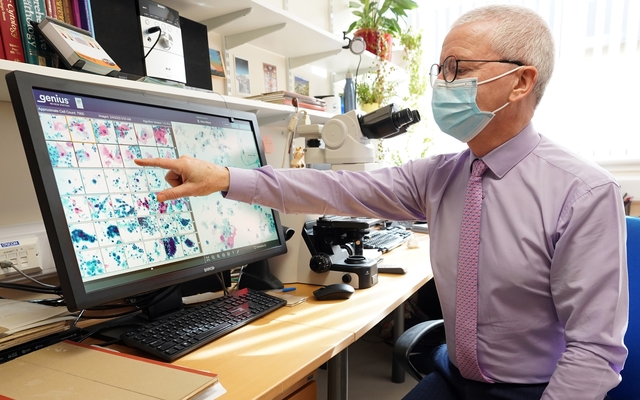
Image: © Stewart Attwood
Allan Wilson, Consultant Biomedical Scientist
|
||
|
||
|
Clinicians at Monklands Hospital have become the first in the UK to use an artificial intelligence and advanced imaging system in a bid to improve early recognition of pre-cancerous and cancer cells as part of its cervical screening programme.
The pilot involves creating digital images of cervical smear slides from people who have tested positive for human papilloma virus (HPV), the foremost trigger for cervical cancer.
Each image is then assessed using a digital diagnostics system called ‘Genius’ supplied by the women’s health medical technology specialist Hologic. Early indications are that the system will increase the capacity of the assessment team by a quarter and speed up analysis.
Consultant biomedical scientist at NHS Lanarkshire, Allan Wilson, says the technology will make a difficult process easier and hopes its use will be extended throughout Scotland:
“Looking for abnormal cells is like trying to find a needle in a haystack because in some cases there are only around 50 abnormal cervical cells in a sample that may contain 15,000 normal cells.
“This pilot with Hologic has shown how digital cytology can revolutionise our analysis process in our cervical screening programme.
“Preliminary results from the pilot are promising, as the team at University Hospital Monklands has increased capacity by around 25% in the slide assessment and improved analysis turnaround times, as well as allowing screeners to dedicate more time to training on the latest technologies and dealing with difficult-to-diagnose cases.
“We are now undertaking a retrospective study, using the digital cytology system to test its performance against previous known results. This will then provide the clinical data to make a recommendation on the use of digital cytology in the cervical screening programme in Scotland. Through AI and digital diagnostics, we have the potential to improve outcomes for women not only in Scotland, but around the world.”
Around six women are diagnosed with cervical cancer in Scotland each week with early identification can improve their outcomes.
A large pilot study for the use of AI in identifying skin cancer lesions is already underway in Scotland – with the team behind it saying their goal is to make a diagnosis within just 25 minutes.
Tim Simpson, the UK & Ireland General Manager of Holigic, a leading women’s health company that developed the cytology system, , says his team is proud to be working with the University Hospital Monklands’ clinicians and scientists:
“Digital cytology has a key role to play in ensuring pre-cancerous cells are picked up early and treated so fewer women go on to develop cervical cancer. Our goal is to help create a world where no woman dies from cervical cancer.”
Read more: “Opportunity” in Scotland’s life sciences sector; High cancer diagnoses rate via emergency care; How the Internet of Things can transform health & care;
Sign up to our bulletin for key health & social care updates straight to your inbox. Tags: Cancer; Tech And Digital. |
