|
Home carer: We were never trained for this |
Related newsArgyll & Bute HSCP facing budget cuts Home adaptations – council spend will prevent NHS cost A trusted partner in long term conditions care Working together to ensure No Life Half Lived Hospital at Home exceeds targets Long COVID: Alone and forgotten 
|
|
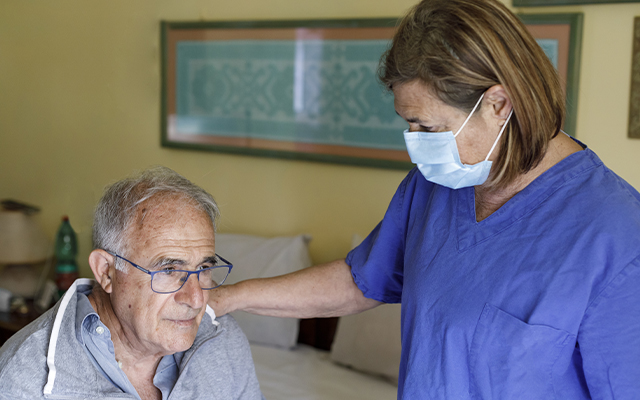
Stock Image: © alex.pin
|
||
|
||
|
As Scottish and local governments agree to divert people and resources to filling care gaps, one local council-employed home care worker has revealed that her team is so short-staffed that they are being told not to wait with sick or injured clients after arranging medical help, but to get on to their next appointment.
Speaking to healthandcare.scot on condition of anonymity, Maggie [not her real name] says working conditions faced by care at home workers are more difficult than at any time since she started the role more than two decades ago.
“I had never been sent off sick before covid. I’ve been off sick several times in the last two years with stress.
“My partner wants me to stop it. My children want me to stop. Three people I’ve worked with for a long time have all given up. I just try and get through my shifts but everything is wearing really thin now.”
On the morning we spoke, Maggie said there were so many people off sick or self-isolating that care for as many as 200 people that day wouldn’t be delivered properly – or at all.
Maggie says that although she comes into contact with people who have tested positive for covid every day, her only training in the use of PPE was watching a video online:
“I keep asking: how do I do this to cut the risk? Where do I put on my PPE? Is it outside the house or inside? I know I have to put on my mask before I open the front door, but does that mean my PPE should be put on then too? If it is raining, is it compromised?
“Nobody will answer me. They just say watch the video. But the video is of somebody inside a building in a big clean space. I’ve not got that luxury. In some houses I want to wipe my feet on the way out!”
Maggie says her role has changed beyond recognition over 20 years, but training has not kept up.
“When I came into the job you didn’t need any qualifications – but it was a completely different role. Our job was mostly about cleaning. We spent hardly any time on personal care. But that changed and we are the professionals keeping people out of hospital.
“I’m not sure how to describe the job anymore because it’s not care. It’s medical, nursing. But we don’t have the training… In all the time I’ve been a carer, I have never had any official training in the correct way to wash a client. I just had to rely on what other more experienced carers taught me.”
Alongside the new tasks that have been expected of home carers, Maggie says the conditions her clients are living with in their homes have become more complicated and challenging:
“The things that all the other agencies used to do have been given to us, which means caring for people with serious medical conditions, advanced Parkinson’s and people at the end of their lives.
“Dedicated end-of-life care services don’t exist around here anymore. We are just going in for 15, 30 or 45 minutes. Can you really care for somebody properly in that time?
“We deal with so many medical problems and yet there’s nobody medically trained who I can ask for advice. I am supposed to speak to a manager with an SVQ3 and no medical experience.
“If I have to phone NHS 24 for a service user, I can be on the phone for two hours trying to get help because the lines are so busy. And that is then a disaster for all the other people I’m supposed to see.
“If I have somebody who’s fallen and is on the floor and I can’t help them back up I am told by my supervisors that, as soon as I know that help is on the way, I need to move on. Put a blanket on them and leave them because we are so short staffed. But I can’t do that.
“If I was a district nurse or an auxiliary coming in, I’d have a phone number to call for help and I would get through immediately. Why can’t we as home carers get that number?”
Maggie says she, like so many people in her job, stays working in care because she doesn’t want to let down the service users who she has gotten to know and who have come to rely on her.
“I don’t see how you are going to attract people into working as a home carer unless you put the wages up, give people proper training and make everyone – employers and employees – feel that they are needed.
“And you have to give us the same recognition as the NHS. Because the NHS is on this big, huge pedestal.
“There’s really no difference between me and an auxiliary nurse. Except, perhaps, we have more responsibility because we are the ones who clients see.
“We are the ones who make the decision about whether we should phone an ambulance or get a GP. We are the ones who will then explain what is going on. We are the people who will advocate for our clients.”
healthandcare.scot approached Public Health Scotland to ask what guidance on PPE has been issued to carers visiting multiple clients in their homes.
Read more: Councils agree to divert staff to social care; Column: Carers are not "invincible"; Care workers swayed by NHS recruitment campaign
Sign up to our bulletin for key health & social care updates straight to your inbox. Tags: Covid-19; GP & Community; Home Care; Hospital to Home. |
