|
Insight: Year ahead “critical” for social care future |
Related newsProgramme for Government: the reaction FM signals national pay bargaining in NCS Analysis: The case for a £15/hr social care wage MSPs to examine future of social care Care home relatives to meet health secretary Nearly 200 alerts over care home staffing in pandemic 
|
|
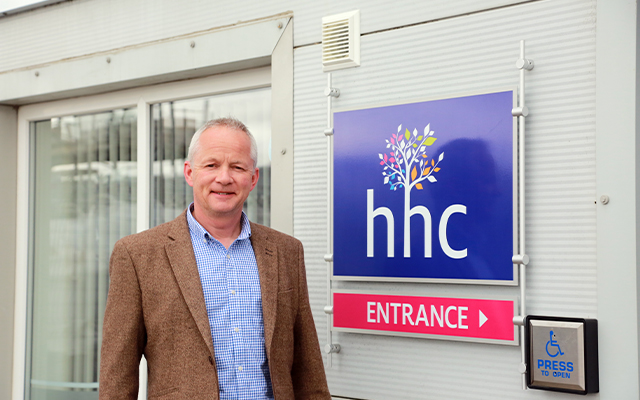
Highland Home Carers Managing Director Campbell Mair
|
||
|
||
|
An ‘effective and collective’ voice for social care will have to emerge to ensure the sector does not find itself lagging behind the health service as a new cohort of MSPs arrives in Holyrood, the managing director of a home care provider tells healthandcare.scot.
Highland Home Carers’ Campbell Mair says the next 12 months will be “absolutely critical” as the sector finds its way through the wake of the pandemic, the Scottish Parliamentary elections and the Feeley review of social care.
“This is going to be an absolutely critical year for all of us in social care, and we better put on our seatbelts because it will be swift and bumpy and pretty hectic,” says Mr Mair.
“We will be welcoming a new Cabinet Secretary for Health and Sport in the coming weeks – almost certainly that will be within an SNP government – and there will be a queue from their door down the carpeted corridor of people wanting to influence them.
“My sense is, as ever, that queue will start with NHS acute hospital environments then go to chief medical officers and so on, and somewhere way down the back of that queue will be social care.
“I think care homes will be somewhere near the middle but unfortunately I think care at home will be right at the back; I think that remains way down the list and that worries me deeply.
“One of my main challenges is how do we ideally not have a queue, but have a focus group or something like that? Because there needs to be a straight line where we are all equal.”
“The commitment to legislate in the first 12 months of the new parliamentary cycle on a national care service is fantastic…My only hesitation is that we have been saying the same thing for nearly 30 years.”
Derek Feeley’s review of social care emphasised the importance of helping people to live independently in their own homes for longer, avoiding care homes and hospital where possible.
Asked if that bumps an organisation like his further up the list, Mr Mair says it could and should, but a lack of a “collective and effective voice” for adult social care means it could easily get left behind other areas of support.
“The report on the concept of a national care service is going to have a huge impact in the next 12 months.
“I can’t remember another political party manifesto in previous elections where the words social care featured at all, let alone fairly prominently like in the SNP’s manifesto this year. It’s fantastic that social care is on a platform where people can maybe see it and understand it differently.
“The commitment to legislate in the first 12 months of the new parliamentary cycle on a national care service is fantastic…My only hesitation is that we have been saying the same thing for nearly 30 years.
“I am old enough now to remember trying to change things through things like GP fundholding and then joint futures in local healthcare cooperatives - we have had so many goes at this and I worry this is another go at it.
“The high-level strategy isn’t something new, this is about by and large keeping people as well as possible in their own home environment for as long as possible...
“That in theory pushes out acute consultant-led care environments; it’s not that they are not important but in terms of focus and upstream investment social care is right in the middle of that along with extended primary care or GPs and their community teams, community nurses, physios, occupational therapists, social workers and so on.
“There is great opportunity and that is why I think it is going to be a busy and bumpy year because there is almost so much that is going to be happening all at once.”
But why have successive governments in Scotland failed to grasp fundamental social care reform?
“I think there is a political fear of getting it wrong,” Mr Mair says, “and the fear of facing the reality of dealing with a finite resource like money.
“I think of it like a balloon with only so much air in it and if you want to make one end bigger there is only one way to do that and that is to squeeze the other end. There is a fear of doing that which is partly driven by the fact there is a very loud, genuine and effective voice from organisations like the BMA, the Scottish GP Committee and others.
“What we have in social care is a pretty fragmented ineffective voice and that’s perfectly understandable because there are hundreds of providers; some charities, some independent sector and so on.
“Having one conversation with the BMA must be a lot easier than having 500 conversations with providers in our sector but it doesn’t mean we should shy away from those conversations because they need to happen.
“…The barriers today are the same as they have always been…If there is no new money then we are always left with the reality that investing money in one area requires disinvestment in another.”
Former Health Secretary Jeane Freeman admitted last month she did not fully understand the social care sector when elderly patients were rapidly discharged from hospitals to care homes as the health service prepared for the first wave of covid-19 – an admission that did little to dampen speculation about whether a specific social care minister is needed.
If we are committed to an integrated model of health and social care though, Mr Mair questions whether this move is “by definition dis-integrating and making things worse, not better.”
“Equally though I think it will be difficult to have a national care service without some type of ministerial leadership because the opposite of that is accountability through local government.”
During the pandemic care homes were brought into the remit of public health directors from the NHS. Concerns have been raised over allowing medical models of care to supplant social models, which speaks of a wider nervousness when it comes to creating a national care service ‘on a par’ with the NHS.
“There are disincentives that exist in our health system that I’m really keen we do not replicate in social care, otherwise the greatest reward will go to those who have historically delivered the poorest employment terms and that’s shocking.
“We target our new money in the NHS at the longest waiting lists and it can be such a disincentive to doing the right thing.
“Pretend for a minute that the next government decide they want to introduce a minimum wage of £12 an hour in care…If I am an employer who only pays £9.50 an hour so that I can make more money – because that’s my business model – that means that provider will get more money than another if the approach to additional investment is to plug the gap where it is widest. That disincentivises good practice.
“If there is additional resource being put into social care it has to be allocated on a fair shares basis.”
“As an employee-owned organisation, we try and run our company with the smallest possible profit margins by paying people as well as we can and giving them the best conditions to work under in terms of learning, training, IT etc.
“What I don’t want to be is disadvantaged at the other end of that because we end up giving people who haven’t bothered to do the same as us the most money.
“That’s a needs-based approach and that doesn’t feel very fair.”
“Do we really think that would be an acceptable way to treat and deal with our nursing colleagues in community environments? Not a chance.
“So why is that not the case for the social care?"
Caseload-based ways of working though must be brought across from the health service into social care, Mr Mair says.
“Ideally we move away from pounds per hour as the currency in social care, as that can drive a lot of poor practice. Why can’t we move to a system where we apply the funding, the thinking, the commissioning to social care in the same way we do to primary and extended primary care?
“If you look at general practice they are funded on a capitated basis. If you have a thousand patients you get funding for that. Why can we not be funded the same way? It’s essentially a caseload model.
“I think one of the barriers is trust. Say you were a community nurse and I was your employer and I said come and work for me but I’m only paying you in 20-minute chunks, and to earn an hour of pay you will have to do three 20-minute chunks of work and you will not get paid for the time it takes to get from one of job to the other, and you won’t get any development time and need to buy your own uniform and so on.
“Do we really think that would be an acceptable way to treat and deal with our nursing colleagues in community environments? Not a chance.
“So why is that not the case for the social care?
“In no other part of society would that be acceptable, none. Why can’t we give our social care workforce a caseload the same way that we do our community nurses?
“We have a population already weighted for age, sex, morbidity, plurality, and sparsity which isn’t difficult to do because that’s how we allocate our health budget. That is how the funding comes from Westminster to Holyrood and that’s how it goes back out from Holyrood to our health boards – why can’t we do that for social care and have a caseload model?
“That could be done as individuals or teams. We should end up commissioning for people in the workforce rather than the currency which at the moment is 15 or 20 minute visits.”
Read more: Care provider pays £500 ‘thank you itself after delay; Failure to understand social care ‘unsurprising’;
Sign up to our bulletin for key health & social care updates straight to your inbox. |
