|
Scotland-England social care spending gap widening |
Related newsScotland’s IJBs becoming "financially unsustainable" The in-between: what’s happened to care reform? All public bodies must focus on health, urges charity Frailty services supported with £85m ‘Leaps’ needed to secure change for disabled people Fixing social care funding must be council “priority” 
|
|
|
||
|
||
|
The gap between social care spending per head of the population in Scotland has continued to grow compared to that in England – while, in contrast, a long-standing Scots health funding lead has almost disappeared.
Analysis by the Institute for Fiscal Studies suggests the Scottish government has ‘prioritised the health budget to a lesser extent’ than its counterpart in England.
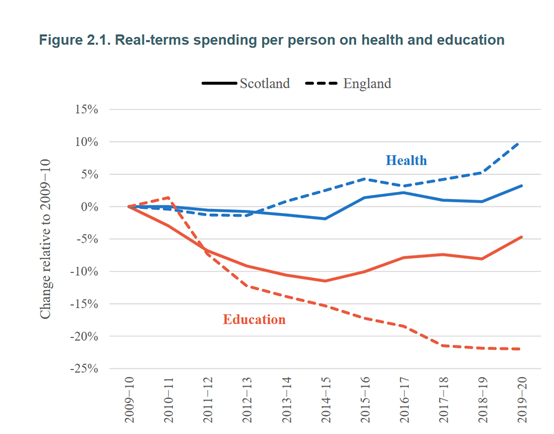
Per-person health funding remains higher north of the border but the gap has shrunk from being 22% higher in 1999-2000 to just 3% more in 2019−20.
In contrast, the think thank says the difference on social care spending per head of the population has continued to widen – with England actually seeing a real terms fall in the last decade.
Spending on adult social services in Scotland was 43% higher per person in 2019-20, up from a gap of 30% in 2009-10 and 27% in 1999-2000.
The IFS attributed the widening of this gap to the Scottish policy of free personal care for older people that was introduced in 2002 and extended to under-65s in 2019 under Frank’s Law.
The same policy has not been introduced south of the border despite being recommended by a number of reviews.
In recent weeks, the debate has moved onto scrapping more care charges, with campaigners pressing for immediate action.
The independent review of adult social care said that all care should be free at the point of use, with the exception of care home accommodation fees.
Derek Feeley’s review team calculated that this move, along with all the other commitments in the report, would cost an extra £660m a year – a 20% real terms increase on what was spent on social care in 2018-19.
A 20-year-trend trend of “relatively smaller” boosts to health spending north of the border was identified by the IFS in a briefing note published today.
Funding for the NHS in England grew at a faster rate from a lower starting point.
Per capita spending in on the NHS in Scotland actually fell in real terms between 2010-11 and 2014-15, the analysis reveals.
The IFS said the findings were ‘perhaps surprising’ given a Scottish government commitment to pass on any Barnett consequentials from increases in NHS spending in England to NHS Scotland, and said the Scottish government needed to provide further clarity.
It said non-health services like education were the main beneficiaries of higher public spending in Scotland.
The IFS suggested that the UK government was placing a ‘greater priority’ on the NHS in England, where staffing is increasing.
While Scotland still enjoys more NHS staff per 1,000 people, levels have remained constant since 2015, according to the IFS.
Read more: Independent care providers set out election asks; Plan to end care charges “as soon as possible”; Care home visits need ‘case by case’ approach; Private care homes - an essential part of the sector?
Sign up to our bulletin for key health & social care updates straight to your inbox. Tags: Finances; Scottish Government; Social Care. |