|
Social care review: What does the report say? |
Related newsFixing social care funding must be council “priority” Care home visits promote wellbeing FM candidates asked if they care about care Kerley: Don’t talk about a postcode lottery Ministers launch ‘more to care’ campaign 
|
|
© David Pereiras
|
||
|
||
|
The recommendations of the much-anticipated independent review of adult social care were published today. The 100-page report makes 53 recommendations, ranging from more funding for unpaid carer respite services, to creating a new care minister to oversee reform.
There is no shortage of ambition, with the review stating: “We need a system that is controlled nationally, that delivers locally, has the person at the centre, that does not cost the earth.”
A new minister, and local authorities pushed out?
The review recommends a significant – potentially seismic – shift in the way that social care across Scotland is overseen.
Most significantly, councils would be stripped of their dual and, some argue, conflicted role as both commissioners of social care and often providers of services.
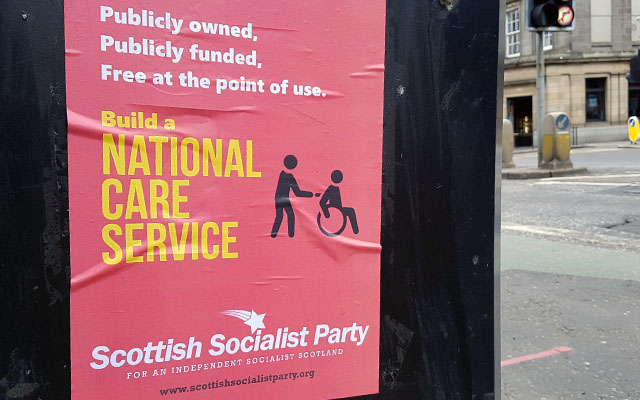
A National Care Service would be established as a legal entity and have a chief executive, on a par with the NHS in Scotland, directly accountable to a newly-created minister for social care.
It would be the role of the national care service to ensure a ‘once for Scotland approach’ to putting in place the workforce planning, data, research and IT systems required to deliver national quality standards and improving outcomes for service users.
While the plan calls for a narrowing of the role of local authorities, it proposes a greater, direct and more independent role for health and social care partnerships.
Instead of being funded by both their local health board and council, Integration Joint Boards (IJBs) that oversee health and social care partnerships would get their money directly from the Scottish government.
They would take over the role of not just planning but also directly commissioning and procuring services – with an increased workforce to match.
The plan envisages a continued mixed ecosystem of “delivery partners” that would include councils, private and voluntary sector providers. It also calls for the IJBs to work with GPs “to remove the current confusion about where responsibility for primary care sits”.
While the National Care Service would rely on local partnerships for the majority of local care delivery, the review proposes that care for people whose needs are particularly complex and specialist, and for people in prisons, to be delivered by the national organisation.
In their report, the review team say that “the importance of clear, committed leadership at all levels and in every organisation to making a reformed system work cannot be overstated”.
They propose “the creation of a National Integration Joint Board where the senior leadership of the national care service and NHS meet regularly to agree strategy and priorities”.
The review recommends a reassessment of whether the Care Inspectorate and Scottish Social Services Council remained “fit for purpose” in such a new system.
How to pay?
The total bill for the proposals in the review adds up to an extra £660m a year – a 20% real terms increase on what was spent on social care in 2018-19.
“Even allowing for a phased introduction, an investment on these lines will require a long-term and substantial uplift in adult social care funding,” the review states.
Review lead Derek Feeley makes the case that these sums should be seen not as a “revenue cost” but an investment that creates jobs.
Health Secretary Jeane Freeman, who is stepping down at the Scottish Parliament elections in May, has previously said the public and politicians face “important decisions” about how to pay for social care.
The review sets out a few mechanisms for achieving this, including “hypothecated” taxation – where money raised from a particular tax is ring-fenced for a specific use.
UK policymakers have generally shied away from such a move, though they can be popular with the public. To garner public support for a 1% hike on national insurance in 2002, Gordon Brown said additional funds were for the NHS.
The review notes there is “evidence of public support for hypothecation to fund increased expenditure on social care” but warns that lower tax returns in economic slumps can lead to lower levels of funding.
Some options would require more powers to be devolved from Westminster and the review calls for “further analysis and careful consideration” before any decisions are taken.
Free at the point of need?
The report is clear that social care in Scotland should be “free at the point of need”.
It states: “It does not make sense for people to have access to healthcare free at the point of need but, in circumstances that are equally related to their health and wellbeing, to be charged for support. It also does not support delivery of their human rights.”
However, this does not extend to accommodation in care homes, because the review concluded “in other circumstances that person would be paying accommodation costs at home.”
This is the only charge for social care that the review backs, pointing out that it is and should remain means-tested.
Currently care home residents with assets above £28,500 are expected to meet all of their residential care costs.
As personal and nursing care has been free for over-65s since 2002, the Scottish government, makes additional payments, through local authorities, to cover this portion of the bill.
Earlier Jeane Freeman announced these personal and nursing care payments would go up by 7.5%, well above usual levels – a pre-emptive acceptance of the review’s claim that the supplement had ‘not kept pace’ with increasing costs.
Nationalisation
Some National Care Service advocates – including COSLA’s health and care lead Stuart Currie, who sat on the review panel – had called for all care to be taken into public hands.
The move would be a major change, as care is mostly delivered by private and third sector providers, but would mirror the vast majority of NHS services – with some notable exceptions such as GPs and community pharmacies, which are independent contractors.
Indeed, Health Secretary Jeane Freeman pre-empted this conclusion when she told a Scottish Care conference that she did not think care would be “run by the state”.
The review turned this down on two grounds: outcomes and cost.
On the former, the report says there is “no evident link” between the type of ownership and quality of care in homes for older people during the pandemic. In community services, it notes that charitable providers generally score the best.
There is also the eye-watering cost. NHS Highland spent £900,000 purchasing the Home Farm care home in Skye after concerns about the care of residents; the review states it would be “unaffordable” to replicate this across the country’s nearly 1,000 adult care homes.
Mr Feeley goes on to say there are other areas which should be “the priority” for extra funding – such as extending support to people who need but do not currently have care.
However, the review does express “unease” at the role of profit in the care system and suggests government could do more to stop the “leakage” of funds that could be used to improve staff pay rather than shareholder dividends.
The social care ‘gap’ – access and prevention
Planned social care delivered before people reach crisis point is widely recognised as an effective means of keeping people healthier and happier for longer, and preventing expensive hospital admissions.
By 2040 the number of people aged 80 and older in Scotland is predicted to increase by around 68%, while a 74% increase in the number of Scots with dementia is also expected over the same time.
Despite this, today’s report found there were 25,505 fewer people (20%) receiving care in 2018-19 than would be expected based if 2009-10 levels of access had been continued.
As the older population has increased in Scotland, resources have focused on those with the greatest needs meaning fewer people are receiving social care support than before the period of UK-wide austerity brought in after 2010.
The review panel recommends investing to address what it describes as care “gap” – around 36,000 people are said to not currently have access to social care support “for whom it would be beneficial” – which could cost around £436m.
Fair work
Trade unions that represent social care workers have welcomed the review.
The Scottish Trades Union Congress – which represents over 540,000 trade unionists in Scotland – has welcomed the report’s focus on “structural challenges” that inhibit workers’ ability to collectively bargain for improved pay and conditions.
But Roz Foyer, STUC General Secretary, disagrees with the review when it comes to keeping a mixed picture of providers:
“We believe any new national care service must be fully funded and sit within the public and not for profit sectors to ensure that shareholder profits are not funded by Scotland’s tax-payers,” she said.
UNISON meanwhile praises the report’s criticism of a market-based approach to commissioning care services. The review panel cites UNISON's Ethical Care Charter “as a route to driving out profit motive and delivering fair work standards across the various types of care.”
The Independent Living Fund
Nearly 3,500 people could benefit from reopening the Independent Living Fund, according to the review.
An open letter to the Health Secretary Jeane Freeman in August called on the government to reopen the fund that was established in 1988 to provide disabled people with high support needs with the ability to live more independently in their communities. It closed to new applicants in 2010 but still supports around 2,600 Scots.
Re-opening it could help a further 3,400 people that the review body estimates would be eligible for funding to support their wellbeing and independence.
The report authors state they see the fund operating in the future are part of a national care service:
“In effect, it will provide a national service of self-directed support to people with the most complex needs in the country.
“…To ensure that the fund focuses on people with the most complex needs, we recommend that the threshold sum for entry to the new scheme should be reviewed and adjusted.
“To give some indication of the likely additional costs, if the threshold sum for new entrants was set at £600 per week, an additional investment of £32m would be required, increasing the total fund value to £85m p.a.”
Unpaid carers – a right to respite
The pressure has been piled on Scotland’s unpaid carers during the pandemic like never before, with many saying they are close to breaking point because of spending 24/7 with those they care for while respite services and day centres remain closed.
Carers should, according to the report, be given a “right to respite” enshrined in law through an amendment to the Carers Act.
The report states the financial support available to them must also be reviewed and that more should be invested in respite provision:
“Although charges to carers are waived under the Carer’s Act, some Local Authorities allocate charges to the supported person for respite. Removing such charges should be considered alongside other investment priorities.”
|