|
‘Street benzo’ deaths surge linked to criminalisation |
Related newsAwards celebrate great link working Community link workers now “indispensable” Link worker profile: Small grants and big impacts Blue spaces: Part of our health infrastructure The Scots behind evidence-based medicine Public health – don’t just focus on the goalkeeper 
|
|
|
||
|
||
|
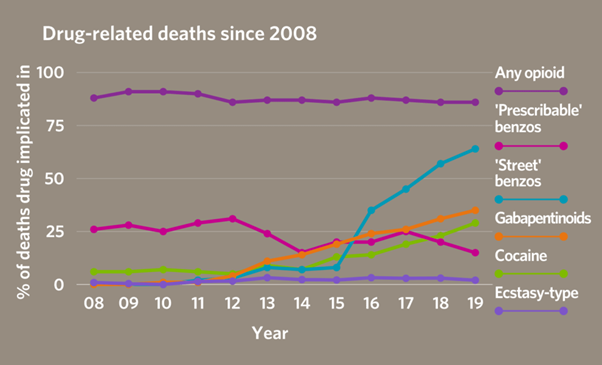
Drug deaths in Scotland involving a type of ‘street benzo’ or ‘street valium’ rose to their highest-ever level in 2019, with a report suggesting a decision to prohibit the substance has led to a surge in its popularity.
Deaths involving etizolam soared from 43 in 2015, before it was controlled, to 752 in 2019 – more than any other single illegal substance.
Drug harm reduction charity Crew says that supply of etizolam has become dominated by organised crime groups, contributing to a decline in quality and price, as well as an increase in ‘variability and potency’.
Steve Rolles, of the Transform Drug Policy Foundation, said it was ‘hard to imagine a worse outcome’.
‘Even with the usual causality caveat - this looks exceptionally bad for UK policy and lawmakers,’ he tweeted.
Overall drug deaths rose to record levels in 2019, with 1,264 Scots losing their lives. This was the highest number in 20 years and the worst rate in Europe.
Outcry at the statistics prompted Nicola Sturgeon to replace the public health minister and bring in a new minister dedicated to drugs policy, accompanied by a pledge to dramatically increase funding for services.
Crew’s latest drugs trend report, which covers 2019 to 2020, warns of a ‘benzo crisis’ after the percentage of deaths that involve benzodiazepines or ‘street benzos’ increased by nearly 500% since 2008, from 149 to 888.
So-called ‘street benzos’ are distinguished from other forms of benzodiazepines that can be prescribed for medical reasons.
Deaths involving etizolam, the most common substance in this category, rose sharply after its sale was banned in 2016 and it was designated a class c drug in 2017.
‘Eitzolam’s popularity surged after it was controlled and along with it, its prescence in drug-reglated deaths,’ Crew states.
Previously the drug, which first emerged in 2011, had been available over the counter and online.
Crew states that the moves caused a ‘substantial shift’ in the Scottish benzos market, as higher-quality pills from overseas were replaced by organised crime groups importing powder and pressing the pills themselves.
Crew also surveyed people using drugs on their experiences during the pandemic, with a third saying quality had dipped, a finding escribed as ‘one of the most concerning’.
Sign up to our bulletin for key health & social care updates straight to your inbox. Tags: Public Health & Prevention. |