|
Unlocking a different approach to social care |
Related newsPoliticians told: “Carers cannot wait” National Care Service Forum 2025 Analysis: abolishing non-residential care charges Smart houses ‘paving way’ for independent living Turning policies into social care practice Holyrood scrutinises self-directed support 10 years on 
|
|
|
||
|
||
|
One of the biggest challenges in social care is realising the goal of independent living and self-directed support for everyone who needs it in Scotland.
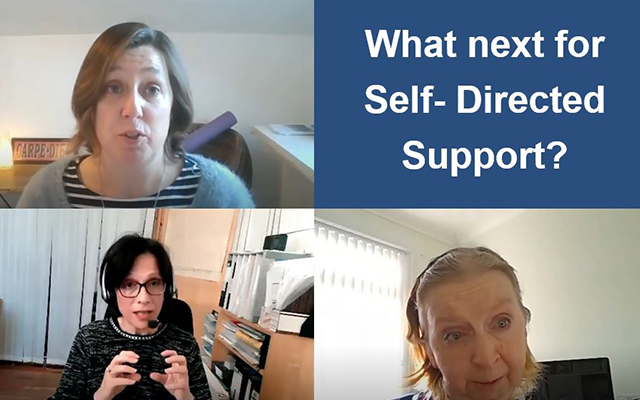
Leading experts in the sector shared their thoughts on what’s next for this approach in an online seminar held by healthandcare.scot.
In the second of two reports on the event, here we look at the discussion around how to address the issues facing self-directed support (SDS) in Scotland.
“A lot of the issues with SDS and social care are incredibly well rehearsed. We have known for a long, long time what is wrong – it is really just a question of getting on and making the change now.”
Lucy Mulvagh, Director of Policy and Communications at the Health and Social Care Alliance, said while the pandemic has shone a light on problems with the system, many of the problems have been known about for a long time.
A recent report which consulted more than 600 users of SDS made 66 recommendations on how to improve the system.
Ms Mulvagh said this included action to widen sources of information on SDS.
“For example, we could be making far more use of health and education professionals to help inform and signpost people towards SDS,” she said.
“We really need targeted efforts to make sure everyone enjoys a meaningful choice and control over their SDS options and support.
“Particular work is required for specific population groups including people with learning disabilities, black and minority ethnic people and other groups such as women as users of SDS and people with lived experience of homelessness. “
She said that human rights “hold the key” to unlocking the door to a different approach to social care.
“It is important to recognise that rights aren’t just lofty, theoretical aspirations that apply to someone else,” she said.
“They can be used in increasingly practical ways to help realise the true purpose and value of social care and develop a system that is firmly cemented in Scottish culture as a positive investment in its people, our society and our economy.
“With the prospect of ever-shrinking resources and a post-pandemic recession looming on the horizon, it’s not realistic to expect good quality care and equitable care for all by continuing with the status quo.”
The covid crisis has also brought increasing debate about the establishment of a national care service.
Florence Garabedian, a board member with Self-Directed Support Scotland and Chief Executive of the Lothian Centre for Inclusive Living, said this should be explored as a potential way forward.
“At least we need to have this option fully considered and I am bit worried the current review of social care – which has a very short deadline – may not actually be able to fully consider what may be a very good option,” she said.
She said a national approach could help ensure assessment processes were not based on local budgets and pointed to the Independent Living Fund as a model on which it could be based.
The ILF is now closed to new applications but still supports around 2,500 disabled people. The ILF transition fund, which provides funding for 16-25-year-olds with a disability, is still open.
Ms Garabedian said in the meantime, the SDS Change Map, which was developed by the Scottish Government, local authorities and voluntary organisations, can provide a national monitoring framework “if used properly”.
She added: “What we see locally is the importance of having coordinated communication.
“I am not talking necessarily about having more information, but having a strategic approach to the information so that people have the information at the right time, in the right place, in the right format. That is crucial.
“I may need some information when I leave hospital, I may need information when I have just been diagnosed with a condition or I may need information because I am moving to adult services or becoming an older person.
“Communication in a strategic way is crucial for SDS to work.”
Sally Witcher, Chief Executive of disabled people’s charity Inclusion Scotland, warned there had to be greater transparency and accountability.
“The system at the moment is not working and it is incredibly hard for each of us who is involved in a little bit of it to identify where it is going wrong and who is accountable for it going wrong,” she said.
“So that has got to be tackled or we are never going to sort this out.”
Asked about whether appointing local ‘SDS champions’ would help more people know about support options, Ms Witcher said it “wouldn’t do a lot of harm”.
But she added: “I think the challenge is what is it that stops this happening? What is it that means this is not being communicated, what are the barriers for social workers that have incentives not to tell people about this?
“A personal example is when ages ago I had an assessment and the social worker said to me ‘please don’t choose a direct payment as I have got to fill out 90 pieces of paper’.
“It is about having a real thorough look about what from all sides prevents that from working. There are disincentives built into the system – you have got to identify them, you have got to tackle those.”
Ms Witcher said the traditional ‘culture’ of social care which erred towards protection rather than support was also a potential hurdle.
“Disabled people get told all the time you can’t do this, you are a burden, expectations of what people can do are very low – and that is [the case] for older people too,” she said.
“And it is very hard being part of a culture that tells you that. So there is a lot here about how you support people to build their confidence.
“A champion alone isn’t necessarily going to do it unless that champion has a very clear brief and remit about what needs to happen. Part of it is you have got make sure this is driven by people who use that support.”
However Ms Witcher said the starting point had to be making sure disabled people truly have equal rights – meaning situations such as being left bed-bound or without access to crucial support are no longer tolerated:
“Until we all really believe that is really unacceptable, until we really believe that people have the power and the capacity with support to exercise choice and control over their own lives – and the right to do so – this is not going to get sorted out.”
Supporters – If you can help support our reporting for Scotland's health and social care community, please head to our donations page.
Bulletin – Sign up for all the latest news and events.
Tags: Disability; Older People; Social Care. |
