|
Briefing: Self-Directed Support six years on |
Related newsPoliticians told: “Carers cannot wait” Exercise key to combatting frailty epidemic FM candidates asked if they care about care New carers continue to face financial crisis Bridge the gap between reality & promise, carers urge Freeman: ‘We won’t nationalise social care’ 
|
|

© Robert Kneschke
|
||
|
||
|
Six years on from its introduction, a flagship policy designed to give people more choice over their social care has not prompted a major shift to people taking personal control over their support.
Instead figures on Self-Directed Support (SDS) released last month show the vast majority of people are still having local councils arrange and direct social care on their behalf.
The Health and Social Care Alliance Scotland told healthandcare.scot that “we don’t know the extent to which people have played a meaningfully active role” in making decisions about their care.
The findings will fed into an online event hosted by healthandcare.scot on Friday.
Around 100,000 people choose their social care through SDS, with a range of options available from having a local council decide care arrangements for them to being granted their own care budget.
The policy, which came into effect in 2014, was hailed as a potential game changer but after its introduction there were large year-on-year increases in the numbers having their care decided by a local authority.
Known as option three, this was the default position and represents the status quo before the legislation came into force.
Option one sees an individual given their own budget they can use to directly manage their own care. Under the second option, this funding is allocated to an organisation and the person is in charge of how it is spent, while option four is a mix of the different choices.
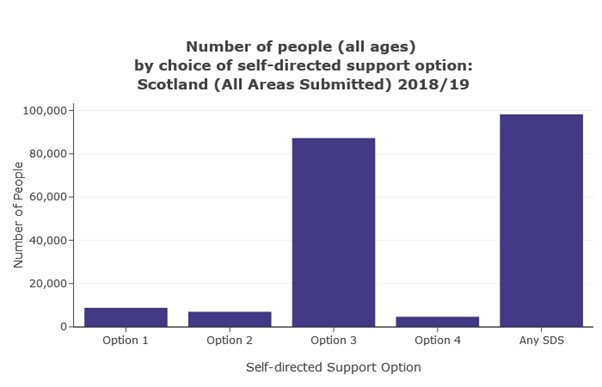
In 2018/19, an estimated 102,805 people of any age were involved in choosing and controlling their support through one or more of the self-directed support options, according to Public Health Scotland.
Of these, nearly 87,000 were on the third option of council-run care, with the remainder opting to take more control over their support.
In 2019 the Care Inspectorate watchdog examined the policy, focusing on six different council areas.
They highlighted the positive experience of many on SDS but concluded “more needed to be done” to enable people to participate properly.
A lack of evidence, they said, made it “impossible to determine the extent to which choice and control was being offered”.
Although option three can be an active choice, the Care Inspectorate say “it was not clear whether people were always actively choosing option three in the full knowledge of all their options.”
Commenting on Public Health Scotland’s figures, the Health and Social Care Alliance Scotland echoed these findings.
Lucy Mulvagh, Director of Policy and Communications at the organisation, said: “While official data suggests that the number of people on SDS option three has increased over the past few years, we don’t know the extent to which people have played a meaningfully active role in choosing that option.”
An Alliance report looking at the experiences of 637 people across Scotland before covid-19 suggested that the vast majority were happy with the option they were on, with one person describing SDS as a “passport to independence”.
But Lucy Mulvagh says there are still “concerning gaps” in regional and national data.
The organisation told healthandcare.scot: “We believe action is required to ensure that robust and systematic disaggregated data gathering and intersectional analysis is carried out by local and national public bodies, because it is an essential part of developing policy and practice that prioritises equal access to social care for everyone, following human rights principles of equality, non-discrimination, participation and inclusion.”
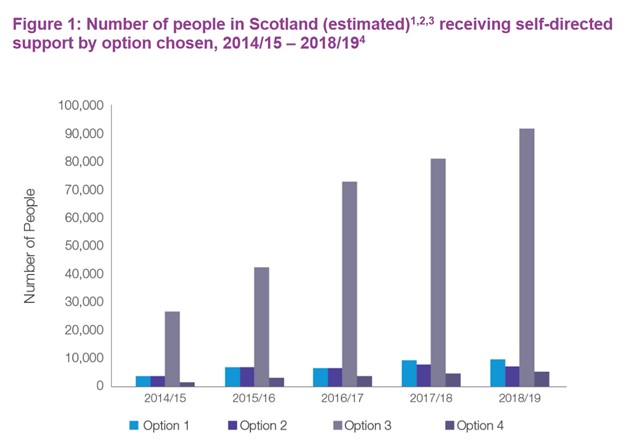
Looking back at how this has changed since the policy was brought in, there have been significant year-on-year increases in numbers on the third option.
There have been smaller increases in the popularity of the other options.
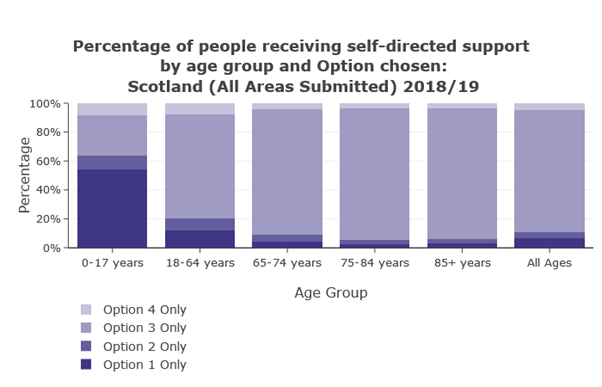
When the figures are broken down by age, a clear disparity emerges.
Breaking the figures down by age, more than half of under-18s on SDS were using direct payments but this reduces the older a person gets.
Scottish Care, which represents a range of care providers, told healthandcare.scot more research into these age-based disparities is needed.
It also raised reports from members who say the people they work with are not being offered a choice and that covid-19 had made the situation worse.
“All people in Scotland should be accessing care and support via SDS. However, the high numbers of people aged over 65 and accessing option 3 of SDS questions if there has been a lack of system change in services for older people,” a representative said.
“One of the reasons is that there is no method for applying SDS options for those who live in a care home, an oversight which contradicts the person-led model of care that we are famous for in Scotland. The statistics show that there is also disparity for those accessing care and support in their own homes.”
Supporters – If you can help support our reporting for Scotland's health and social care community, please head to our donations page.
Bulletin – Sign up for all the latest news and events. Tags: Disability; Older People; Social Care; Unpaid Carers. |