|
Space mission expertise used to develop ventilator |
Related newsInsight: Building Scotland’s digital shielding support Webinar: The anatomy of quality in medical devices Drone delivery: when innovation takes flight ‘Major’ update to One Health AMR register Children’s doctor new Chief Scientific Adviser Chief Medical Officer: ‘Critical connections’ priority 
|
|
|
||
|
||
|
A group of scientists has used expertise in developing life support systems for manned space missions to build a ventilator for the covid-19 crisis.
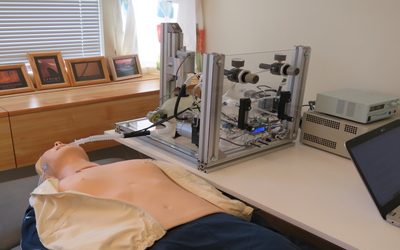
The Planetary Science Group, based at the University of Aberdeen’s school of geosciences, has developed a prototype device using low-cost components which are commonly available.
They believe the ATMO-Vent (Atmospheric Mixture Optimization Ventilator) is quicker to build, more cost-effective and more user-friendly than any other model currently in development.Work is now underway to have the device officially certified, so it can be rapidly deployed in healthcare settings around the world.
Professor Javier Martin-Torres, who heads the Planetary Science Group, said the researchers involved specialised in Martian study and had a wealth of experience in building space instruments using commercial materials.
“We’ve used this expertise to design and build a fully operating prototype ventilator using widely available parts,” he said.
“This means that it is easy to build and ideally suited to rapid, mass deployment in healthcare settings.
“This will be especially useful in countries with underdeveloped healthcare infrastructure.”
He added: “The ATMO-Vent has been designed to comply with UK regulatory guidelines, and we are now in the testing phase as we seek industrial and healthcare partners to collaborate with us on its continued development.”
Professor Martin-Torres’ previous work has included designing and building an instrument that will be used in a European Space Agency probe scheduled to fly to Mars in 2022.
He said the group had watched the spread of covid-19 with “growing alarm” and wanted to use its expertise to help.
“Our hope is that the ATMO-Vent’s cost-effective design and short development time means it can rapidly supplement the number of ventilators being produced by manufacturers,” he added.
“Looking beyond the current crisis, there is also the potential to scale the design for space applications by using it to implement and control artificial atmospheres, for example in space greenhouses and artificial habitats for future planetary explorations.”
Marion Campbell, Vice Principal for Research at the University of Aberdeen, said: “Across multiple disciplines, our research community is working as part of a broad effort to harness our world-renowned academic expertise in the fight against Covid-19.”
|
