|
National award for pioneering Tayside liver test |
Related newsGathering of CLANS to boost CVD research Heart failure being missed in diabetes patients Investigating inequalities in kidney care Eye provides a window to kidney health Scotland commits to change the dementia story Greener NHS research funding boost NHS Tayside welcomes largest intake of doctors Mental health book: Molly and Mr Monkey Shocking levels of violence towards NHS staff NHS Scotland relying on older diagnostic kit Scotland’s frailty services to help address NHS waits 
|
|
|
||
|
||
|
The team behind a new type of test to detect liver disease at an earlier stage has received a national accolade for innovation.
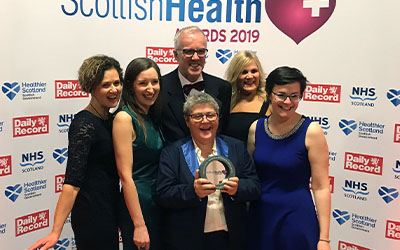
The multidisciplinary intelligent liver function testing group picked up the innovation award at the Scottish Health Awards, the latest of several honours for the project.
Consultant gastroenterologist and hepatologist Professor John Dillon and consultant in biochemical medicine Dr Ellie Dow worked with colleagues from NHS Tayside and the University of Dundee to develop the intelligent liver function tests (iLFTs) using automated blood sciences laboratory infrastructure at Ninewells hospital.
Also highly commended in the digital innovation category of the BMJ Awards 2019, Professor Dillon explains more than 2500 patients have benefitted from the test, which is in routine use in Tayside:
“It is popular with GPs and we are hopeful it will be taken up by other health boards in Scotland and healthcare institutions across the globe.”
Liver function is routinely investigated by testing blood samples requested by GPs but abnormal test results can appear, are often under investigated and the opportunity to diagnose and treat liver disease at an early stage can be lost.
Using advances in laboratory technology, Professor Dillon and Dr Dow’s team created the new iLFTs which see more tests automatically carried out on a patient’s blood sample if there is a suspected liver disorder or abnormal results with no clear explanation.
GPs receive the results along with 32 potential outcomes, making it easier to identify the cause of liver dysfunction and give a firm diagnosis, complemented with lifestyle advice for those who need it, while those with advanced or complex disease are referred for further treatment.
Initial results from the iLFT trial showed a 44% increase in diagnosis of liver disease, giving patients earlier access to treatment.
Professor Dillon added: “By working with the existing IT systems in the lab, we were able to develop a system that detects the early warning signs of liver disease and which can then give GPs the tools they need to make a solid diagnosis and begin treatment plans.
“More importantly, our modification allows us to immediately differentiate between alcoholic or non-alcoholic fatty liver disease and the more rare diseases such as autoimmune liver diseases Hepatitis C or metabolic diseases, meaning those who need immediate assistance receive it faster.
“We hope that with continued tests, people drinking too much or eating high-fructose sugars can make the lifestyle changes now that will reduce the numbers coming into hospital with fatal liver failure in the years to come.”
|
